
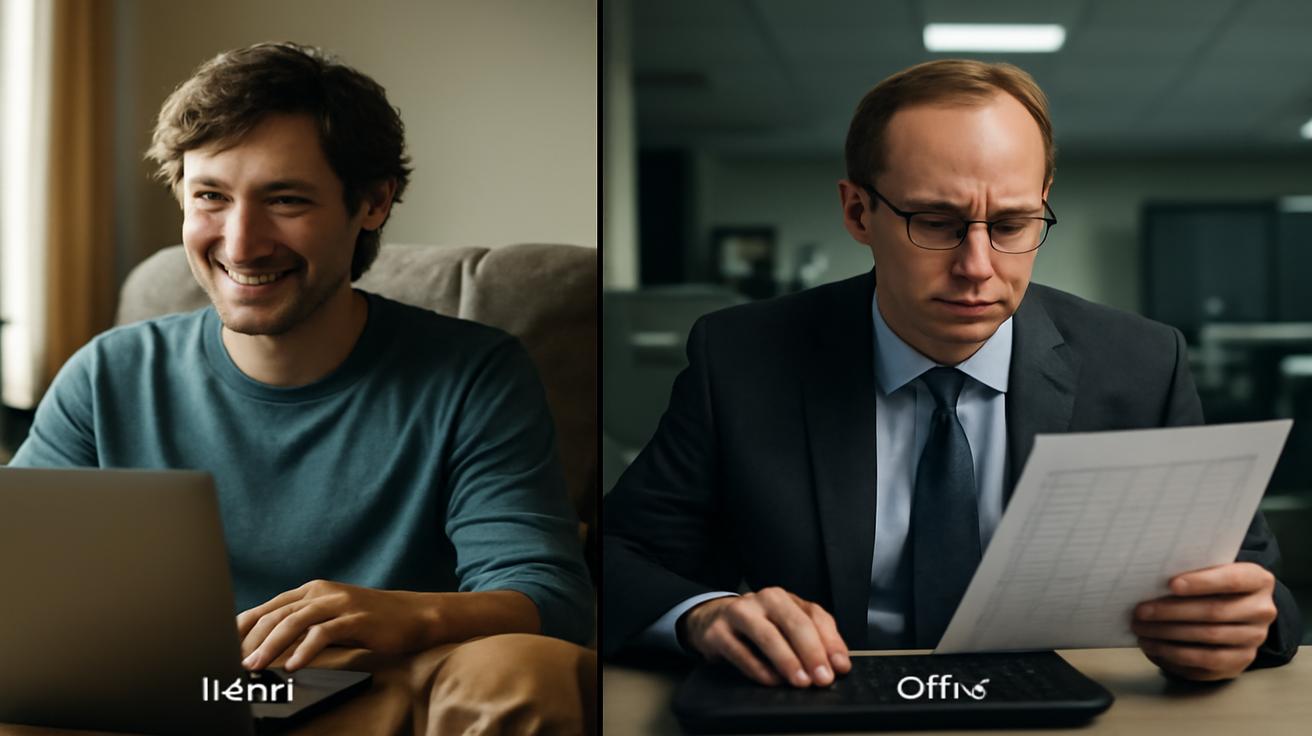
The first thing you notice is the silence.
Not the tense, humming kind that fills open-plan offices—the silence at home is softer. It has texture. It’s the low purr of a dishwasher in the next room, the muffled traffic filtering through double-glazed windows, the distant laughter of a neighbor’s child on a lunch break you actually have time to notice. Somewhere in this quiet, a new kind of workday has taken shape—messier, more human, and, as a growing number of scientists now insist, much, much happier.
After four years of data, diaries, interviews, and biometric studies, the verdict is in: working from home makes people happier. Noticeably, consistently, measurably happier. And if you listen carefully, beneath the calm of remote workers brewing coffee in their own kitchens, you can hear something else rising—a low murmur of unease from managers who aren’t sure what to do with this truth.
The Long Experiment No One Planned For
In early 2020, when the world lurched sideways, working from home wasn’t a social experiment; it was a necessity. Dining tables became desks. Bedrooms merged into boardrooms. Cats wandered into meetings, children appeared on camera with jam-smeared faces, and the last illusion that work lived in some separate, polished dimension from real life vanished overnight.
What felt like chaos at the time turned out to be a researcher’s dream: a global-scale, unplanned trial on how environment, autonomy, and stress reshape human wellbeing. Over the next four years, research teams from universities, think tanks, and workplace labs watched, measured, and compared. They studied sleep patterns using wearables, tracked mood through daily surveys, analyzed heart rate variability, and mapped out how people’s social lives twisted and adapted.
What emerged wasn’t a perfect picture—nothing involving humans ever is—but it was strikingly consistent. On average, people who worked from home at least three days a week reported higher life satisfaction, lower stress, better sleep, and a greater sense of control over their time. Some were a little surprised. Remote workers themselves were not.
“I feel like I got my life back,” one participant wrote in a long-term diary study. “Not all of it, not perfectly—but compared to before, it’s like someone quietly turned down the volume on everything that used to grind me down.”
The Science of Feeling Less Rushed
Researchers kept circling back to one theme: time. Not more hours in the day—no one’s cracked that code—but a different relationship with those hours. Commuting, that daily ritual of crowded trains and brake lights, had long been accepted as a necessary tax on having a job. When it vanished, scientists were curious: what would people do with the reclaimed minutes and hours?
It turned out they did something radical with them: mostly, they exhaled.
Sleep studies showed a modest but significant shift; on average, remote workers slept about 30–50 minutes more per night. Not because they were lazy, but because their days began on human time, not train schedule time. Cortisol measurements—the hormone often dubbed the “stress chemical”—were typically lower in the early morning hours for those working from home. The body knew, even if the calendar still looked busy: no rushing to catch the 7:12, no elbowing through station crowds.
Psychologists call this “temporal autonomy,” the sense that you have some control over when and how you do things. People didn’t necessarily work fewer hours; in some studies, they even worked slightly more. But the hours bent around their lives instead of shattering them. A mid-morning school run didn’t mean a furious evening sprint to “catch up.” A walk at lunch didn’t feel like a guilty secret. The day, in its simple, unglamorous ways, felt more humane.
What Happiness Actually Looked Like
Happiness, in the scientific sense, isn’t about euphoria or constant joy. It’s about a blend of positive affect, lower negative emotion, and a sense that life is manageable and meaningful. So when scientists say people were “happier” working from home, they mean that across thousands of people and four years of follow‑up, certain patterns kept repeating.
| Wellbeing Measure | Office-Based (Pre-2020 Baseline) | Hybrid / Remote (4-Year Average) |
|---|---|---|
| Self-rated life satisfaction | 6.5 / 10 | 7.3 / 10 |
| Daily perceived stress | High in 42% of respondents | High in 28% of respondents |
| Sleep quality (self-reported) | “Good” or better: 48% | “Good” or better: 61% |
| Sense of control over schedule | Moderate to high: 39% | Moderate to high: 68% |
These numbers, averaged and anonymized, are the clinical side. But happiness also showed up in smaller, everyday moments that participants described when researchers simply asked, “What feels better now?”
They talked about hanging laundry between meetings and feeling oddly peaceful. About finally seeing daylight in winter because they could take a walk at 3 p.m. and finish a report at 7 p.m. About cooking actual lunches instead of inhaling something forgettable at a desk. About not crying in parked cars before going into the office—not every day, at least.
For parents and caregivers, the difference was even starker. One woman described it like this: “Before, my life was rushing from drop-off to commute to work to commute to pickup to late-night emails. Now it’s still full, but the edges are softer. I see my kids between calls. I can put a load of laundry on and somehow that tiny thing makes me feel less like I’m drowning.”
The Quiet Power of Place
Nature snuck in too. Working from home didn’t instantly turn people into forest bathers, but it did nudge more of them toward windows, balconies, back gardens, and neighborhood parks. Environmental psychologists noticed remote workers were more likely to report seeing daylight and greenery during work hours, even if it was just the view of a tree outside an apartment window.
This mattered. Exposure to natural light, even brief and indirect, is deeply linked to mood regulation, sleep cycles, and cognitive focus. Office buildings try to mimic this, but the reality of many workplaces is fluorescent light, interior cubicles, and climate‑controlled sameness. At home, a worker might tilt their laptop to face the window, or move from the kitchen to the balcony when the sun shifts. Small, instinctive acts—yet layered across weeks and months, they add up.
One study followed participants who deliberately took a 10-minute outdoor “micro‑walk” each afternoon. Those who worked from home were twice as likely to make it a habit. The result? A boost in afternoon focus, fewer reported headaches, and a modest uptick in overall mood. The workers called it “getting air.” The scientists called it an evidence‑based intervention. Either way, it felt good.
Meanwhile, in the Corner Office
And yet, even as data began to solidify, another set of emotions emerged—this time from managers and executives. On paper, remote and hybrid work were linked not just to happier employees, but often to stable or even improved productivity. People got their tasks done. Many did more. Some teams, particularly in knowledge work, thrived.
Still, the unease persisted.
One executive in a longitudinal interview study put it bluntly: “I don’t know how to manage what I can’t see.” For decades, leadership—especially middle management—had relied on what researchers call “presence bias”: the idea that being physically in the office was a proxy for commitment and output. You knew who was “on it” because you saw them arriving early, staying late, looking busy. A lot of careers were built on this dance.
Remote work pulled back the curtain. Suddenly, it was possible—painfully so—to see that visible busyness and actual value weren’t always the same thing. Some managers struggled to adapt. They introduced more check‑ins, more reporting, more digital “proof” of activity. Employees interpreted this as mistrust; managers saw it as survival.
The Tangled Knot of Control and Culture
Underneath the tension was something deeper than productivity metrics. It was about control and identity. Offices weren’t just places where work happened; they were also where leaders felt their leadership most vividly. They walked the floor, read the room, overheard half‑conversations by the coffee machine, and stitched together a picture of what was going on.
Take that away, and a quiet question hovers: what does it mean to manage now?
Some embraced the question and evolved. They shifted from time‑based oversight (“Are you at your desk?”) to outcome‑based trust (“Did the project move forward?”). They learned to read Slack threads the way they once read body language. They agreed on clearer goals instead of vague expectations. Their teams often reported higher satisfaction and a sense of being treated like adults.
Others reacted differently. They pushed hard for office returns, sometimes insisting on three or four mandated days without a clear reason beyond “culture.” Yet when researchers dug into what “culture” meant to them, the answers were often thin. They weren’t talking about shared values or purpose; they were talking about rituals, routines, and a familiar sense of hierarchy. In other words, they were talking about comfort—for themselves.
This is where the science of happiness gets quietly radical. If your employees are measurably healthier, more rested, and more satisfied working from home—and your main discomfort is that it unsettles your old way of leading—whose feelings take priority?
The Trade‑Offs We Don’t Like to Admit
None of this is a fairy tale. Remote work isn’t magic, and it’s not universally better for everyone. The same studies that praised increased happiness also flagged concerns: loneliness, blurred boundaries, longer hidden hours, and a creeping sense that work might now live everywhere, all the time. For people in small apartments, noisy homes, or unstable housing, “working from home” could be more aspirational slogan than soothing reality.
Younger employees and new hires often missed the casual mentoring that happens when you overhear how a tricky conversation is handled or get pulled into a last‑minute meeting because you happened to pass someone in the hall. Some reported feeling like “ghost colleagues”—present on screens, but somehow still peripheral.
Yet even here, the picture is nuanced. Loneliness, for instance, wasn’t purely a function of remote work. It was tied to whether teams made deliberate efforts to connect, whether managers checked in like humans rather than only as supervisors, whether there were regular chances for in‑person or well‑designed virtual gatherings. Remote work exposed social cracks that offices had always papered over.
Boundaries, too, were a double‑edged sword. The flexibility that felt liberating for some felt like pressure for others, who found themselves sending “just one more email” from the couch at midnight. Researchers noticed that the happiest remote workers weren’t necessarily the freest—they were the ones whose organizations helped them define and defend limits: clear end times, no‑meeting blocks, actual respect for days off.
What People Really Want (It’s Simpler Than It Sounds)
Across multiple studies, one theme rose above the noise: choice. Not endless, chaotic choice, but meaningful input into where and how you work best. When people were forced into remote work with no support, happiness gains were smaller and more fragile. When they were forced back into offices despite thriving at home, morale took a noticeable hit.
The sweet spot—over and over—was flexibility with structure. Maybe it was three days at home, two in the office. Maybe it was fully remote with quarterly in‑person retreats. Maybe it was the freedom to work early mornings or late evenings as long as core collaboration hours were covered. The details varied. The pattern did not.
People wanted to weave work into the tapestry of their real lives, not pin their lives awkwardly to the margins of work. They wanted to walk a dog between calls, or visit an aging parent midweek, or attend a mid‑day class, and still be seen as serious, committed professionals. The data suggests that when they were granted this, they responded with loyalty, creativity, and, yes, happiness.
So Where Do We Go From Here?
Four years on, the question isn’t whether working from home makes many people happier—it does, in ways science can quantify and in ways only the heart can fully feel. The question is what we’re willing to do with that knowledge.
We’re used to thinking of work as something fixed and immovable, like a mountain you build your life around. The research of the last few years suggests something different: work is more like a river. It already bends and shifts; we just rarely admit we have some say in where it flows.
Managers stand at a difficult bend in that river. Their unease is real. They’re being asked to reinvent their craft, to measure value in new ways, to build trust across distance, to care about wellbeing not as a perk or a poster on the break room wall, but as a measurable, operational priority. That’s not trivial.
But there’s another truth sitting beside it: people have quietly tasted a kinder version of their own lives. They have felt what it’s like to start the day without a frantic commute, to take a walk under actual sky between meetings, to knit together their responsibilities instead of watching them collide. Many are not willing to give that up.
Listen, for a moment, to the sound of a remote worker’s afternoon: the clink of a mug in their own kitchen, the soft whir of a fan, the distant bird outside a window, the chime of a calendar reminder that doesn’t feel like a summons so much as a choice. It’s not a utopia. Some days are still hard. Deadlines still loom. But beneath it all is a quiet, stubborn sense of being more fully alive during the hours once sacrificed to the office.
The science now says this feeling is not an illusion. It’s measurable. It’s durable. It matters.
The next chapter won’t be written in spreadsheets alone. It will be shaped in the conversations where a manager asks, genuinely, “How do you work best?” and is willing to act on the answer. In the policies that treat flexibility not as a favor, but as a smart, evidence‑based way to run a company. In the homes where someone closes their laptop at a reasonable hour, steps outside into the cooling evening, and realizes they still have time, and energy, to actually live.
Work didn’t disappear when it moved home. But for many, something else did: the constant, grinding feeling that life was always one step behind. In its place, a different rhythm has emerged—less visible from the corner office, perhaps, but beating strongly all the same.
Frequently Asked Questions
Does working from home really improve happiness for everyone?
Not for everyone, but for a clear majority in the studies conducted over the past four years. People with stable home environments, some control over their schedules, and supportive managers tend to benefit the most. Those in cramped housing, with high isolation, or unclear expectations can struggle more.
Are remote workers actually more productive, or just happier?
Most large-scale studies show that productivity stays the same or improves slightly for many remote and hybrid workers, especially in knowledge-based roles. The big difference is in wellbeing—lower stress, better sleep, and a stronger sense of control.
Why are some managers opposed to long-term remote work?
Many managers built their skills in an office-first world, where presence was used as a shortcut for measuring effort and engagement. Remote work challenges that model, requiring new tools, trust-based leadership, and clearer goals. The discomfort is often about losing familiar forms of control and visibility.
What are the biggest downsides of working from home?
Common downsides include loneliness, blurred boundaries between work and home, longer but less visible working hours, and fewer spontaneous learning moments for junior staff. These can be eased with deliberate team rituals, clear norms about availability, and regular in-person or high-quality virtual connection.
Is hybrid work the best compromise?
For many people and organizations, yes. Hybrid setups—some days at home, some in the office—often combine the wellbeing benefits of remote work with the social and collaborative advantages of shared spaces. The key is offering meaningful choice and designing office days with intention, not just requiring presence for its own sake.







Leave a Comment