
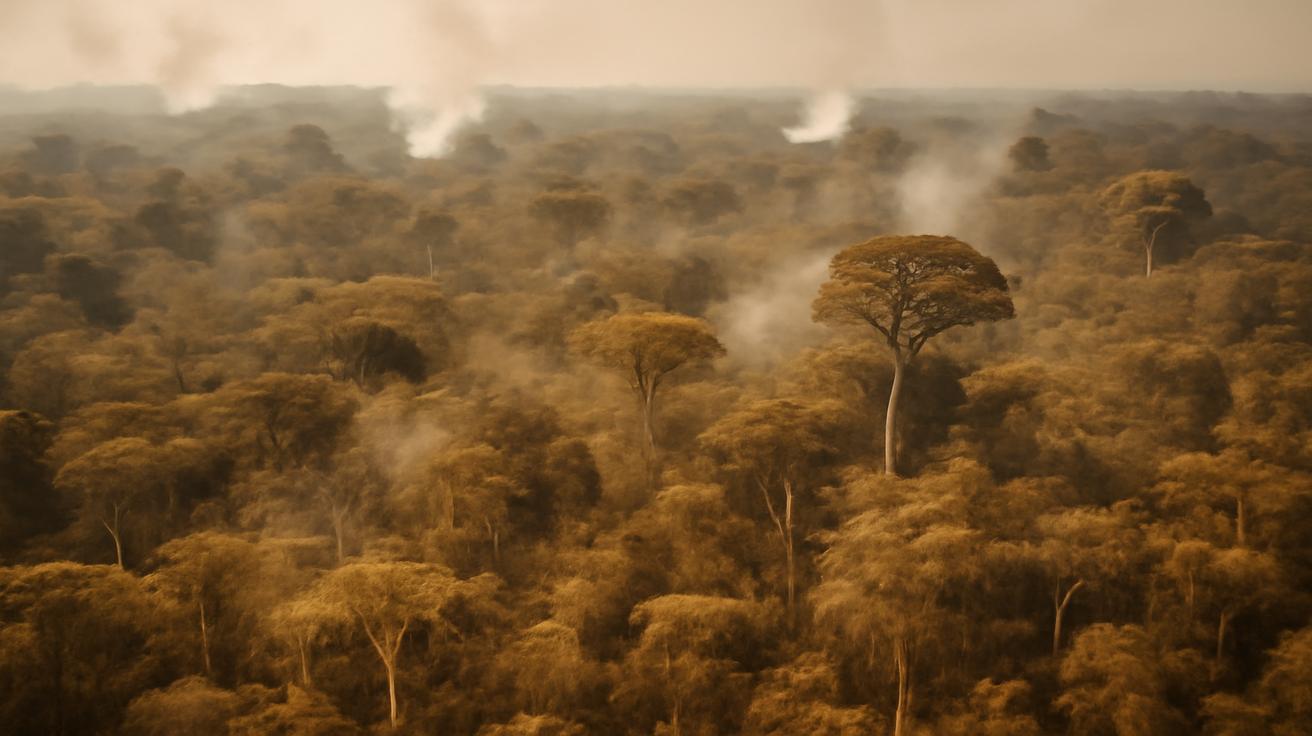
The first thing you notice is the sound. Not the roar of lions or the chattering of monkeys that documentaries love, but a quieter, deeper pulse: the hiss of rain on broad leaves, the distant rumble of thunder, the faint crackle of beetles burrowing in rotting wood. You are standing in the green dusk of an African rainforest, where light falls in soft coins through a ceiling of leaves stacked layer upon layer. The air is thick, warm, almost sweet with the smell of damp soil and sap, the breath of millions of plants turning sunlight into life. For decades, places like this have done more than shelter wildlife or anchor cultures. They have silently pulled carbon from the atmosphere, tucking it away in roots and trunks and soil. They have been our unseen allies, our great natural buffer against climate change. But now, scientists are sounding an unsettling alarm: these forests are changing. Some of them are no longer absorbing carbon. Some may even be giving it back.
A forest that remembers fire
Walk a little farther and the illusion of untouched wilderness starts to fray. On the ground you notice black scars on the base of a tree. You bend closer. The bark is rough, charred in places, the old wound healed but still visible. Nearby, a gap opens in the canopy where a giant once stood. A vine-draped column of light spills down to the forest floor, where thickets of saplings and shrubs scramble for the new real estate.
A forest is a memory machine. It remembers every storm, every axe, every spark. In Central and West Africa, from the Congo Basin to the edges of coastal mangroves, that memory has grown heavy in just a few decades. Logging tracks snake into previously remote valleys. Some are legal roads carved by timber companies; others are little more than muddy scars left by informal loggers and charcoal burners. Add to that the subtle but relentless pressure of a warming climate—longer dry seasons, hotter days, more intense downpours—and you start to understand why scientists are worried.
For years, researchers strapped instruments to trees, trekked through knee-deep mud to measure trunks and branches, and flew over canopies with lasers and satellites. Their goal was deceptively simple: how much carbon do these forests absorb, and how much do they release? Forests breathe in carbon dioxide, locking it away in wood and soil. But they also breathe out, releasing carbon back when trees fall, leaves rot, or fires rage. What matters is the balance.
In Africa, that balance is shifting. Plots that once showed steady carbon gains are plateauing or even flipping. Some old-growth forests that used to be powerful carbon “sinks” are now barely breaking even. A few are becoming net “sources” of carbon—releasing more than they absorb.
The numbers behind a changing breath
It sounds abstract, until you think of forests as lungs. Imagine lungs that once drew in deep, steady breaths, easing the strain on an overburdened atmosphere. Now, those lungs are hesitating, sputtering, coughing out more than they take in.
Scientists studying tropical forests in Africa and across the tropics have been tracking this change. Their measurements tell a sobering story: over recent decades, the capacity of tropical forests to absorb carbon has declined. For African forests, which have so far been more intact than those in the Amazon or parts of Southeast Asia, this is especially troubling. They were, in a way, our backup system—still relatively vast, still storing colossal amounts of carbon in old trees and deep, dark soil.
But climate stress and human disturbance are beginning to catch up. More frequent droughts reduce growth, leaving trees weaker and more vulnerable to disease, insects, and windthrow. Heat waves push trees toward physiological limits. At the same time, selective logging—the removal of valuable large trees—quietly erodes the forest’s carbon bank. Those giants are the heavy lifters of carbon storage; lose them, and the forest’s overall account shudders.
In many areas, small fires creep into forest edges where they rarely burned before, fuelled by drier air and leaves. A single fire can kill or weaken a large number of trees, releasing decades of stored carbon in a matter of days or months. Multiply that by thousands of hectares and the arithmetic becomes terrifyingly clear.
| Region | Past Role (Approx. 1990s) | Current Trend | Key Pressures |
|---|---|---|---|
| Congo Basin | Strong carbon sink | Weakened sink, nearing balance in some areas | Warming, logging, fire, road expansion |
| West African Rainforests | Moderate carbon sink | Patchy—some fragments now net sources | Deforestation, farming expansion, fuelwood |
| Miombo Woodlands (Southern Africa) | Variable sink, seasonal storage | Highly variable, often close to carbon neutral | Charcoal production, shifting cultivation, drought |
| Mangrove Forests | High long-term carbon storage | Declining in disturbed coasts, stable in reserves | Coastal development, pollution, erosion |
These trends are not just local curiosities. When Africa’s forests falter, the atmosphere feels it. The carbon that is no longer absorbed, or that is released, adds to the global pool already driving climate change. The forests that once bought us time are starting to send us the bill.
The people of the green threshold
Step out of the deep forest and you might find yourself on its moving edge—a ragged boundary of farms, fallows, and village woodlots. Here, the silhouettes of palm trees and banana plants rise against the sky. Smoke curls from a clearing where cassava is being roasted, the smell of woodfire thick and familiar. Children walk past carrying bundles of sticks on their heads, the daily harvest of fuelwood from the forest fringe.
For millions of people, especially in rural Africa, forests are not just carbon vaults; they are kitchens, pharmacies, hardware stores, and spiritual centers. They provide poles for building, bark and leaves for medicine, fruits and nuts for diet, bushmeat for protein, and mushrooms after rain. They cushion hunger when crops fail. They protect water sources, shading streams and feeding springs. Their identity is woven into stories, taboos, and ceremonies.
When scientists warn that forests are no longer absorbing carbon, it can sound like a distant, technical crisis. But on this threshold, the crisis is tangible. As trees are cut faster than they can regenerate, nearby landscapes become barer. Soils erode more quickly, streams run muddy after storms, and dry up faster in drought. The air grows hotter in the day and colder at night because the forest’s moderating blanket is thinner.
Paradoxically, many of the communities most reliant on forests are among the least responsible for global emissions. They are locked in a double bind: as climate change disrupts rainfall and raises temperatures, people may push deeper into forests for land and resources, which in turn weakens the forests’ ability to buffer the climate.
Stories from the forest edge are filled with quiet ingenuity. Villages establishing community woodlots to take pressure off nearby remnants. Women’s cooperatives planting fast-growing trees for fuel. Youth groups mapping sacred groves with smartphones, marking them as no-go zones. But these efforts often unfold against a larger backdrop of industrial logging, mining, and infrastructure that can erase local gains in a single project.
When forests turn from ally to risk
To understand what is at stake, it helps to linger on a single, old tree—the kind that takes several people with linked arms to encircle. Its trunk rises like a pillar, buttressed at the base by flaring roots that look like frozen waves. In its bark, ants ferry food through narrow highways. In its branches, epiphytes cling in miniature gardens of moss and ferns. This one tree may hold as much carbon as a small car emits over its entire lifetime on the road.
Now imagine that tree felled by a storm after a severe drought. Its wood, once a stable vault of carbon, begins to rot, releasing what it has stored little by little. Or worse, it is caught in a ground fire that consumes its dry heartwood in a rush of heat, exhaling decades of carbon in an afternoon. When such scenes play out across thousands of square kilometers—prodded along by climate change, logging, and fire—forests reach a tipping point in their role in the carbon cycle.
Scientists speak of feedback loops. Warmer temperatures and drought weaken forests, which absorb less carbon and can release more during disturbances. The extra carbon in the atmosphere drives further warming, which further stresses forests. For Africa’s forests, still among the planet’s great remaining wildernesses, this loop is no longer a hypothetical future. It has begun.
This does not mean that all of Africa’s forests have suddenly switched from sink to source, nor that the entire continent is doomed to lose its green mantle. It means that the safety margin is thinning. It means we cannot simply assume that forests will go on doing, for free and forever, what they did in the past.
In climate politics, there has long been a temptation to think in offsets: if we emit here, we will plant or protect trees there. But a future where African forests are weakened, fragmented, or unstable makes this bargain far riskier. Counting on a stressed forest to offset fossil fuel emissions is like planning your retirement on a savings account you keep dipping into.
Listening to the forest’s warnings
One of the miracles of modern science is that we can now “listen” to forests in ways that go beyond our senses. Instruments strapped to towers measure the exchange of gases between canopy and sky. Drones and satellites capture the faint differences in color that reveal a tree’s health. Laser scanners map every branch in three dimensions, pinpointing where carbon is stored and how it shifts over time.
In research plots scattered from Gabon to Ghana, teams of local and international scientists return year after year, measuring and tagging trees, noting every new sapling and every fallen trunk. Their data have revealed both the resilience and the vulnerability of African forests. Where protection is strong and hunting and logging are limited, some forests still absorb significant amounts of carbon, even in a warming world. In others, however, the trend lines bend toward decline, especially where human disturbance and climate stress overlap.
These efforts are more than academic exercises; they are a kind of early-warning system. They show us where forests are in trouble before the crisis becomes obvious from space, before the canopy thins and fires become the new normal. They also highlight an uncomfortable truth: time is short.
Yet in the quiet of a forest plot, surrounded by tagged trees and humming instruments, there is also a sense of possibility. The very act of measuring is a statement that these places matter, that their future is not preordained. The knowledge gathered here can shape policies, guide funding, and support the rights of the people who have long lived with and cared for these ecosystems.
Keeping the green giants on our side
If Africa’s forests are wobbling in their role as carbon guardians, what does it take to steady them? Part of the answer lies in familiar verbs: protect, restore, respect.
Protection begins with old growth. The remaining intact forests, especially in the Congo Basin, are irreplaceable on any human timescale. Once you cut down a 300-year-old tree, you cannot “replant” it and expect the same carbon storage or ecological complexity in a few decades. Safeguarding large, continuous areas from industrial logging, mining, and conversion is one of the most powerful climate actions available.
Restoration, meanwhile, is not just about mass tree planting. It can mean allowing degraded forests to regrow naturally, with minimal disturbance. It can mean helping landscapes heal through assisted regeneration—protecting sprouts and saplings, curbing fire, and reducing grazing pressure so that young trees can survive. It also means being honest about where trees belong and where other ecosystems—like savannas, wetlands, and grasslands—should be conserved as they are.
Respect might sound less tangible, but it is crucial. It means recognizing the rights and knowledge of Indigenous peoples and local communities who have long managed forests sustainably when given the chance. Studies around the world show that forests under community control, with secure tenure and support, often fare better than those governed only from distant capitals. Respect also means acknowledging that people need energy, food, and livelihoods—so any vision of forest protection that ignores human well-being is doomed to fail.
Beyond the forest edges, cities and nations have their own part to play: reducing reliance on charcoal through cleaner cooking alternatives, redirecting development away from critical habitats, combating illegal logging with real enforcement, and aligning climate promises with on-the-ground reality. For wealthy countries and corporations, the message is sharper still: cutting fossil fuel emissions at the source is non-negotiable. Forests can help, but they cannot carry the burden we have placed upon them alone.
Questions the forest asks us back
As dusk deepens, the forest changes register. Insects start a thousand-note chorus. Bats flicker between trunks. Somewhere, a hornbill calls—a hollow, resonant sound that seems to bounce off the very air. You stand still and listen, letting the layered rhythms surround you.
For a long time, our questions to the forest have been practical: How much timber? How many hectares? How many tons of carbon? Now, the forest’s condition throws the questions back at us.
What do we value in this green expanse—only the invisible service of carbon absorption, or also the rough bark under our hands, the rain-cooled air we breathe, the cultures and languages it shelters, the deep-time patience of trees growing ring by ring? When we say that Africa’s forests are no longer absorbing carbon as they used to, are we willing to face what that reveals about our relationship with the living world, and the speed at which we have burned through our planetary credit?
A future in which these forests stabilize again as strong carbon sinks is still imaginable. It would be a future where countries treat remaining intact forests as strategic climate infrastructure, where local communities are rewarded and empowered for stewardship, where global emissions decline steeply enough that forests are not battling an ever-hotter, ever-drier world.
Whether we get there depends less on what the forests can do, and more on what we choose to do for—and with—them. Because in the end, a forest is not just a carbon account. It is a living conversation between soil, water, light, and life. And right now, that conversation is strained, its tone urgent. The question is whether we are willing to listen.
Frequently Asked Questions
Are all African forests now releasing more carbon than they absorb?
No. Not all African forests have turned into net carbon sources. Many still absorb more carbon than they release, especially large, intact tracts in the Congo Basin and well-protected reserves. However, the overall capacity of African forests to act as strong carbon sinks is declining, and some disturbed or fragmented areas are already emitting more carbon than they store each year.
What is causing African forests to lose their ability to absorb carbon?
The decline is driven by a combination of climate change and human disturbance. Hotter temperatures, shifting rainfall patterns, and more frequent droughts stress trees and slow their growth. At the same time, logging, agricultural expansion, charcoal production, and fires remove large, carbon-rich trees and fragment habitats, reducing the forest’s overall carbon storage and resilience.
Can tree planting alone solve this problem?
Tree planting can help, but it is not a magic fix. Newly planted trees take decades to approach the carbon storage of mature forests, and poorly planned plantations can even harm biodiversity and water resources. Protecting existing old-growth forests and allowing degraded forests to naturally regenerate are often far more effective and reliable climate strategies than planting trees from scratch.
How does this affect people living near the forests?
Communities that depend on forests for fuelwood, food, medicine, and water security are directly affected when forests degrade. They may face more extreme heat, reduced rainfall reliability, soil erosion, and declining access to resources. At the same time, these communities often hold key knowledge and play a crucial role in sustainable forest management when their rights and needs are recognized.
What can be done to help keep Africa’s forests as carbon sinks?
Effective actions include protecting remaining intact forests from industrial-scale deforestation, strengthening community land rights, supporting sustainable livelihoods that reduce pressure on forests, restoring degraded areas through natural regeneration, and, at the global level, rapidly cutting fossil fuel emissions. Without deep emissions cuts, even well-managed forests will struggle to remain strong, stable carbon sinks in a warming world.







Leave a Comment