
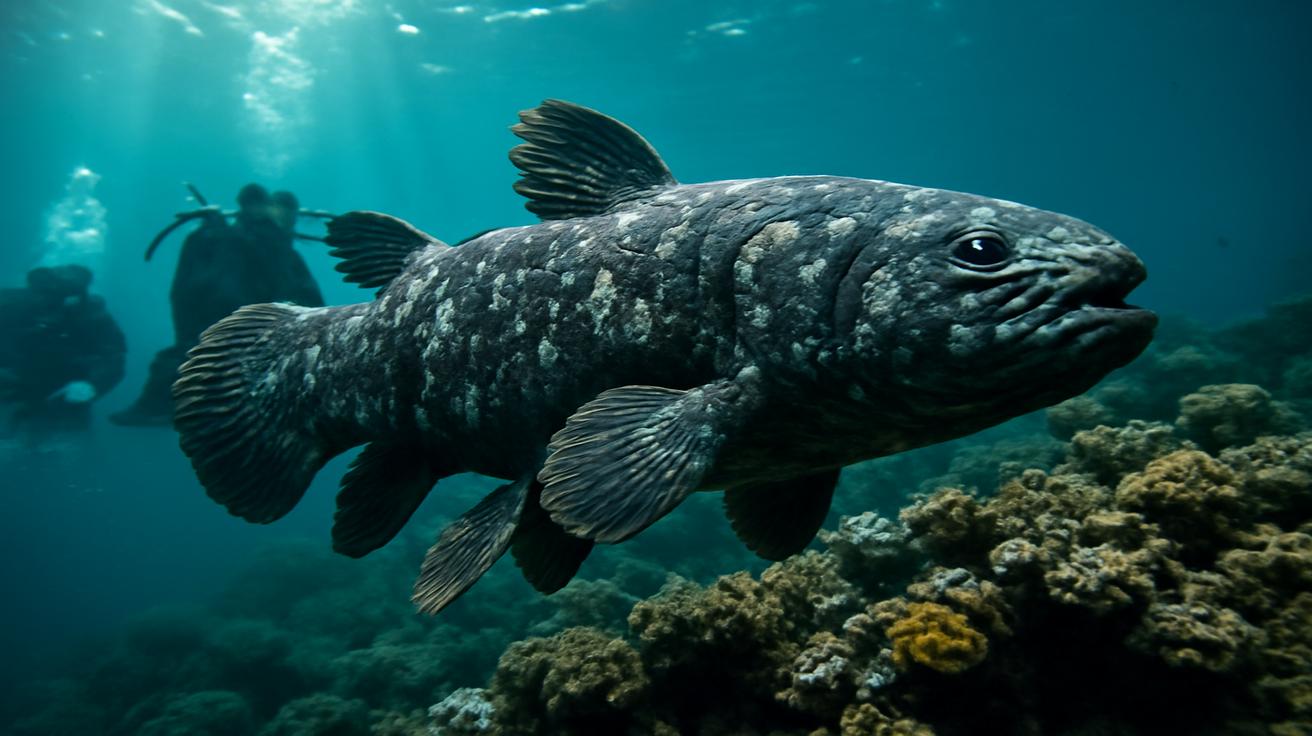
The first thing they see are the eyes—two pale, glassy orbs glowing back from the dark cliff of rock, deep under an Indonesian sea that most of us will never know. Their beams of light sweep slowly over the wall, dusting ancient coral and black sponge. Then the shape resolves: a thick, muscular body, blue and mottled with white freckles like a starry night pressed into scales. The fish does not flinch. It appears as though it has been waiting.
The Night the Past Swam Out of the Dark
It is just after midnight when the French divers descend along the steep submarine slope off Indonesia’s Sulawesi coast. The boat above is a faint memory now, a dim blur of hull and bobbing anchor line. Below them, the water is velvet and cold, swallowing sound. Their bubbles crackle like distant rain as they sink toward a world most people only know from old textbooks and grainy black-and-white photos.
They are not here for coral reefs or manta rays, though both abound in these waters. They have come chasing a rumor, a line in a scientific newsletter, a whispered tale from a local dive guide: that somewhere along this drop-off, where the reef plunges into a canyon that seems to have no bottom, a creature from another age still patrols the currents.
A living fossil, people call it. The coelacanth.
For decades, this fish has hovered at the edge of mythology—something between fact and fable. It was supposed to have vanished with the dinosaurs, its last bones sealed in stone some 66 million years ago. Then in 1938, one turned up in a South African fish market, flopping silently in a net. Later, more were found off the Comoros Islands and in other parts of the Indian Ocean. Scientists saw it alive at last: deep blue, heavy-bodied, with strange, lobed fins that look almost like primitive limbs.
But even with that rediscovery, sightings have been astonishingly rare. To encounter one while diving, in its natural habitat, is the kind of thing that happens maybe once in a career—if ever. It is, in a way, a lottery ticket drawn from the entire history of life on Earth.
Somewhere between 100 and 120 meters down—far deeper than most recreational dives—the divers’ torches rake across a crevice in the rock wall. One of them pauses. Something about the shape inside the crack doesn’t fit: not the right silhouette for a grouper or a shark or a giant trevally. The beam swings back, more deliberate now.
There it is.
The Fish that Refused to Stay Extinct
The divers hover, barely breathing, adjusting their buoyancy until they are suspended in the black like astronauts alongside a cliff of ancient limestone. The fish hangs motionless in front of them, as if welded to the water. It is huge—close to two meters long—with thick, fleshy fins beating slowly like the wings of some underwater bird.
One of the divers, a seasoned photographer, lifts his camera with hands that are suddenly unsteady. His heartbeat thrums inside his suit. He has seen hundreds of reef species, sharks the size of cars, manta rays gliding like underwater aircraft. Nothing feels like this. Pointing his lens at the coelacanth, he has the dizzy sense of aiming a camera not at an animal, but at time itself.
In the cold cone of his light, thousands of tiny white spots speckle the coelacanth’s cobalt body. Each mark feels like punctuation in a story that began long before humans even existed. There is a faint shimmer of metallic sheen along the scales. The fish’s mouth opens and closes, patient, unhurried, a pulse of ancient rhythms.
The coelacanth belongs to a lineage that once flourished in primeval seas and rivers when continents were ragged and forests newly green. Its relatives, fossilized in museum drawers around the world, bear the same key features: a strange hinge in the skull, a tail divided into three distinct lobes, and, most famously, paired fins supported by a stout, fleshy base—primitive architecture reminiscent of the bones of arms and legs.
For over a century, paleontologists believed that these fishes had vanished completely near the end of the Cretaceous period. They appeared in the fossil record and then stopped, their absence becoming another neat if tragic ending in the story of evolution. When the first living specimen surfaced in 1938 off the coast of South Africa, it cracked open one of science’s most comfortable assumptions: that the fossil record, once silent, never speaks again.
Today, two surviving species of coelacanth are known—the West Indian Ocean coelacanth (Latimeria chalumnae), discovered first, and the critically endangered Indonesian coelacanth (Latimeria menadoensis), identified decades later. It is this second, elusive Indonesian species that the French divers believe they are seeing now, shimmering in the blackness, haloed in their beams of light.
What Makes a “Living Fossil” So Remarkable?
Biologists often bristle at the phrase “living fossil.” Evolution never truly stops; no species is literally frozen in time. Yet standing in the hovering, weightless silence before this fish, it is hard to deny the phrase a certain emotional power. This creature’s basic blueprint has changed remarkably little in hundreds of millions of years. While continents tore apart, while flowering plants exploded across the land, while mammals rose and multiplied and one species learned to shape fire and language—coelacanths kept to their submarine cliffs and underwater caves.
The divers watch, entranced, as the coelacanth slowly rotates, its thick, lobed fins sculling in space. Each fin moves almost like a mechanical arm, tracing an alternating, almost walking pattern, echoing the ancient transition from fin to limb. Its eyes—large, pale, reflective—seem to look through the divers, not at them, fixed on some deeper, darker middle distance.
Camera strobes fire softly in the gloom. The light ripples over rock, sponge, and scale. In each flash, details sharpen: the curiously fleshy tail, the ridged gill covers, the slight wobble of the fish’s body as water curls around it. The divers know they are stealing split seconds of the coelacanth’s existence, converting its quiet vigil into digital files that will travel the world.
When they finally rise, reluctantly breaking away from that watchful gaze, they carry with them something both fragile and weighty: evidence. Clear, close-up photographs from Indonesian waters, collected not from a trawler’s bycatch or a dead fish in a market stall, but from a living animal in its home realm, night-shrouded and deep.
Indonesia’s Secret Abyssal Balcony
The stretch of sea where this encounter unfolds is not the bright, postcard-blue shallows of tourist brochures. This is a threshold zone, a steep underwater balcony pressed against the abyss. Here the continental shelf collapses abruptly, and the seafloor plunges from colorful coral gardens into a vertical realm of shadows.
During the day, sunlight fades quickly with depth. By the time you reach the coelacanth’s favorite haunts—between 100 and 300 meters down—the world has gone mostly monochrome. Temperatures drop. The gaudy reds and yellows of the reef disappear. In their place remain slow movements: a passing shark, a drifting jelly, the occasional flash of silver as a deepwater fish turns in the darkness.
Indonesia sits at the heart of the Coral Triangle, a region famed for holding the greatest marine biodiversity on the planet. But that richness exists not just in the shallow reefs where snorkelers roam. It extends down these submarine walls, where currents from the Pacific and Indian Oceans collide, mixing warm and cool waters, nutrients and plankton, in intricate, ever-shifting patterns.
For an animal like the coelacanth, these steep, shadowed cliffs are perfect. They offer caves and crevices in which to rest during the day, strong currents that deliver oxygen and food, and quick access to deeper hunting grounds. It is a world that favors patience over speed, endurance over frenzy. The coelacanth, with its slow metabolism and nocturnal habits, fits right in.
Locals have long whispered of strange, big blue fish hauled occasionally from deep nets in the region. Some older fishers remember seeing them thrash on the deck, all bulk and unfamiliar shape, before they were sold or discarded with little fanfare. To them, these were simply oddities from the deep, not celebrities of evolutionary biology.
For years, scientists suspected that Indonesia might hide a population of coelacanths distinct from their Indian Ocean cousins. Genetic samples and a few accidental captures confirmed it. Yet living images remained scarce, especially from divers in the wild. Most knowledge of the Indonesian coelacanth’s behavior came from remote cameras, submersibles, and the descriptions of fishers who pulled them up dead.
That is what makes the French divers’ footage feel so intimate. For once, the coelacanth is not a lab specimen, a tagged corpse, or a grainy submersible video drifting across a science conference screen. It is a living, breathing neighbor, framed by rock and dark water, inhabiting its own, ancient routines.
A Glimpse Carefully Measured in Minutes
The divers’ time with the coelacanth is painfully brief. Deep diving is always a negotiation with physics and physiology: every extra minute spent at depth translates into long, patient pauses on the way up. Nitrogen seeps slowly into blood and tissues; ascend too fast and it boils out again, forming dangerous bubbles that can paralyze or kill.
Each diver carries a mixed-gas setup, meticulously planned. Computers strapped to their wrists tick silently through no-decompression limits. They know from training that this is not a place to linger lightly, and certainly not a place for impulsive decisions. Seeing a coelacanth in front of them, though, is the kind of event that tears at calculation. How do you turn away from an animal whose ancestors watched the first forests spread across Earth?
They ration their time like misers. One minute for wide shots, one minute for close-ups of the eye and fins, one more for a slow pan along the body and tail. The coelacanth barely reacts, shifting position slightly in the crevice, turning its head once, then twice, then resettling, as though irritated only by the unfamiliar glare.
Eventually, the computers insist: it is time. The divers lift away from the wall, their beams pulling back. The fish becomes a shape in the distance, then a blur, then nothing but a dark notch in the rock where, for a few heartbeat-long instants, the past and present overlapped.
On the long, cold ascent, the divers hang at their decompression stops, suspended in blue nothing. Air bubbles rise around them in silver ropes. The excitement in their earlier gestures has subsided into something quieter: a shared recognition that they have taken part in a story far bigger than themselves.
Why This Rare Encounter Matters
It would be easy to treat the coelacanth as a mere curiosity—a biological oddball pulled from the hat of deep time. But what happens in that narrow band of water off Sulawesi resonates far beyond a single dive site.
First, the images the French team capture add precious detail to the life history of an extraordinarily elusive species. Coelacanths are slow in almost every sense. They grow slowly, mature late, and can live decades, perhaps over a century. Their reproduction is equally patient: females are thought to carry their young internally for years before giving birth to a small number of fully formed juveniles. That makes them exceptionally vulnerable to overfishing and environmental change.
Second, the photographs confirm what scattered genetic studies and local stories have been hinting at: that Indonesia’s steep reef walls and deep coastal canyons shelter a distinct, fragile population of these ancient fish. Secure habitats like these are vanishing worldwide as coastlines are developed, fisheries expand into deeper waters, and the climate disrupts ocean currents and chemistry.
Seeing an Indonesian coelacanth alive, where it chooses to be, provides a powerful focal point for conservation. It transforms abstract charts and genetic analyses into something visceral: here is the creature we stand to lose. Here are the waters it needs. Protecting it means protecting entire underwater landscapes, from the shallow reefs that seed the food web to the dark ledges where these blue ghosts rest.
Finally, encounters like this challenge the story we often tell ourselves about nature’s timeline. We like to think in neat eras: dinosaurs gone, mammals here, ancient fishes relegated to fossils. Yet the coelacanth insists on a different narrative—one in which remnants of forgotten worlds still swim beside our boats, hidden by depth and indifference rather than absence.
What the Senses Remember
Long after the dive, what stays with the team is not just the image of the fish, but the way the entire experience felt. The smell of neoprene and seawater as they suited up on the dark deck. The way the Indonesian night pressed close around the boat, thick with the scent of salt and diesel and distant cooking fires drifting from shore.
They recall the shock of cold as they slipped below the surface, leaving behind the boat’s harsh white light for the soft, enveloping blue. The sound of their own breathing, loud and rhythmical in their heads, grew slower as they descended, replaced gradually by the groan of distant currents and the occasional clink of gear against rock.
Down near the cliff where they met the coelacanth, the water was different somehow—denser, heavier, as if layered with secrets. A faint metallic taste crept into the back of the throat. Pressure squeezed gently at the mask, the suit, the spaces inside their ears. Every movement had to be deliberate, measured. Even the light from their torches seemed more fragile there, more easily swallowed.
And then, there was the fish. The coelacanth’s eye, caught in the halo of their lamp, seemed to hold a reflected world of its own—a pale, glassy calm, untouched by our human anxieties about extinction and preservation. To that eye, the divers were just another flicker, another brief disturbance in an otherwise continuous night.
When they surfaced, the air felt almost wrong at first—too light, too noisy, full of human voices and clattering tanks. The sea around the boat slapped and hissed, black and opaque once more. Stars burned overhead. Somewhere beneath, the coelacanth returned to its slow patrol.
A Species Measured in Millions of Years
Scientists sometimes speak of “charismatic megafauna”—those big, appealing animals that capture public attention and galvanize conservation efforts: whales, tigers, elephants. The coelacanth fits awkwardly in that category. It is large, yes, but also strange, almost alien in its proportions. It does nothing dramatic. It does not breach like a whale or stalk like a big cat. It simply exists, as it has for so long, in the quiet, middle depths.
And yet, in its own subdued way, it may be one of the most charismatic creatures we know. This is not because it is beautiful in a conventional sense, though many divers would argue that its star-flecked, midnight body has a stark, haunting allure. It is because of the scale of time it represents. To look at a coelacanth is to confront the stubborn persistence of life. Entire ecosystems have risen and crumbled while this lineage endured, adjusting slowly, stubbornly, in the shadows beyond our sight.
When French divers bring back images of one from Indonesian waters, they do more than add a new chapter to a fascinating scientific tale. They help redraw the emotional map of our planet. They remind us that our world is thicker with time than we imagine, that under the surfaces we skim live beings whose histories are longer than our species’ dreams of gods and empires.
In an era when so much of Earth’s wildness feels precarious, when stories of extinction and decline crowd the headlines, the coelacanth is a kind of paradox. It is critically endangered, yes, vulnerable to nets, habitat loss, and the warming seas. But it is also proof of resilience—a life form that has ridden out cataclysms before, given half a chance. Our task, if we choose it, is not to “save” it in some heroic, one-sided gesture, but to step gently enough that it can continue doing what it has done best for so long: existing, slowly, in the dark.
On some future night, perhaps years from now, another dive team may drop down along another Indonesian wall. Their lights will skim past the same black corals, the same curling sea fans. And if they are very lucky, and very quiet, they might see a familiar shape—thick-bodied, blue, patient—holding its post in the shadows.
The camera shutters will fire again. The past will drift briefly into focus. And then, as always, it will turn away and vanish into the deep.
Quick Facts About the Indonesian Coelacanth
| Scientific name | Latimeria menadoensis |
| Common label | “Living fossil” lobe-finned fish |
| Typical depth range | 100–300 meters, often along steep reef walls |
| Geographic area | Indonesian waters, notably around Sulawesi |
| Key feature | Lobed fins that move in an alternating, “walking” pattern |
| Conservation status | Considered critically endangered and extremely rare |
FAQ: The Coelacanth and the French Divers’ Discovery
Why is the coelacanth called a “living fossil”?
The coelacanth is often called a “living fossil” because its overall body plan has changed very little compared with fossil coelacanths that are hundreds of millions of years old. While it has continued to evolve in subtle ways, it still closely resembles species that swam in ancient seas long before humans existed.
What makes this French divers’ footage so special?
Most records of coelacanths come from accidental captures in deep nets or remote camera work. The French divers documented a living Indonesian coelacanth in its natural habitat, at depth, using scuba-based techniques. This kind of close, observational footage from divers is extremely rare and offers unique behavioral and visual details.
Where exactly are coelacanths found in Indonesia?
Indonesian coelacanths are known from deep slopes and submarine walls around northern Sulawesi and nearby regions. They favor areas where the seafloor drops steeply, providing caves and ledges between roughly 100 and 300 meters deep.
Are coelacanths dangerous to humans?
No. Coelacanths are slow-moving, deepwater fish that avoid contact with humans. They do not attack divers and are far more at risk from us—through fishing and habitat disturbance—than we are from them.
How can encounters like this help protect coelacanths?
Striking images and firsthand accounts make the coelacanth more real to the public and decision-makers. They help identify key habitats, highlight the species’ vulnerability, and support arguments for protecting deep reef ecosystems in Indonesia through careful fisheries management and marine protected areas.






Leave a Comment