
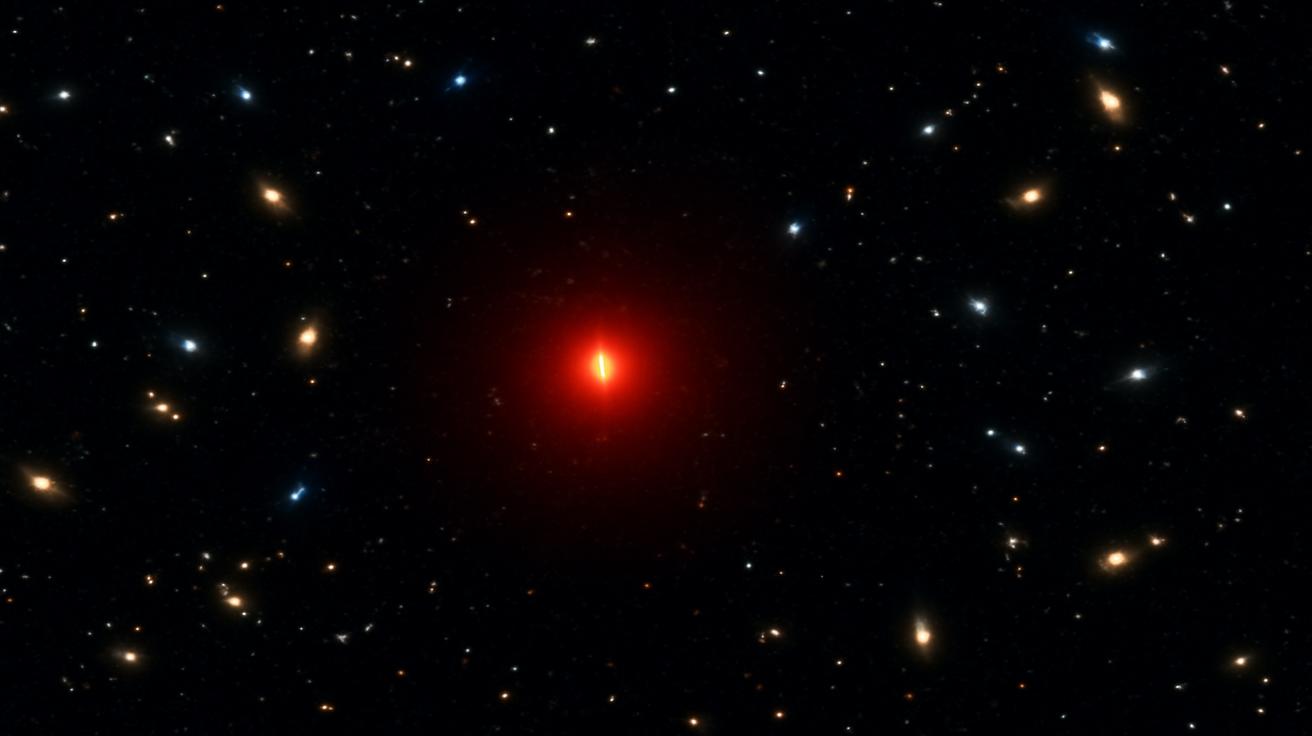
The monster doesn’t look like much at first. On the astronomer’s screen, it’s nothing more than a pinprick—one stubborn red pixel blinking against a velvet-black background crowded with quieter stars. No gaping jaws of plasma, no cinematic spiral arms, no fireworks of colliding galaxies. Just a tiny red dot at the far edge of everything we can see. And yet, if the numbers are right, that unassuming speck might be one of the strangest, most unsettling objects the universe has ever grown.
The Night the Red Dot Appeared
Picture a control room lit mostly by monitors, the air humming with the low whirr of cooling fans and the soft tapping of keys. Outside, the actual telescope—in reality a towering assembly of mirrors and metal far away on a desert mountaintop or drifting in space—drinks in photons that began their journey billions of years ago.
Someone notices it first as an anomaly. A faint, blood-tinted dot in a deep survey of very distant space. It doesn’t look like much, almost lost in the digital noise. But its spectrum—light stretched and shifted by the expansion of the universe—is deeply red, more redshifted than most things in the frame. That tells astronomers something astonishing: this light left its source when the universe was barely out of infancy, when galaxies were just learning how to be galaxies.
The researchers circle around the data like people gathered around an ember in dark snow. Screens glow. Public channels buzz. A candidate at extreme redshift. Very compact. Very bright. No obvious match to known types of objects. There’s an undercurrent no one quite says out loud yet: This doesn’t fit the rules.
The Color of Impossible Distance
To understand why a tiny red dot can provoke so much scientific adrenaline, you have to tune into what “red” really means in this context. This isn’t the cheerful red of sunsets, cherries, or brake lights. It’s an old red—worn out and stretched thin by the universe’s growth itself.
Every bit of light on that pixel began as something bluer, hotter, more energetic. Over billions of years, as space expanded, the wavelengths of that light were pulled longer and longer, drained of energy, pushed steadily toward the red side of the spectrum. The more extreme the redshift, the farther and earlier the source. That is, the tinier and younger the universe was when that light began its journey.
So this particular red dot is not just distant. It’s ancient—or rather, we are seeing it as it was when everything else was anciently young. Our own solar system would not be born for more than ten billion years. Dinosaurs and humans, forests and oceans, the concept of “Earth” itself—all still far in the future. And yet this object was already doing something dramatic enough to scream across eternity.
But what, exactly, is it? That’s where the monster theory creeps in.
The Puzzle: Too Big, Too Bright, Too Early
Once astronomers identify an intriguing red dot, the real detective work begins. They extract its spectrum, measure its luminosity, estimate its size. They check it against models, simulations, and catalogs of known celestial characters: galaxies, quasars, supernovae, black holes. Is it behaving like any of these?
Often, the answer is: not really.
Some of these ultra-compact red dots appear to be far more massive than they have any right to be, given how little cosmic time has passed since the Big Bang in their era. They’re too bright, too dense, too mature. It’s as if you stepped into a kindergarten classroom and found a fully grown oak tree sprouting right from the middle of the carpet: tall, knotted, ancient in appearance, while the crayons and construction paper still smell new.
In standard cosmic history, structures grow gradually. Tiny fluctuations in the early universe turn into slightly denser patches of gas, which slowly clump into small galaxies, which then merge and collide and grow into massive ones. Black holes, too, start small—seeded by collapsed stars—and take their time fattening up on gas and stars, sometimes shining as quasars while they feed.
But these tiny red dots, if the measurements hold, short-circuit that slow, steady narrative. They suggest that huge black holes or super-compact galaxies—perhaps both—assembled themselves incredibly quickly, in just a fraction of the time models predict. That’s where the idea of a “new kind of cosmic monster” enters the room: not a single class of object, necessarily, but a whole population that plays by different rules.
Monsters in the Making: Direct Collapse and Dark Seeds
To tame the paradox, theorists have sharpened their pencils and opened their simulation codes. One appealing explanation involves what are called “direct collapse” black holes. In our familiar universe, most black holes come from dead stars. But a direct collapse black hole would be born not from a star, but from a titanic cloud of pristine gas collapsing straight into a black hole, skipping the stellar phase entirely.
Imagine a city’s worth of mass caught in a single fog bank, enormous and structureless. Instead of fragmenting into thousands of individual stars, that fog simply caves inward under its own gravity, deeper and deeper, until nothing can escape. The resulting black hole could start out at tens of thousands, or even hundreds of thousands, of solar masses—huge compared with ordinary stellar remnants.
If even a few of these dark seeds formed in the first few hundred million years, they could, in theory, grow quickly into the bright, ravenous monsters that might explain the tiny red dots we see: compact, but ferociously luminous, wrapped in disks of inflowing, superheated gas.
Other models propose exotic variations: super-massive stars that burn briefly and violently before collapsing, or primordial black holes born directly from density ripples in the Big Bang’s first heartbeat. Each scenario rewrites key parts of our understanding of how structure rises from the cosmic soup. Each one carries its own fingerprint in light, mass, and behavior. Right now, the faint red dots are leaving just enough fingerprints to be suspicious, but not enough to give a clear confession.
The Red Dot’s Secret Life
Of course, calling it a “dot” is our human shorthand. In reality, the object behind that pixel is likely a complex system: swirling gas, violent radiation, perhaps a young galaxy’s worth of stars huddled around a central heavyweight. We see only its combined effect on the light that reaches us.
Within that pinpoint, temperatures might soar into the millions of degrees. Magnetic fields twist and snap, jets of high-energy particles lance out into surrounding space at nearly the speed of light. Nearby gas clouds collapse into new stars, which live fast and die young as supernovae, seeding the region with heavier elements. It’s a neighborhood in violent acceleration—everything happening sooner, faster, and more intensely than we thought possible in such an early universe.
Yet at our distance, all of this tumult is reduced to a shy, steady glow, fed by photons so tired from their epic journey that they arrive whispering in the deep-red and infrared range. Instruments tuned to those whispers, like the newest generation of space telescopes, finally give us ears sensitive enough to hear them.
In a way, this is the universe leaving us a time capsule. Most of what happened back then is gone, transformed, or swallowed by later events. But the light remembers. It carries a fossil record of impossible brightness and odd behavior that we are only now learning to read.
Peering with New Eyes
The leap that made these red specks visible is largely technological. Earlier telescopes, powerful as they were, simply couldn’t catch such faint, stretched-out light from so far back. Their eyes were clouded at exactly the wavelengths where the oldest galaxies whisper.
Enter ultra-sensitive infrared observatories, backed by giant mirrors and detectors cooled nearly to absolute zero. To us, infrared often feels like the light of warmth—the glow of a resting stovetop, the heat radiating off sun-baked rock. To the universe, though, it’s the color of time itself. The farther back we look, the more visible and ultraviolet light has been dragged into the infrared by cosmic expansion.
Now, as astronomers systematically scan small patches of sky with such instruments, they’re finding a forest of these compact red sources, more than many models predicted. Not just one oddball, but dozens, even hundreds of candidates: young, overachieving structures born when the universe was supposed to be sleepy and slow.
With each new survey, the catalog grows and the tension increases. Are we misreading them—tricked by dust, geometry, or gravitational lensing that makes distant objects look brighter and bigger? Or are we facing a genuine shortfall in our theories about how the cosmos evolves?
Numbers Behind the Mystery
Some of the strangeness hides in simple comparisons—mass versus time, brightness versus distance, size versus age. Even stripped of equations, the relationships are startling. Here’s a simplified snapshot of how unusual these cosmic suspects appear when lined up against “ordinary” expectations:
| Property | Typical Early Galaxy | Tiny Red-Dot Candidate |
|---|---|---|
| Cosmic Age When Seen | ~1–1.5 billion years after Big Bang | ~300–600 million years after Big Bang |
| Estimated Mass | Millions to a few billion Suns | Comparable to mature galaxies today |
| Apparent Size | Sprawling, loosely structured | Extremely compact; nearly point-like |
| Dominant Light Source | Starlight from young stars | Possible massive black hole accretion |
| Model Friendliness | Fits standard growth scenarios | Strains or breaks existing models |
These are broad strokes, but they frame the disquiet: the universe seems to have built some of its skyscrapers while we still thought it was pouring foundations.
Why This Matters to Us, Here on Earth
It’s tempting to treat all this as an abstract curiosity, a puzzle for specialists whose lives revolve around simulation code and noisy data. But glimpsing a new kind of cosmic monster—if that’s what these red dots turn out to be—reaches into deeper questions about origin, time, and the limits of our understanding.
Our entire cosmic story, from hydrogen fog to conscious observers, rests on the scaffolding of structure formation: how matter clumps, collapses, ignites, and assembles into the familiar hierarchy of stars, galaxies, and clusters. If the earliest chapters are more dramatic and efficient than we thought—if black holes bloomed quickly, if galaxies skipped steps—then everything downstream is affected, including the environments in which planets like ours eventually form.
It also nudges something quieter, almost philosophical. For centuries, we told ourselves that the universe ran like a clock: elegant, predictable, governed by clean laws that left little room for surprise. Every time we build a more sensitive instrument, however, we find something that doesn’t quite fit: galaxies that are too massive, explosions that are too bright, particles that behave unexpectedly. The tiny red dots are the latest ghosts lurking at the edge of our map.
For many scientists, that’s not discouraging—it’s fuel. Each outlier is an invitation to refine the story, to sharpen the math, to re-ask questions we thought were settled. The universe, it seems, is not done teaching us how to be astonished.
Listening for a Roar in a Whisper
In the coming years, these barely-there pixels will be scrutinized to exhaustion. Astronomers will aim longer exposures, parse finer spectra, and leverage gravitational lenses—massive galaxy clusters that bend and magnify background light like natural telescopes—to see faint detail otherwise beyond our reach.
They’ll look for telltale signatures: a particular shape in the spectrum that screams “accreting black hole,” or a smoothness in the light profile that signals direct collapse, or a spread of heavy elements that betrays a prior generation of stars. They’ll check for variability—tiny flickers over weeks or months that can reveal the size and nature of the central engine.
Some candidates will likely be demoted. A few will turn out to be cosmic illusions, their brightness boosted by lensing or their distances overestimated by noisy data. But if even a core handful remain as massive, bright, and early as they first appear, we will be forced to admit that the universe had more than one way to grow monsters.
And somewhere, perhaps, in one of those data rooms, someone will lean back from the monitor and feel a curious shiver. Not of fear—this monster can’t touch us—but of perspective. That inside a single pixel, a whole wild epoch of the cosmos is playing out, inaccessible except through a rain of red-tinted photons that have spent almost the entire age of the universe just getting here.
Questions and Answers: The Tiny Red Dot Mystery
What exactly is the “tiny red dot” in deep space?
It’s a very distant, extremely compact source of light—likely a young galaxy, a massive black hole, or a combination of both—seen when the universe was only a few hundred million years old. Its light is so stretched by cosmic expansion that it appears very red and faint, even though it may be intrinsically brilliant.
Why do astronomers think it might be a “new kind of cosmic monster”?
Because some of these objects appear to be too massive, too bright, and too compact for such an early time in cosmic history. They don’t fit well with standard models of how galaxies and black holes gradually grow, suggesting we may be seeing a population of objects that formed and evolved in a faster, more extreme way than expected.
Could it just be a normal galaxy or black hole that we’re misreading?
That’s possible, and astronomers are cautious. Dust, gravitational lensing, or measurement errors can all make distant objects appear stranger than they are. Ongoing observations aim to rule out these effects. The excitement comes from the fact that, even after careful checks, several candidates still look unusually massive and mature for their age.
How do telescopes detect something so distant and faint?
Modern space telescopes use large mirrors and ultra-sensitive infrared detectors cooled to extremely low temperatures. They gather and amplify tiny trickles of infrared light—photons that have been traveling for over 13 billion years—then analyze how that light is spread across different wavelengths to infer distance, composition, and energy output.
Why does the light from these objects look red?
As the universe expands, it stretches the wavelengths of light traveling through it, shifting them toward the red end of the spectrum. This effect, called redshift, is stronger the farther the light has traveled. For these early-universe objects, what began as visible or ultraviolet light has been stretched into the infrared, making them appear as tiny red dots in our detectors.
What are “direct collapse” black holes, and how are they related?
Direct collapse black holes are hypothetical giants born when a huge cloud of gas collapses straight into a black hole, instead of first forming many smaller stars. Such objects would start out far more massive than typical stellar black holes, helping explain how enormous black holes could exist so early. Some scientists think the tiny red dots might be powered by these rapid-growth seeds.
Does discovering these objects change our understanding of the Big Bang?
It doesn’t overturn the Big Bang itself, but it may refine the timeline of what happened afterward—how quickly matter clumped, how early black holes and galaxies formed, and how efficiently they grew. In other words, the basic origin story remains; what changes is the pace and drama of the first chapters.
Will we ever see more detail than just a dot?
Directly resolving fine structure in such distant objects is extremely difficult with current technology. However, by combining longer observations, clever analysis, and the natural magnification of gravitational lensing, astronomers hope to tease out more detailed information about their structure, composition, and behavior—even if, on the screen, they still look like a single pixel of ancient red light.







Leave a Comment