
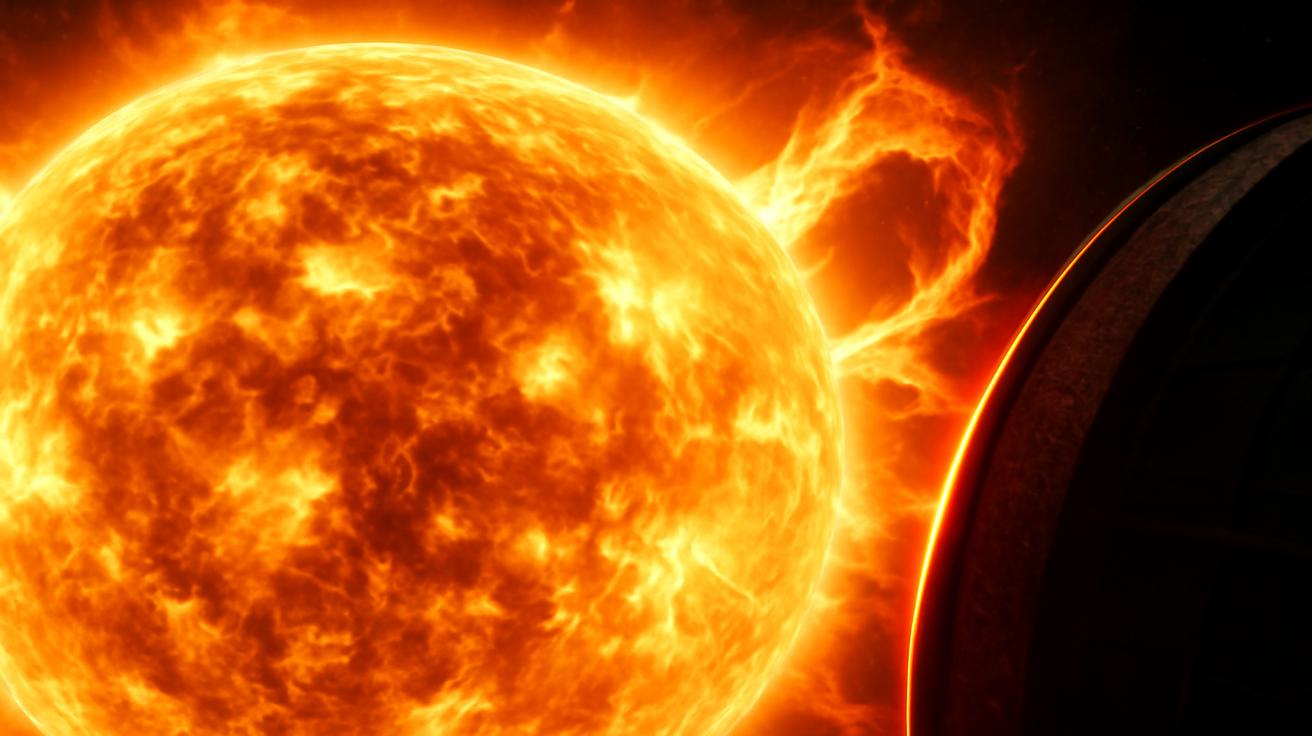
The Sun does not roar in space the way storms roar on Earth. There is no air to carry sound. Yet if you could stand on the hull of a tiny ship skimming the edge of its furnace, it would feel loud. The light alone would seem to shout, hammering your eyes and skin with more than 500 times the intensity we get on Earth. Charged particles would scream past in invisible torrents. Magnetic fields would twist around you like ghostly ropes being pulled tight, then snapped. And somewhere in that blazing chaos, a mystery first posed a hundred years ago would begin, finally, to give up its secrets.
A Century-Old Puzzle Wrapped in Fire
For as long as we’ve been building telescopes, the Sun has been both familiar and deeply strange. We see it every day, feel its warmth on our faces, time our lives by its rising and setting. Yet when early solar astronomers pointed their instruments toward it in the early 20th century, they stumbled on a fact that made no physical sense at all.
The surface of the Sun—the part we see shining as a smooth, bright disk—is about 5,500 degrees Celsius. That’s hot enough to vaporize rock. But just above that surface, in the Sun’s outer atmosphere, or corona, the temperature suddenly jumps. Not to ten thousand degrees. Not to a million. To several million degrees Celsius.
Imagine standing next to a campfire, and discovering that the air several meters above the flames is suddenly hundreds of times hotter than the fire itself. That is the solar corona. It glows with a thin, ghostly halo during a total solar eclipse, beautiful and quiet to our eyes. In reality, it is a violent, superheated plasma whose very existence insults common sense and the laws of thermodynamics. Heat should flow from hot to cold, from core to surface to space—not the other way around.
This unsolved puzzle, known as the “coronal heating problem,” has sat in textbooks for decades. Engineers designing solar panels have lived with it. Astronomers building space weather models have worked around it. And gradually, as people grew more accustomed to the idea that the universe was sometimes deeply weird, the question of why the Sun’s corona is so astonishingly hot became a kind of quiet background hum in solar physics: always there, rarely resolved.
To truly understand, we would need to go there. Not just close in the figurative sense—that we point a telescope or send a satellite to a safe distance—but close in the way that makes engineers wince and shrug and start rethinking what “shielding” can even mean. Close enough to touch the Sun’s atmosphere with instruments built to taste heat, magnetic fields, particles, and light all at once.
And so humans built a machine that could do the unthinkable: a spacecraft willing to fly into the furnace.
Riding a Machine into the Sun
The first time the spacecraft dipped in toward the Sun, it was like watching a small bird dive toward the mouth of a volcano. Months of careful trajectory planning—stealing a little bit of speed from Venus each time it looped around—had brought it inside the orbit of Mercury. That alone was a record. But the plan was more audacious: pass after pass, year after year, it would fall closer. It would skim nearer to the Sun than any machine had ever dared, until it finally slipped into the fringes of the corona itself.
To keep it alive, engineers wrapped its delicate heart in a heat shield just a few inches thick, made of carbon foam sandwiched between carbon-composite plates. On the side facing space, it would be cold—so cold water had to be pumped through radiators to keep instruments from freezing. On the Sun-facing side, the shield would glow at temperatures hot enough to melt steel. All that stood between survival and instant vaporization was a careful dance of orientation: the shield had to stay perfectly angled toward the Sun, like a medieval knight raising a round metal shield against a hail of arrows.
Inside, a suite of instruments waited. Magnetic field detectors, so sensitive they could feel the ghostly twist of invisible solar ropes. Particle analyzers, ready to count and weigh each speeding proton, each helium nucleus, each stray electron. Electric field sensors, charged and watchful. And cameras, peeking sideways, taking in the Sun’s outer layers from vantage points no human eye would ever know directly.
The spacecraft slipped through space in near silence. When it first crossed the invisible line where the solar wind begins to dominate, it could not shout its excitement. It simply recorded, measured, and stored. Later, those data packets would trickle back across millions of kilometers of empty space to the deep antenna dishes on Earth, where they were unpacked and turned into graphs, curves, and fields of color that made scientists sit up straighter in their chairs.
Where Solar Wind Is Born
The solar wind is another old riddle tied to the corona. For decades, we have known that the Sun is not a tranquil orb but a leaking star, constantly shedding a stream of charged particles. This solar wind flows outward in all directions, racing across the solar system, brushing Earth’s magnetic field, and igniting auroras near the poles. It shapes comet tails and batters the atmospheres of other worlds. It can disrupt satellites, fry electronics, and stir dangerous currents in power grids.
But we have never seen where, exactly, the solar wind truly begins. We could measure it farther out—at Earth, at Mars, at the fringes of the heliosphere—but each time, we were catching the river miles downstream from its source, after turbulence and distance had already smoothed away the wildness of its birth.
As the Sun-skimming spacecraft passed through its first close encounters, its instruments began telling a new story. Instead of a smooth, laminar stream of particles, it found a river wrinkled with abrupt reversals—little “switchbacks” where the magnetic field seemed to whip around and point almost back at the Sun for a moment, before snapping forward again.
These magnetic switchbacks weren’t gentle bends. They were sharp, like the sudden kink of a rope that has been twisted and then released. Imagine standing in a stream and feeling the water suddenly surge backward around your ankles for a second, then forward again. For a long time, these strange reversals had been seen from afar and puzzled over. Now, flying through them directly, the spacecraft could sample them in exquisite detail.
They turned out to be surprisingly common—and surprisingly strong. They carried energy. Lots of it. Enough, potentially, to heat plasma, to stir motion into particles, to help fuel the corona’s impossible temperatures. Suddenly, one piece of the century-old coronal heating problem felt less mysterious. The Sun, it appeared, might be pumping energy into its atmosphere by twisting and snapping its own magnetic fields, like a slow but relentless storm of invisible whiplashes.
Feeling the Magnetic Twists
To picture this, it helps to think of the Sun not as a ball with neat magnetic bar lines running from north to south, but as an ocean of electrically charged gas in constant motion. Every churning convective cell, every bubbling loop of bright plasma, helps tangle the underlying magnetic field. These tangled fields can store energy the way a coiled spring stores tension. When they suddenly rearrange—snapping into a less twisted shape—they release that energy explosively.
On larger scales, that process powers solar flares and coronal mass ejections, the immense storms that can knock out satellites and bathe astronauts in radiation. On smaller scales, it appears that similar processes might happen constantly, everywhere, all the time. The spacecraft, swooping through the corona’s lower altitudes, flew directly through the places where that tangled energy is being fed into the solar wind.
In its data, scientists found not just the sharp kinks of switchbacks, but subtler signatures: waves rippling through the plasma, interactions where particles were clearly being heated, velocity spikes that spoke of energy injection on small scales. It was as though we had finally moved our microphones from the back wall of a concert hall to the very edge of the stage—and the music, long muffled, roared into full complexity.
Crossing the Invisible Boundary
For years, solar physicists have talked about something called the “Alfvén critical surface” in almost mythic tones. This is the boundary where the solar wind finally breaks free from the Sun’s magnetic grip—where the waves that carry information back to the star can no longer keep up with the rushing plasma. Beyond that point, the solar wind is on its own, essentially disconnected from the surface that spawned it.
The spacecraft’s inner-most orbits finally dipped low enough that it crossed this boundary, not once but multiple times, as it flew through different regions of the Sun’s atmosphere. Each time, the data showed a subtle but profound shift. Inside the boundary, plasma movements could still “talk back” to the Sun via magnetic waves; outside, they could not. It was like stepping from the shallow surf, where waves tug at your ankles and change as you move, into a fast-flowing river where nothing you do can be felt upstream.
Crossing that line gave scientists a long-sought reference point. For decades, models of the corona and solar wind had to guess where this transition occurred. Some argued it was close to the Sun, some placed it farther out. Now, for the first time, there was a measured answer—one written not in equations, but in the vibrations of real plasma and real magnetic fields recorded by a silent, sunburned machine.
A Closer Look at the Data
On Earth, researchers turned those measurements into color maps and time-series curves. They laid one orbit’s data over another, then a third, watching as a pattern emerged. In closer passes, the frequency and strength of magnetic switchbacks grew. The densities and temperatures of particles shifted. Regions of relatively calm flow alternated with turbulent zones where the wind seemed freshly energized.
To make sense of these encounters, many teams built combined catalogs of key conditions recorded during multiple solar flybys. A simplified version of this kind of summary might look like this:
| Flyby | Closest Approach (Solar Radii) | Approx. Distance (Million km) | Key Observations |
|---|---|---|---|
| Early Pass | 35–40 | 25–30 | First clear detection of frequent magnetic switchbacks; solar wind still relatively smooth. |
| Mid Pass | 20–25 | 14–18 | Stronger turbulence; heating signatures increase; variations in particle speed and density grow. |
| Corona Entry | < 15 | < 11 | Direct crossing of coronal boundary; localized regions of intense magnetic activity; clear energy transfer to particles. |
Each row in a table like this hides months of preparation, days of nail-biting flight, and terabytes of data. But taken together, they tell a coherent story: as we move closer to the Sun, the solar wind loses its apparent smoothness and reveals the drama of its origin. The corona is not a still, static atmosphere; it is a boiling, braided sea of magnetic energy constantly being poured into space.
Rewriting the Mystery, One Orbit at a Time
The beauty of this mission is that it is not a single, brief touch-and-go encounter. It is a slow, spiraling descent, shaped by repeated gravity assists. Each time it brushes past Venus, the spacecraft bleeds off a little more orbital energy and drops a little closer to the Sun. Each time, its instruments probe a slightly different altitude, a slightly different slice of the magnetic and particle environment.
This means the story of the coronal heating problem is not being solved in one blinding revelation, but as a series of chapters. One orbit highlights the importance of magnetic switchbacks. Another clarifies how waves carry energy through plasma. A later one reveals how some regions above coronal holes—dark patches on the Sun where magnetic field lines open into space—are cradles for faster, hotter wind streams.
Layer by layer, these observations are forcing scientists to adjust old models. Long-standing caricatures of the corona as a static, symmetric bubble are being replaced by something more alive, more textured. In this revised picture, the Sun’s surface is constantly braiding and unbraiding its own magnetic hair. Each tiny tangle, each small-scale reconnection event, may add a bit of heat. Multiplied by the vastness of the surface and the relentless passage of time, those small contributions can fuel a million-degree atmosphere.
The ’century-old mystery’ is not a single locked box suddenly flung open. It is more like a fog that is gradually thinning. Through it, shapes that once looked simple and monolithic now show depth: ridges of magnetic waves, valleys of turbulent flow, and hidden currents that lift energy from the solar surface up into the corona and out into the solar wind.
Why It Matters Back Home
Understanding the Sun’s outer reaches is not just an intellectual prize. It ripples back into daily life in quiet, practical ways. Weather in space is, in many respects, born in the corona. The speed and density of the solar wind, the structure of its magnetic fields, the timing and strength of eruptions—all are downstream consequences of what happens in that superheated atmosphere.
When the Sun hurls a blob of magnetized plasma outward, whether that event merely paints pretty auroras across the sky or triggers power blackouts can depend on details deep in the corona: how energy was stored, how it was released, how the background wind shaped its journey. Better models built from real, close-up measurements can lead to more accurate warnings for astronauts, satellite operators, and grid managers on Earth.
There’s something oddly grounding about that chain of connection. A wilderness of super-hot plasma a hundred and fifty million kilometers away tugs on the quiet hum of transformers in a suburban neighborhood. The same physics that twists magnetic fields above sunspots can, eventually, flicker the screen of a weather satellite watching a storm over the Atlantic.
Flying on the Edge of the Possible
There is also, undeniably, a more human layer to this tale. The idea of flying a spacecraft so close to the Sun that it technically enters the corona sounds like something out of myth. For centuries, we have told stories about Icarus, the boy who flew too close to the Sun and fell. In this version, our wings are made of carbon composites and radiators and whisper-slim sensors, and they are designed not to melt but to measure.
Somewhere, in control rooms and offices and living rooms around the world, the people who dreamed and built this craft wait for each new downlink. They know the arc of the mission by heart: each closest approach, each Venus flyby, the date when the spacecraft will finally make its deepest plunge and skim through the corona at a distance that, to earlier generations, would have sounded like science fiction.
They know, too, that this mission has limits. The Sun is patient. It burns on timescales long beyond any spacecraft’s lifetime. We are getting a few fleeting years of intimacy with it, a handful of carefully chosen dives into its atmosphere. In those years, we hope to glean enough understanding that when this machine finally falls silent, the questions it set out to answer will be more resolved than not, its measurements feeding models and theories and perhaps, one day, textbooks that no longer describe the coronal heating problem as a stubborn, century-old mystery.
In the meantime, the spacecraft continues its looping path—one small ember of human ingenuity orbiting a colossal furnace. Each orbit is a conversation between our species and its star, carried out in particles and fields, in bits of data that whisper across the void. For the first time, that conversation is happening not from a safe, cool distance, but from within the Sun’s own blazing breath.
FAQ
Why is the Sun’s corona hotter than its surface?
The corona’s extreme temperature is thought to come from magnetic energy. The Sun’s magnetic field becomes tangled and twisted by motions in the solar surface. When those twisted fields snap into simpler shapes, they release energy that heats the surrounding plasma, potentially to millions of degrees. Waves traveling along magnetic field lines may also transfer energy upward and contribute to heating.
How close did the spacecraft actually get to the Sun?
In its deepest passes, the spacecraft approached within just a few solar radii of the surface—only a few million kilometers above it. That put the spacecraft well inside the region we traditionally think of as the Sun’s corona, closer than any previous mission and close enough to sample the birthplace of the solar wind directly.
How does the spacecraft survive such intense heat?
It is protected by a specially designed heat shield made of carbon-based materials. This shield faces the Sun at all times during close approaches, enduring temperatures of more than a thousand degrees Celsius while keeping instruments behind it at near room temperature. The spacecraft also uses a cooling system that circulates water through radiators to carry excess heat away.
What are magnetic “switchbacks” and why are they important?
Switchbacks are sudden reversals in the direction of the Sun’s magnetic field measured in the solar wind. They look like sharp kinks in the otherwise mostly outward-pointing magnetic field. These structures carry energy and appear to be linked to processes that heat the corona and accelerate the solar wind, making them key clues in solving the coronal heating problem.
How will this mission improve space weather forecasting?
By measuring the solar wind and magnetic fields close to their origin, the mission provides data that help refine models of how the Sun’s atmosphere behaves and how eruptions form and travel. Better models mean more accurate predictions of when solar storms will reach Earth and how strong they might be, giving satellite operators, power grid managers, and astronauts more reliable warnings.







Leave a Comment