
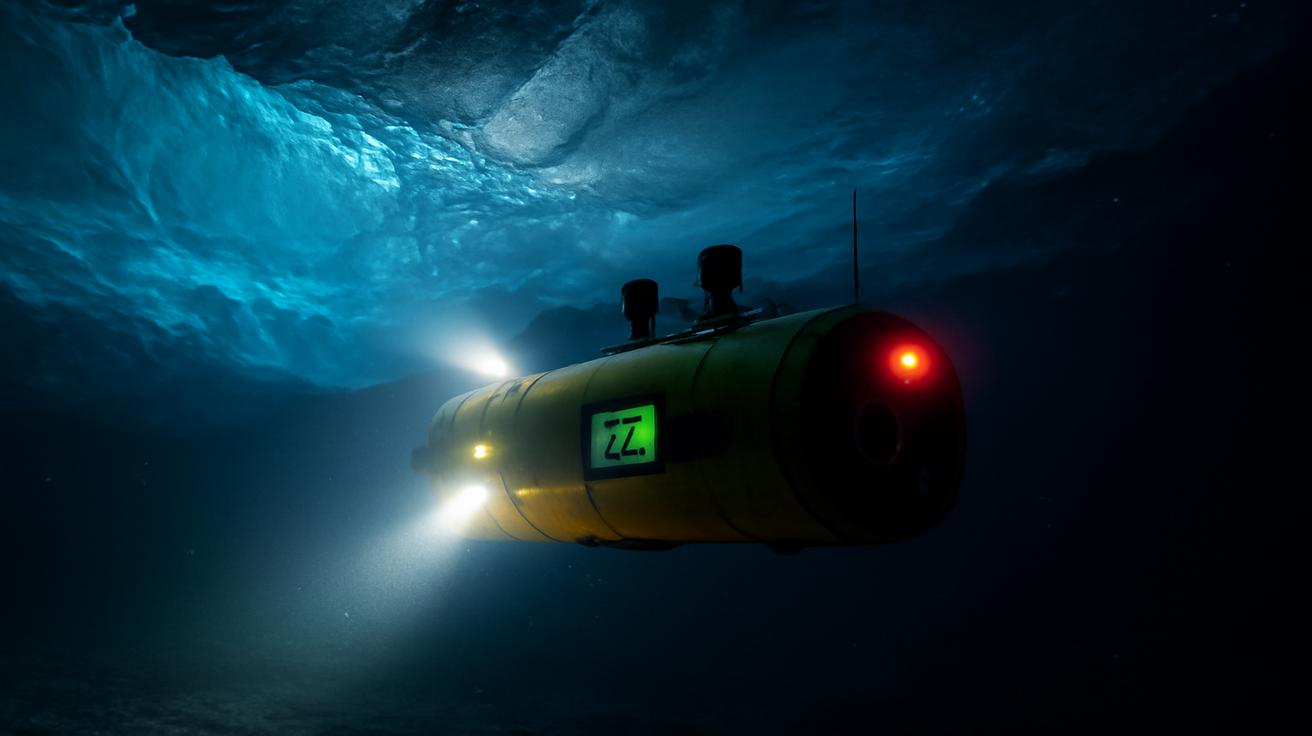
The robot almost didn’t come back.
For eight months it drifted alone in the black water beneath one of the most forbidding places on Earth, feeling its way through a labyrinth of ice and rock that no human eye had ever seen. Its thin metal shell creaked under pressures that would crush a submarine. Fine silt hissed across its sensors like underwater sandstorms. Above it, nearly a kilometer of ancient Antarctic ice pressed downward, heavy as a mountain range. Below, the ocean moved in slow, relentless currents that carried the memory of distant storms and warming seas.
Then, one day, in the faint beams of its lights, the robot saw something shift—something the scientists who had built it had hoped never to find.
Under the Roof of the World
The story begins in a place that almost doesn’t feel real: the grounding line of one of Antarctica’s colossal glaciers. Picture a frozen cliff taller than a skyscraper, stretching beyond the horizon. This is where ice that once rested on land begins to float, forming the great ice shelves that fringe the continent. It’s also where the future of coastlines around the world is quietly being decided.
For decades, researchers suspected that warm ocean water was slipping into the hidden spaces beneath these glaciers, gnawing at their underbellies. Satellite images showed the surface of the ice subtly lowering. Radar hinted that grounding lines were retreating inland. But no one had watched the process unfold directly from inside the dark, pressurized labyrinth where it was happening.
So a team of glaciologists, oceanographers, and engineers created a robot for a single purpose: to go where they could not. It was about the size of a kayak, shaped like a torpedo, packed with sensors that could taste the salt in the water, feel the tiniest changes in temperature, map the shape of the ice above it, and listen to the faint murmurs of the glacier as it creaked and fractured. They called it simple things—“the vehicle,” “the probe”—but the stakes it carried were anything but simple.
To launch it, they melted a narrow shaft through nearly a kilometer of ice using a hot-water drill, a silver straw into the void below. When the drill broke through the final meter, a ghost of seawater vapor rose from the hole, smelling faintly of salt and stone and something old. They lowered the robot on a cable, watching its depth tick down on a laptop screen in a tent lit by humming generators and dim LED lamps, snow hissing outside in the wind.
And then, with a mixture of hope and dread, they let it go.
Eight Months in the Dark
Once untethered, the robot began its slow exploration of the hidden ocean under the glacier. This was a world of extremes. The water temperature hovered only a fraction of a degree above freezing, yet compared to the ice, it was warm enough to melt it from below. Every centimeter of ice it touched recorded the subtle difference between a stable future and an accelerating collapse.
The robot drifted with the currents, sometimes nudging close to the jagged, sculpted underside of the ice shelf, sometimes gliding a few meters above the seafloor. Its sensors pinged and hummed. It sent short bursts of data back when it could, but full communication was impossible beneath so much ice. In many ways, the team had simply thrown it into the dark and waited.
What they wanted to know was simple to ask and brutal to answer: How much warm ocean water is getting in here, and what is it doing to the glacier?
Scientists already knew that Antarctica’s giant glaciers—especially the so-called “doomsday glacier,” Thwaites, and other massive ice streams in West Antarctica—hold enough ice to raise global sea levels by several meters if they collapse. Cities from Miami to Mumbai, Shanghai to Lagos, would face a new shape of their coasts and a new definition of “high tide.” But the timing of that future hinged on what was happening in the hidden undersides of the ice.
As the robot wandered its silent path, seasons shifted above. Winter cloaked the ice in bitter cold and months of darkness. Storms swept the Southern Ocean, whipping waves against the ice edge far away. The robot knew none of this. It only tasted water, measured pressure, felt the faint tug of currents. It mapped under-ice canyons, slopes, and shelves, all in the dark.
The Signal They Didn’t Want to See
When the robot finally returned to the launch point—guided by pre-programmed instructions, inexact currents, and a bit of engineering optimism—it carried with it a memory of the under-ice world unlike anything ever recorded. In a cramped field lab back on the ice, the scientists watched the data begin to spill across their screens.
At first, there was relief. The robot had survived. The maps were detailed. The temperature and salinity profiles were crisp. Months of risk and waiting had not been wasted. But that relief faded as the patterns began to emerge.
Layer by layer, graph by graph, the same message appeared: warm, salty deep ocean water was reaching far beneath the glacier, right up to—and in some places beyond—the grounding line. And it wasn’t just seeping in. It was flowing, carving pathways, pooling in pockets, and creating a subtle but deadly circulation loop beneath the ice.
In the data, the warm water showed up as a thin but persistent layer, only slightly warmer than the freezing point, but enough. The robot’s sensors recorded fresher, colder meltwater flowing back out along a shallower path—a two-lane traffic system of ocean heat in and ice melt out. This is the signal scientists had long feared: direct confirmation of a feedback loop that could drastically speed up ice loss.
For years, models had predicted this possibility. If deep warm water—known as Circumpolar Deep Water—found a clean path up sloping seafloor canyons to the grounding line, it could eat away at the ice from below, thinning it, unpinning it from the bedrock, and allowing the glacier to slide more easily toward the sea. The robot’s journey showed that this was not just a hypothetical. It was happening.
What the Robot Actually Felt
Inside the technical data were small details that made the abstract alarmingly tangible. There were tiny spikes in temperature—fractions of a degree—that lined up suspiciously well with subtle changes in seafloor depth, as if the water were being funneled upward along invisible underwater ramps. The robot’s upward-looking sonar traced places where the ice above had scalloped and undercut, the underside melting into caves and overhangs instead of a smooth flat surface.
In some sections, the robot’s instruments suggested that the melt rates right at the grounding line were several times higher than what scientists had previously estimated from satellites alone. Models that once seemed aggressive in their predictions of future sea-level rise now looked conservative.
The fear wasn’t just that this particular glacier was in trouble. It was that the robot had confirmed the mechanism by which whole sectors of West Antarctica could begin to let go.
A Slow Catastrophe, Measured in Millimeters
From far away, sea-level rise sounds slow. A few millimeters a year. A few centimeters a decade. Numbers you could almost shrug at, if you were determined not to care. But when you live near the ocean, or study it for a living, those millimeters carry weight.
They stack on top of storm surges, turning what used to be “once in a century” floods into familiar seasonal menaces. They creep into groundwater, poisoning wells with salt. They push tides further upriver, reshaping wetlands and erasing salt marshes that once buffered coastlines from waves.
The robot beneath the glacier wasn’t watching whole cities flood. It was watching the beginning of the process, where warm water turned solid ice into fluid future oceans. Yet in its measurements was a quiet urgency that leapt from polar darkness to human streets.
At the grounding line, a few extra centimeters of melt in a year can translate into a softer grip between ice and rock, a smoothed slope that invites sliding. Once a glacier begins to accelerate, it can thin and retreat faster, exposing more of its interior to the ocean. It’s a chain reaction that can’t be turned off easily. The fear had never been that the robot would catch a sudden, Hollywood-style disaster—a titanic crack, a catastrophic instant collapse. The fear was that it would document proof of a slow-moving, but relentless, transformation already underway.
The data did something else, too: they gave scale and shape to the hidden heat that is already in the climate system, heat absorbed now by the ocean that will go on working at the ice long after any individual storm, policy, or headline has passed.
What the Numbers Tell Us
In the weeks and months after the robot’s recovery, the team back home began turning raw data into stark numbers. How much heat was entering the cavity beneath the glacier each year? How many meters of ice could that theoretically melt? How well did their earlier models match this new reality?
Here’s a simplified snapshot of the kind of picture they were able to build from those measurements:
| Key Factor | What the Robot Detected | Why It Matters |
|---|---|---|
| Water Temperature | Slightly above freezing, warmer at depth than near the ice base | Even tiny amounts of extra warmth can dramatically speed under-ice melting. |
| Salinity | Saltier deep water flowing in, fresher meltwater flowing out | Confirms a circulation loop: warm water in, meltwater out, driving more melting. |
| Ice Geometry | Undercut, uneven underside with pockets and slopes | Complex shapes can focus melting and destabilize the ice shelf over time. |
| Grounding Line Position | Evidence of retreat deeper into the continent | Once the grounding line moves onto deeper bedrock, retreat can accelerate. |
| Melt Rates | Higher than earlier estimates in some key zones | Suggests current projections of future sea-level rise may be too low. |
None of these findings, taken alone, screamed catastrophe. But together they painted a future where the glacier’s grip on the seafloor was weaker, its stability more precarious, its contribution to rising seas less avoidable.
And there was another message buried in the data: time. The ocean heat that was now reaching the glacier had been accumulating for years, even decades, as the planet warmed. Much of it was locked into the deep currents that circle Antarctica. Turning down global greenhouse gas emissions now can still shape the long-term outcome enormously, but some of the changes under the ice are already set in motion.
Listening to Ice in a Warming World
When the robot’s story reached outside the world of glaciologists and ocean modelers, it took on a symbolic weight. Here was a small, human-made explorer drifting alone under a continent of ice, sending back a warning from a place that had been beyond our senses for all of human history.
It’s easy, from a distance, to think of Antarctica as separate—white, distant, untouched. Yet what this mission revealed is how intimately connected that isolation really is. The ocean currents that are now carrying warmth beneath the glaciers are powered in part by winds shaped by global weather patterns, which are in turn influenced by the greenhouse gases produced in industrial centers, farms, highways, and power plants far to the north.
In a way, the robot was listening to our own echoes: the distant, delayed outcome of choices made thousands of kilometers away, years before it slipped beneath the ice.
And yet the story is not only about loss. It’s also about the remarkable ingenuity being brought to bear in understanding and slowing that loss. The robot itself, and the decades of fieldwork and modeling that surround it, represent a kind of quiet, stubborn hope: that by truly seeing what is happening, even in places that were once considered unreachable, we gain the power to respond more wisely.
What Comes Next
The data from this single robot will feed into more accurate models, which will then shape coastal planning, infrastructure decisions, and global policy. Engineers designing sea walls and stormwater systems in low-lying cities will put new numbers into their calculations. Communities already grappling with “sunny-day flooding” on clear, calm days will have clearer timelines. The slow-motion story of sea-level rise will become a bit less mysterious, a bit more predictable—and therefore more manageable.
Meanwhile, more robots are being planned. Some will dive under different glaciers, some will carry even more advanced sensors, some will stay longer, mapping seasonal changes and tracking how pulses of warm water wax and wane. Each mission will refine our picture of the under-ice world, turning fear and uncertainty into measured, if sobering, understanding.
The irony is that to protect our coasts, we first have to get comfortable with the idea of exploring the most uncomfortable places: the deep, dark, pressurized zones where warm water meets ancient ice, where our past emissions meet our future shorelines.
FAQs
Why did scientists send a robot under Antarctica’s glaciers?
They needed direct measurements from beneath the ice where satellites and ships cannot reach. The robot gathered data on water temperature, salinity, currents, and the shape of the ice underside to reveal how quickly warm ocean water is melting the glacier from below.
What exactly did the robot detect that worried scientists?
It found a clear flow of relatively warm, salty deep ocean water reaching all the way to the glacier’s grounding line and circulating beneath the ice. This confirmed a long-feared feedback loop: warm water in, meltwater out, and increasingly rapid under-ice melting.
How does this affect global sea levels?
Faster melting at the grounding line can destabilize the glacier, causing it to thin, retreat, and flow more quickly into the ocean. Over time, this adds more water to the seas, contributing to higher global sea levels that can worsen coastal flooding and erosion.
Does this mean Antarctica is collapsing right now?
No, there is no instant, cinematic collapse underway. What the robot found is evidence of a slow but accelerating process of destabilization. The changes are unfolding over years to centuries—but they are already in motion, and they matter for planning our future.
Can anything still be done to slow these changes?
Yes. Reducing greenhouse gas emissions can limit future ocean warming and slow the flow of heat toward Antarctica’s glaciers. Better data from missions like this one also help governments and communities plan adaptation measures—such as improved coastal defenses and smarter development—in a more informed way.
Will more robots be sent under the ice?
Almost certainly. This mission has shown how valuable under-ice data can be. Future robots will explore more glaciers, stay longer, and carry more advanced instruments, helping refine predictions of ice loss and sea-level rise.
Why does it matter if the changes are happening so far away?
Because the ice locked up in Antarctica directly affects the height of the oceans everywhere. What happens under a glacier thousands of kilometers away can shape whether your city faces slightly higher tides or transformative flooding in the coming decades. Antarctica may be remote, but its influence is global.




Leave a Comment