
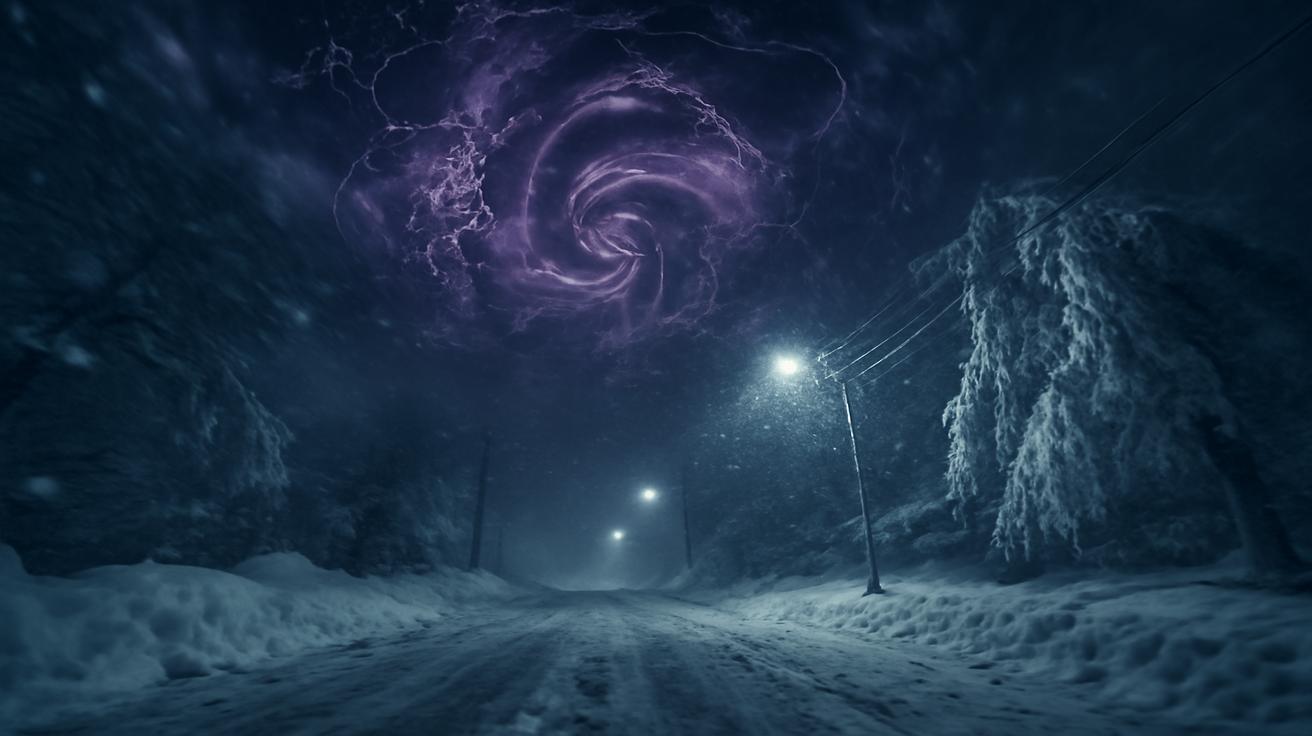
The first hint is not what you see—it’s what you feel. You step outside one late-winter morning, expecting the familiar softening of February, that almost-spring feeling in the air. Instead, the cold hits you like a wall: sharper, denser, oddly metallic. The sky is a washed-out porcelain, the wind carries a bite that belongs to January, not the cusp of March. Somewhere far above, in a layer of atmosphere most people never think about, the polar vortex is shifting—and with it, the quiet choreography of the seasons is about to go off script.
A Winter Engine You Never See
High above your head, more than 10 miles up in the stratosphere, there’s an invisible engine whirling around the North Pole. This is the polar vortex: a sprawling, spinning ring of frigid air, contained by powerful westerly winds that circle the pole like a cosmic racetrack. Most winters, it stays put, locked in place, keeping the deepest cold bottled up over the Arctic.
Imagine a colossal bowl filled with icy air. As long as that bowl is deep and symmetrical, the Arctic cold mainly stays in its place. Weather at ground level can still be nasty, of course—blizzards, cold snaps, lake-effect snow—but the truly brutal air, the kind that steals your breath and freezes pipes solid, tends to remain far north, trapped by those howling stratospheric winds.
But some winters, the bowl cracks.
Sudden stratospheric warming events, or SSWs, are the meteorological equivalent of slamming on the brakes while doing highway speed. Over just a few days, huge pulses of energy from lower in the atmosphere—driven by mountain ranges, ocean temperature patterns, and shifts in the jet stream—push upward into the stratosphere. The polar vortex, bombarded from below, can weaken, stretch, or even split in two.
When that happens, the beautiful order of winter begins to unravel.
When the Sky Quietly Breaks
From your window, nothing looks different at first. There is no warning siren for the atmosphere. No sudden change of color in the sunset. But hundreds of miles overhead, temperatures in the stratosphere are rising by tens of degrees in a matter of days. The once-stable whirl of the polar vortex is wobbling, like a spinning top that’s lost its balance.
Meteorologists have been watching this particular wobble for weeks. Ensemble models—a kind of statistical chorus of many, many forecast scenarios—have been hinting at a rare configuration: a weakened, displaced vortex that looks likely to send slivers of Arctic air sliding southward into mid-latitudes. That means North America, Europe, and parts of Asia could all be drawn into the vortex’s new, chaotic orbit.
The tricky part is timing. What happens high in the stratosphere does not instantly translate to what you feel at your doorstep. It’s more like a stone dropped into a pond. The initial splash is invisible to you, but in the days and weeks that follow, the ripples propagate downward through the atmosphere, eventually reaching the layer where we live and breathe: the troposphere.
Experts warn that those ripples are now aligned with late winter. And that’s where March enters the story.
March: The Month That Can’t Make Up Its Mind
March, in much of the Northern Hemisphere, is supposed to be an in-between place—a season made of contradictions. The light grows stronger and the days longer. Birds begin testing their songs. Snowbanks shrink and thin. On a good March afternoon, you can smell wet soil and old leaves emerging from the thaw. It’s a month that whispers, Almost there, just a little longer.
But when a polar vortex disruption collides with that fragile seasonal transition, March can shapeshift into something far more volatile. Think of it as the atmosphere’s version of mood swings: sudden plunges into deep freeze followed by brief, almost taunting warm-ups; heavy, wet snowstorms landing on roads that were dry and bare only days earlier; icy rain glazing over the early flowers that dared to emerge too soon.
This year, the stage is set for exactly that kind of theatrical volatility. Forecast models are flagging a high probability that displaced Arctic air will spill southward in waves. Rather than one singular “polar plunge,” we could see a staggered series of cold surges, each one reshaping local weather patterns for a week or more.
In practical terms, that might mean an early-March blizzard in one region, a late-season ice storm in another, or a brutal windchill episode where winter had already begun to loosen its grip. The phrase “unusually extreme winter conditions” doesn’t necessarily mean a single catastrophic event. It can mean a grinding, relentless pattern of disruption.
The Subtle Ways You’ll Notice It First
The first signs of a vortex-influenced March may not be blockbuster storms but subtle dissonances in daily life. A backyard that briefly turns muddy in a three-day thaw, only to lock back into rock-hard frost. A sunset that looks too golden for a temperature that gnaws at your fingertips. Morning school runs in blinding snow, afternoon commutes in rain, then refreezing at night.
If you garden, you may notice flower buds that seemed on schedule suddenly halted, encased in rime frost. If you drive, you might find the salt-stained roads of midwinter morphing back into treacherous ice after a deceptively warm spell. Birds may seem confused, arriving on migration routes only to stall in the face of a returning, stubborn cold.
For many people, the psychological weight of winter in March can feel heavier than in January. It’s one thing to brace for deep cold when the holiday lights are still fresh in memory; it’s another to watch snow swallow your spring expectations.
Why This Polar Vortex Shift Is Different
Polar vortex disruptions are not new. Meteorologists can point to famous winters—like 2009–2010 in Europe or 2013–2014 in North America—when a weakened vortex helped unleash brutal cold waves and record snowfall. But each event has its own signature, shaped by sea-surface temperatures, long-term climate patterns like El Niño or La Niña, and the slow, relentless warming of the planet itself.
What makes this year’s shift particularly concerning to experts is the timing and the background state of the climate. Many regions have just experienced an unusually warm early winter, with delayed snowfall and persistent above-average temperatures. That warmth can lull people—and infrastructure—into a sense of early reprieve.
When a late-season polar outbreak arrives after such a mild stretch, the contrast is jarring. Pipes and buildings that never had to cope with deep cold in December or January suddenly face it in March. Snow removal budgets, already stretched or scaled back, may be unprepared for an extra round of storms. Public attention has turned toward spring flooding or wildfire management, not another blast of winter.
There’s also the snowpack problem. A warm early winter can leave many regions with thin or patchy snow cover. If a late-season cold pattern settles in and is accompanied by heavy snow, it can rapidly transform hydrological forecasts—affecting spring flood risk, river levels, and soil moisture heading into the growing season.
In the bigger picture, scientists are still investigating how a warming Arctic may be altering the behavior of the polar vortex itself. Some research suggests that reduced sea ice and warmer high-latitude oceans may increase the likelihood of vortex disruptions, particularly later in winter. The science is far from settled—but the pattern, when it does occur, is unmistakable on the ground: out-of-season cold and a winter that refuses to leave quietly.
Reading the Signals in the Data
Behind the weather apps and local forecasts lies an intricate web of observations and simulations. Weather balloons sampling the stratosphere. Polar-orbiting satellites measuring temperature and wind fields. Climate reanalysis datasets comparing today’s atmosphere to decades of historical patterns.
Forecasters are currently watching several key indicators:
- Stratospheric temperature spikes: Rapid warming above the pole, a classic sign of vortex disruption.
- Changes in zonal wind: The strong west-to-east winds that encircle the pole are weakening, even reversing in some layers.
- Jet stream waviness: At the surface and mid-levels, the jet stream begins to buckle, sending cold air south and warm air north in exaggerated loops.
While no forecast can pinpoint every storm weeks in advance, the large-scale signals are strong enough that meteorologists across continents are sounding a cautious alarm: March may not behave like the gentle prelude to spring many have come to expect.
What This Could Mean Where You Live
No two cities will experience a polar vortex-shifted March in exactly the same way, but the kinds of impacts tend to fall into a few recognizable categories. Think of them less as a deterministic script and more as a menu of possibilities that your region might sample from.
| Region Type | Likely March Impacts | What You Might Notice Day-to-Day |
|---|---|---|
| Northern inland areas | Extended cold snaps, deep windchills, heavy snow bursts | Frozen pipes, crunching snow underfoot, bright sun with bitter air |
| Coastal mid-latitudes | Snow-to-rain storms, ice events, coastal flooding where snowmelt meets tides | Slushy sidewalks, refreezing at night, heavy, wet snow on branches and power lines |
| Temperate cities with mild winters | Unusual cold shots, rare snowfall, transportation disruptions | Unexpected school closures, icy overpasses, people scrambling for winter gear |
| Mountain and highland regions | Boosted snowpack, avalanche risks, late-ski-season powder | Rapidly changing visibility, deep new snow, unstable slopes |
Regardless of your latitude, one common thread is volatility. Days may swing quickly from “this feels like April” to “this is worse than January” in less than a week. That back-and-forth pattern can be more disruptive than a single long cold spell, precisely because people—and systems—struggle to adapt.
Infrastructure, Energy, and Everyday Life
Utility providers are already acutely familiar with the stress that late-season cold can place on power grids and gas supplies. When temperatures plunge in March, energy demand can spike unexpectedly just as some systems begin winding down from winter peak operations. Add ice, heavy snow, and strong winds, and you have a recipe for outages.
On the ground, roads pay the price. Freeze–thaw cycles, intensified by rapid swings in temperature, chew up asphalt, creating potholes that appear seemingly overnight. Black ice forms in deceptive patches, especially after a rain that follows snow. Commuters face that uniquely late-winter mix of bright sun and treacherous surfaces.
Air travel, too, becomes a hostage to the capricious sky. Snow squalls, sudden crosswinds, and repeated rounds of de-icing can throw schedules into chaos, especially when airports in temperate cities are caught off guard by storms more typical of midwinter.
Living Through a Winter That Won’t Let Go
None of this is meant as a call to panic. Weather, even in its extremes, is something humans have navigated for millennia. But there is value in understanding the story unfolding above you—a story written in wind and temperature, in pressure lines and jet streams.
When you know that a polar vortex shift is under way, those odd sensations in March—the cold that feels “wrong,” the snowflake that lands on your windshield like an echo from January—begin to make sense. You can prepare, not just logistically, but mentally.
Preparation, in this context, is less about stockpiling for an apocalypse and more about respecting the season’s lingering power. It means keeping winter gear accessible even when the first warm days tempt you to pack it away. It means giving yourself extra time on the roads, checking updated forecasts before travel, and being realistic about the potential for school or work disruptions.
For communities, resilience might mean ensuring shelters and warming centers remain ready for activation later than usual, checking in on vulnerable neighbors who thought their hardest months were behind them, and revisiting emergency plans with a fresh eye on March and early April rather than assuming winter risk fades after February.
Watching the Return of Light, Even in the Cold
There is a strange beauty in a winter that overstays its welcome. The sun climbs higher each day, even if the air remains stubbornly cold. Snowstorms arrive under brighter skies, and on clear nights, stars sparkle with a crystalline intensity sharpened by frigid air.
Walk outside on one of those March nights, wrapped in layers you thought you’d retired for the season. Listen. The snow will sound different underfoot—coarser, perhaps, grinding as grains rub against each other in the cold. The air will ring with a peculiar silence that only very cold nights can hold, a pause between seasons when even the trees seem to be holding their breath.
In that stillness, it’s possible to feel the conflicting forces at play: the lengthening days, the strengthening sun, the stubborn grip of Arctic air sent wandering by a broken vortex. Climate change may be rewriting the patterns of winter, but the core drama remains as ancient as the tilt of the Earth’s axis: the long, slow contest between darkness and light, cold and warmth.
Looking Ahead: What Comes After the Vortex
The good news is that even the most intense polar vortex disruptions cannot hold back spring forever. Eventually, the sun wins. The high-latitude atmosphere warms. The vortex, whether weakened or displaced, loses its ferocity and dissolves, as it does every year, into the chaotic churn of the summer stratosphere.
But the aftermath of a vortex-shifted March can linger. Deep snowpack can delay the greening of fields. Late frosts can damage early buds on fruit trees and vines, denting harvests months down the line. Water managers may find themselves juggling flood risk if a thick, late snowpack melts rapidly under a sudden burst of warmth.
In this sense, what happens in the sky over the Arctic in mid-winter can ripple all the way into summer, influencing everything from river levels to wildfire risk. A March dominated by extreme winter conditions is not just an uncomfortable anomaly; it is a hinge point in the yearly cycle of water, growth, and heat.
As scientists refine their understanding of the polar vortex and its shifting behavior in a warming world, better seasonal forecasts may give communities more time to prepare for years like this one. Until then, our task is both humbler and more immediate: pay attention to the sky, respect the resilience of winter, and adapt as gracefully as we can to a season that doesn’t always follow our calendar.
So when you step outside in March and feel that startling, knife-edged cold—out of place under a sun that finally has some strength—remember that you are standing in the aftermath of an invisible drama high above you. A rare polar vortex shift has bent the usual rules, sending the Arctic on an unplanned visit. And even as you dig out your scarf again, somewhere in the lengthening daylight, the first quiet notes of spring are still preparing their entrance.
Frequently Asked Questions
What exactly is the polar vortex?
The polar vortex is a large-scale circulation of very cold air that sits high in the stratosphere over the Arctic (and a similar one over the Antarctic). It’s surrounded by strong winds that typically keep that frigid air locked near the pole during winter.
Does a polar vortex shift always mean extreme cold where I live?
No. A disrupted polar vortex increases the odds of cold outbreaks in some mid-latitude regions, but not everywhere. Some areas may actually experience warmer conditions, depending on how the jet stream rearranges.
Why are experts worried about March specifically?
Because the downward effects of a polar vortex disruption often take a few weeks to reach the surface. If the disruption occurs in mid to late winter, its strongest impacts can coincide with March—normally a transition month toward spring.
Is climate change causing more polar vortex events?
Scientists are still debating this. Some studies suggest that Arctic warming and reduced sea ice may be linked to more frequent or intense vortex disruptions, especially later in winter. Other research is more cautious. It’s an active area of study, not a settled question.
How can I prepare for a potentially extreme March?
Keep winter gear accessible, follow updated local forecasts, allow extra travel time, and be ready for sudden shifts between mild and harsh conditions. Communities and households should review cold-weather plans as if it were midwinter, not the tail end of the season.






Leave a Comment