
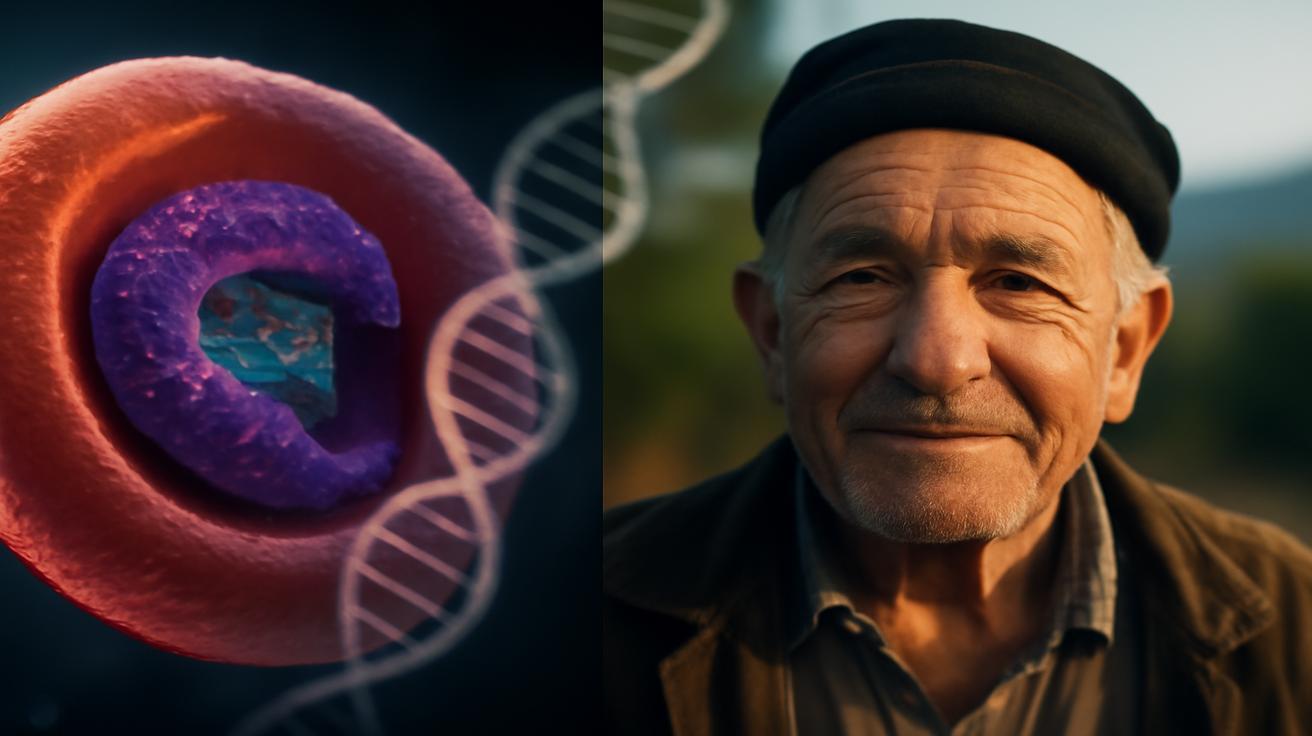
The old woman on the hill says her blood remembers the mosquitoes.
She sits beneath a gnarled olive tree, the silver leaves whispering over her head as the late Sardinian sun spills gold across the stone terraces. The air is thick with the smell of wild thyme and sea salt, and somewhere below, invisible in the shadows of the reeds, mosquitoes are beginning their nightly rise. She doesn’t flinch. “They bite,” she says, shrugging, “but they don’t win like they used to.”
This is not just folklore. For centuries, the people of Sardinia lived with malaria as intimately as they lived with the sea and wind. It was an uninvited relative, one that haunted the marshes and crept into homes on summer nights. It shaped where villages were built, how fields were planted, even who survived long enough to tell their stories.
Now, scientists believe one of those stories is written in Sardinian blood—a rare gene variant that might help the world reimagine its battle with malaria altogether.
The Island That Remembered Malaria
To understand why this tiny piece of DNA matters, you have to understand Sardinia itself. Fly over the island on a clear day and it looks almost mythic: rugged mountains slit by valleys, turquoise bays edged with cliffs, ponds shimmering like mirrors near the coasts. But for much of its history, those ponds were deadly.
Until the mid-20th century, Sardinia was one of Europe’s malaria strongholds. Summers meant fever season. The disease—caused by Plasmodium parasites and spread by mosquitoes—didn’t care that this was Italy, not a tropical rainforest. It seeped into the island’s lowlands, especially into the brackish coastal plains where mosquitoes multiplied in clouds.
Old medical reports describe villages where nearly everyone had an enlarged spleen, where children grew up frail and stunted, and where “the ague” was as common a word as “bread.” People learned to read the sky and wind for mosquito weather. They learned which nights to close their shutters and when to sleep away from the water. But none of it was enough. Malaria was a rhythm of life: fever, shiver, sweat, survive—or not.
After World War II, an ambitious and controversial campaign drenched Sardinia in DDT, drained marshes, and reshaped landscapes to break the cycle. By the 1950s, malaria was declared eradicated on the island. Life went on. But the island’s genes, molded by generations of survival pressure, kept a quiet record of what had happened.
The Quiet Signature of Evolution
When scientists dig into Sardinia’s genetic past, they’re not just hunting for curiosities; they’re reading the footprints of evolution. Malaria has left some of its clearest tracks in the human genome. In many parts of the world where the disease has raged—Africa, Asia, the Mediterranean—certain genetic quirks show up more often than chance would allow.
Some of these are well known. The sickle cell trait, for instance, which slightly warps red blood cells, can offer protection against malaria but also causes serious illness in people who inherit two copies. The thalassemias, another family of blood disorders, are also part of this uneasy truce: genes that both help and harm.
Sardinia has long been famous among geneticists for some of these conditions, especially a high rate of beta-thalassemia. It’s a stark reminder of how survival sometimes demands trade-offs—accepting one risk to lessen another. But in recent years, researchers working with large Sardinian genetic cohorts, including the isolated mountain village populations, began noticing something else. Something rarer. Something that didn’t fit the usual script of “protection with a heavy cost.”
Buried among the familiar variants was a gene difference that seemed to say: there might be another way.
A Gene That Changes the Game
Picture a lab far from the warm Sardinian night, all humming refrigerators and white light. Here, blood samples from the island are quietly transforming our understanding of malaria. Within those vials, one particular genetic variant—rare even in Sardinia, vanishingly rare elsewhere—has become the subject of intense study.
In simple terms, this gene affects how the body responds when the malaria parasite slips into red blood cells. Normally, those cells turn into a kind of shelter, a warm, living cave where the parasite can feed and multiply. Once it has filled the cave, it bursts out and moves on, leaving fever and destruction in its wake.
The Sardinian variant appears to change the rules of that relationship. Early research suggests that people carrying it may be less likely to develop severe malaria, even when infected. Their blood, in a way, is less hospitable to the parasite. It’s like inviting an unwelcome guest into a house where the doors shift, the lights flicker wrong, and the food tastes slightly off—just enough that the guest never fully settles in.
What’s remarkable is that, unlike other classic malaria-protective genes, this one doesn’t seem to cause widespread, obvious harm in everyday life. It may come with subtler trade-offs that scientists are still trying to map, but so far, it looks more like a clever adjustment than a brutal compromise.
What Makes This Variant So Different?
The beauty of this Sardinian gene lies not only in what it does, but in how it does it. Most well-known malaria-related genes act by reshaping red blood cells, changing their structure, lifespan, or hemoglobin. This can confuse or hinder the parasite, but it also affects the body in lasting, often painful ways.
The Sardinian variant appears to work at a different level, closer to the immune system’s language—a shift in signaling, timing, or cellular housekeeping that tilts the balance against the parasite. Instead of turning red blood cells into armor with cracks, it seems to subtly alter the battlefield itself.
That difference matters. If we can understand the trick well enough, we might be able to imitate it in ways that don’t require rewriting human blood from the ground up.
Scientists often talk about “natural experiments”: moments when evolution runs a trial version of something over many generations. Sardinia has unknowingly hosted such an experiment in slow motion. The result is a living hint that humans can resist malaria not only through drastic genetic gambits, but through more elegant recalibrations. Now the question becomes: can we borrow that elegance for the rest of the world?
From Island Gene to Global Strategy
Malaria still kills hundreds of thousands of people every year, most of them young children in sub-Saharan Africa. Behind each number is a grief that feels as raw as it did centuries ago in Sardinian farmhouses. Bed nets, insecticides, and medicines have saved millions of lives, but the parasite and its mosquito partners are adapting. In some regions, the drugs don’t work as well anymore; in others, mosquitos are resisting the chemicals once used to silence their flight.
So the idea of a protective gene that doesn’t bring overwhelming collateral damage is not just academically interesting. It feels urgent.
Imagine three possible futures unfolding from this discovery:
- Future vaccines inspired by the Sardinian variant’s mechanisms, teaching the immune system to recreate its protective pattern.
- Targeted therapies that nudge certain immune pathways or red blood cell behaviors into a Sardinian-like state during infection, buying time for the body to fight back.
- Gene-guided screening in regions where malaria is endemic, helping identify people at highest risk of severe disease or tailoring treatment approaches more precisely.
These are not fantasies. This is exactly how modern medicine advances: by noticing that, in a particular place, in a particular group, something is unfolding differently—and then asking what the rest of the world can learn from it.
To make this concrete, it helps to see how one island’s legacy might fit into the wider toolbox already in motion.
| Approach | What It Does | Potential Role of Sardinian Gene Insight |
|---|---|---|
| Vaccines | Prime the immune system to recognize and attack malaria parasites. | Reveal immune pathways that naturally blunt severe disease, guiding next-generation vaccine design. |
| Drugs & Therapies | Kill parasites in the blood or liver, or support the body during infection. | Suggest new drug targets that mimic the protective effect without changing DNA. |
| Genetic Studies | Identify who is at higher or lower risk of severe malaria. | Offer markers to predict severity and tailor interventions in high-risk regions. |
| Vector Control | Reduce mosquito populations or block their ability to carry malaria. | Complement genetic resistance with environmental strategies for layered protection. |
Each cell in that table represents work already underway. The Sardinian gene doesn’t replace any of it; instead, it may sharpen the tools we have and inspire new ones we haven’t yet imagined.
Ethics on the Edge of a Breakthrough
Whenever a story turns toward genes and global solutions, the air thickens with difficult questions. Whose genes are we studying? Who gives permission? Who benefits?
On Sardinia, the answers are tangled in history. This is an island that has known conquest and neglect, isolation and sudden attention. When researchers arrive, test kits in hand, they step into communities where trust is something grown slowly, like vines trained up an old stone wall.
Many Sardinians participate willingly in genetic research, proud that their island might hold clues for wider human health. But there’s an undercurrent of caution. People want to know: Are we being studied, or are we being listened to? Are we partners in this work, or are we just data points on a chart?
On the other side of the world, in regions where malaria still tears through families every rainy season, these questions deepen. How do you build collaborations where communities affected by malaria—not just those whose genes hold secrets about it—help shape the research agenda? How do you ensure that future vaccines or treatments, no matter how sophisticated, don’t become luxuries only some can afford?
A rare gene found in Sardinia might help transform the global fight against malaria, but it will only be a just transformation if the path from island to world is paved with consent, transparency, and shared benefit. Otherwise, we risk repeating old patterns: extracting knowledge from some places to profit others.
Science in the Language of Landscapes
Leave the labs and return to that hill, where the old woman sits under the olive tree. The mosquitoes are really out now, rising in faint spirals from the grass. If you stand quietly, you can feel the tiny electric buzz of their wings near your skin. For most visitors, they are a nuisance. For her generation, they were once an omen.
“We slept with wet cloths on our heads,” she recalls. “The fever was like being underwater. Hot water.” She remembers neighbors who never rose from their beds again. She remembers the rumors when the DDT trucks came: that the poison would kill them all, that it would save them all.
To talk about the Sardinian gene in isolation—as if it were just a marvel of molecular biology—is to strip it of the landscape that shaped it. That gene exists because of the marshes once buzzing with mosquitoes, because of the farmers who stayed when others left, because of the families who buried their children and kept going anyway. It exists because of centuries of quiet endurance.
Yet there’s a strange, fragile hope in that. Evolution does not have a conscience; it only has time. But humans do have a conscience, and we are running out of time in the face of diseases like malaria. So we reach back into the long, wordless story written in places like Sardinia and ask what it can teach us, quickly, before the climate shifts further and mosquitoes redraw their maps across the globe.
Standing on that hill, listening to the crickets start up their nighttime song, it’s possible to imagine a child in another part of the world—a village in Ghana, a riverside town in Cambodia—growing up in a future where malaria is a memory instead of a threat, the way it has become in Sardinia. A future built, in part, on the strange resilience encoded in one island’s blood.
The Road From Discovery to Change
Of course, between here and there lies a long road of experiments, clinical trials, and policy decisions. Science is slower than stories, bound by careful repetitions and cautious interpretations. Not every promising genetic variant turns into a medicine. Not every insight from one population translates cleanly into another.
But something has shifted. For decades, much of malaria research focused on the parasite, the mosquito, the drugs. Increasingly, the story is widening to include us—our genes, our immune systems, our biological memory of having lived beside this disease for so long.
The Sardinian gene is a chapter in that broader story, reminding us that the human body is not just a passive victim in the face of infection. It learns, adapts, improvises defenses over generations. By paying attention to those improvisations—especially the rare, elegant ones—we might discover strategies more subtle and sustainable than the blunt tools we’ve relied on.
Think of it this way: somewhere inside a Sardinian villager, a microscopic variation in code is performing a quiet act of defiance against a parasite. Somewhere in a research center, a scientist leans closer to a screen, watching data points line up in a way that suggests that defiance can be understood, perhaps replicated. Somewhere on a humid night near the equator, a mother sits awake beside a feverish child, hoping the medicine will work.
Those three scenes are connected, whether or not the people in them ever know each other exists.
A Future Written in Many Bloodlines
In the end, the story of this rare Sardinian gene is not really about Sardinia alone. It’s about how local histories become global resources—and how global problems demand that we honor the local places where clues are found.
Other regions affected by malaria have their own genetic legacies, their own quiet experiments in survival written into DNA. The African continent, in particular, holds countless such stories, many still undiscovered. The Sardinian variant doesn’t overshadow them; it joins them, adding one more lens through which to understand resistance and vulnerability.
If a solution is coming—and many scientists believe it will—then it will likely be a mosaic, not a single, shining key. A vaccine shaped by West African data. A drug target revealed by Southeast Asian patients. A protective mechanism first glimpsed in a Sardinian hillside village. Layer upon layer, piece upon piece, humanity assembling a defense worthy of the adversary it faces.
Back under the olive tree, the woman pushes herself slowly to her feet, brushing dust from her skirt. “They say our blood is special,” she says, half-wry, half-proud. “For us, it was just life. You live, or you don’t. Maybe now they can do something with it.”
Maybe they can. Maybe that is how this chapter ends: with an island that once knew malaria more intimately than it ever wanted to, offering the world not just a warning from the past, but a gift for the future.
Frequently Asked Questions
What is the rare Sardinian gene researchers are talking about?
It’s a genetic variant found at higher frequency in some Sardinian populations that appears to reduce the risk or severity of malaria infection. It is not a single “magic” gene, but one of several variants under study that seem to alter how the body and the malaria parasite interact.
Does this gene completely protect people from malaria?
No. Current evidence suggests it may lower the chances of severe disease rather than provide absolute immunity. People carrying the variant can likely still be infected, but their bodies may handle the infection differently, with fewer life-threatening complications.
Can this Sardinian gene be given to other people through genetic engineering?
In theory, genetic tools could someday mimic some of its effects, but directly inserting it into people’s DNA raises major ethical and technical challenges. A more realistic path is to understand how the variant works and then design drugs or vaccines that reproduce its protective mechanisms without altering human genomes.
How is this discovery different from sickle cell or thalassemia?
Sickle cell disease and many thalassemias offer some malaria protection but come with serious health costs, especially when inherited in certain combinations. The Sardinian variant being studied appears, so far, to offer benefits with fewer obvious downsides, making it a particularly attractive model for new therapies.
Will this research help people in malaria-endemic countries soon?
It won’t lead to overnight change, but it adds a crucial piece to the puzzle. Insights from the Sardinian variant can inform next-generation vaccines, treatments, and risk-prediction tools. As these are developed, their success will depend on equitable access and close collaboration with communities in malaria-endemic regions.
Why is Sardinia such an important place for genetic research?
Sardinia’s history of relative geographic isolation, combined with its long battle with malaria, has created a population where certain genetic variants are easier to detect and study. Large, well-organized research projects on the island have further amplified its role as a natural laboratory for understanding how genes, disease, and environment interact.
Does the end of malaria in Sardinia mean the problem is solved globally?
No. Malaria was eliminated in Sardinia through intensive vector control, environmental changes, and public health campaigns, not genetics alone. Globally, the disease persists where healthcare infrastructure, funding, climate, and social conditions allow it to thrive. Sardinia offers lessons and clues, but ending malaria worldwide will require a broad mix of science, policy, and justice-driven action.






Leave a Comment