
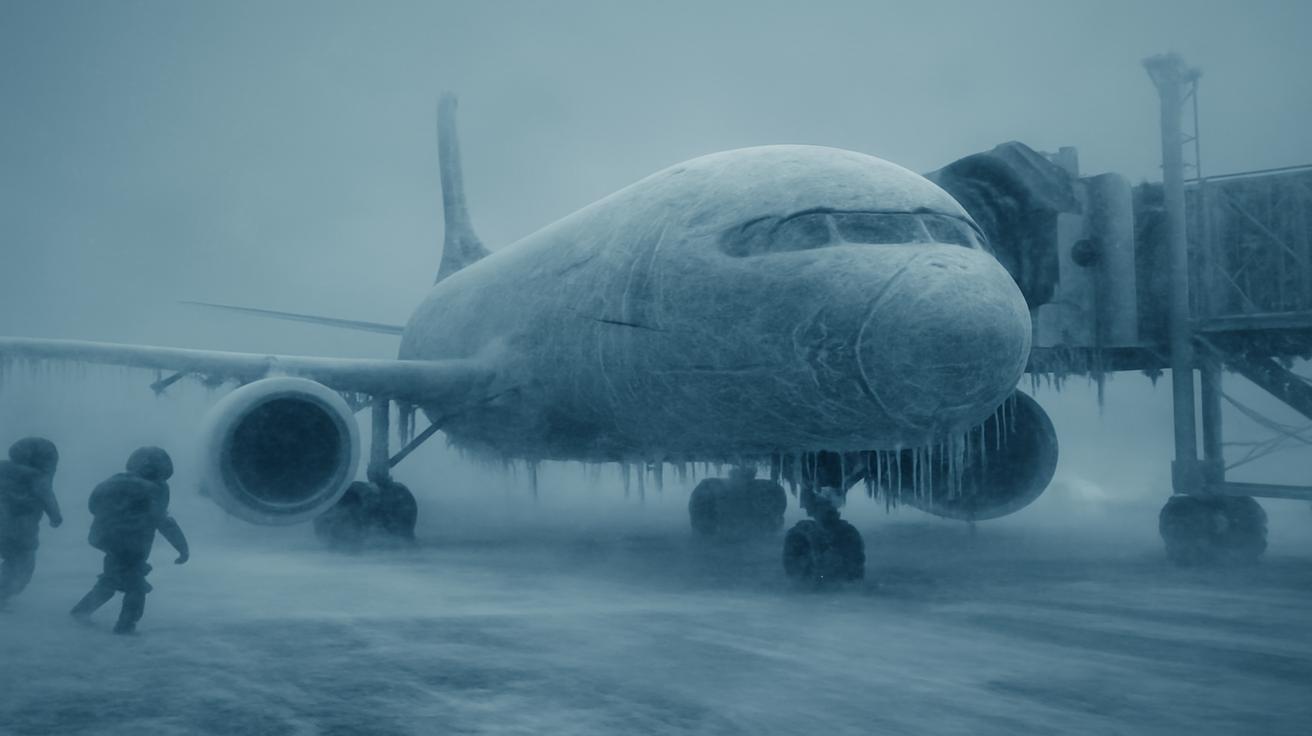
The warning doesn’t come with sirens or flashing lights. It arrives as a quiet line on a meteorologist’s chart, a pulse in the upper atmosphere bending into strange shapes high above the Arctic. On an ordinary weekday, in a hum of emails and errands, a handful of scientists look up from their screens and exhale—slowly. Because the polar vortex, that cold, whirling guardian of the north, is beginning to fracture. And when it breaks, it doesn’t stay politely in place.
When the Sky Starts to Tilt
To understand what’s barreling toward us, you have to imagine the atmosphere as layered music. Down here at the surface, we feel the everyday rhythms of wind, clouds, and rain. But far above, in the stratosphere, there’s a deeper, slower song—a wintertime cyclone of bitter cold swirling over the Arctic, tens of kilometers thick, called the polar vortex.
Most winters, the vortex spins like a well-tuned record, tight and centered. Its cold stays largely caged over the pole, the way we like it. Planes crisscross continents, morning commutes roll on, and the jet stream snakes lazily along, keeping the truly brutal air far away from the middle latitudes.
But not this time. High in the stratosphere, something is going wrong with the music.
Wave patterns—huge undulations in the atmosphere generated by mountains, land–sea contrasts, and even persistent storm systems—have been punching up from below. They slam into the vortex like invisible pressure waves, slowing its spin, warming its core. Over days and weeks, they begin to contort it, squeezing and stretching that once-round ring of cold. On satellite maps it looks less like a circle now, more like a distorted heart, then an hourglass, then a shape you can’t quite name.
Forecasters watch this with a familiar mix of awe and dread. Charts that usually move with the stately calm of the seasons start to buckle. Lines of equal temperature bend sharply south. Anomalies, those colorful streaks on weather maps that represent “this is not normal,” bleed across entire continents.
And somewhere, in an office full of blinking monitors, someone says it out loud: “This could paralyze travel.”
The Anatomy of a Disruption
What’s coming is not just “a cold spell.” It’s more like the atmosphere dropping a gear and dragging entire weather patterns out of their lanes. Meteorologists call it a “sudden stratospheric warming” event—a technical phrase that hides how visceral it feels when it arrives at ground level.
First, the vortex disruption happens up high. Air 30 kilometers above us suddenly warms by tens of degrees—still cold, but dramatically less so. That warmth, paradoxically, is a sign of trouble below. As the vortex weakens or splits into two separate swirls, its grip on the cold Arctic air loosens. Like water seeping from a cracked bowl, that frigid mass starts to spill southward.
The jet stream, our fast-moving river of air that usually runs west to east, begins to wobble. Picture it not as a straight ribbon but as a giant, meandering loop. Where it buckles south, it drags Arctic air over cities that just days before felt like early fall. Where it arches north, it allows unseasonable warmth to surge toward the pole.
On the ground, people don’t see the jet stream; they see its mood swings. In one region, a gray drizzle turns overnight to heavy, wind-driven snow. In another, clear skies and biting cold harden roads into glass. Elsewhere, successive storms ride the contorted jet, hammering the same corridor again and again with snow, ice, and bitter wind.
Forecast models—complex, data-greedy machines—begin painting a stark picture: prolonged cold snaps, high snow ratios, persistent storm tracks. Words like “significant,” “high-impact,” and “widespread disruption” start showing up not as sensational headlines, but in the dry language of official guidance statements. The tone shifts from maybe to likely.
The Moment the Forecast Changes Your Plans
Imagine you’re standing in an airport terminal a week from now, coffee going lukewarm in your hand. Overhead, the departure board is starting to shudder—one delayed flight here, another there, like the first raindrops before a downpour. The reasons are maddeningly bland: “weather,” “air traffic control,” “operational constraints.” But the real reason is unfolding miles above you, in a wind field you can’t see.
In the weather offices, the magnitude of the disruption has forced forecasters into uncomfortable territory: broad-brush warnings. Not just “slick roads in the morning,” but “expect significant travel delays,” “consider adjusting plans,” “prepare for multi-day impacts.” These are phrases they don’t use lightly. Every word is weighed against the risk of overhyping versus the danger of under-preparing a population that has grown used to ducking only the biggest, boldest alerts.
Still, the signals are lining up. Model after model, run after run, points to the same outcome: a slow-motion tangle of snow, ice, and cold parked over major transportation corridors. Highways. Rail lines. Airport hubs. The hidden circulatory system of modern life, about to develop clots.
The Human Pulse Inside the Weather
In a dispatch center on the edge of a snow-prone city, the maps are different but the feeling is the same. Here, screens glow with road networks, color-coded for speed and congestion. A digital snowplow icon crawls across an arterial road like a tiny ship in a stormy sea. The dispatcher glances at a weather briefing: heavy snow bands expected to set up over the beltway during the evening rush, visibility briefly dropping to whiteout levels, followed by a plunge in temperatures.
“If we don’t get brine down before the first band, we lose the surface,” someone mutters. “And if we lose the surface, we lose the city.”
A disruption of the polar vortex isn’t experienced as a single, cinematic blizzard. It’s a sequence: one storm that snarls a region, a day of sub-freezing sunshine that turns slush into ice, another system that lays a fresh layer of powder over the existing glaze, a week of cold that prevents any meaningful thawing. The paralysis seeps in as trucks fall behind on deliveries, as runways need repeated de-icing, as commuter rail switches freeze solid, as bus lines shorten routes or cancel entirely.
The warning from forecasters—widespread travel paralysis—isn’t just about dramatic images of cars stranded on interstates. It’s about the slow tightening of everyday motion: the parent wondering if school will open, the gig worker deciding whether a ride is worth the risk, the nurse building an overnight bag just in case, the grocery store manager mentally calculating how long fresh produce will last if the trucks are late.
And yet, there’s a strange stillness that settles in when the first flakes fall. If you’ve ever stood outside in the opening hush of a major storm, you’ll know it. The usual sounds—leaf blowers, distant traffic, construction clatter—seem to lower their volume as the sky begins to blur. Snow, if that’s what this event delivers where you live, doesn’t just cover; it quiets. Underneath the warnings and the logistics, there’s a raw, undeniable beauty to a world remade in white.
The Landscape Rewritten Overnight
At street level, the transformation is so complete that it can feel disorienting. The parking lot lines disappear. Familiar sidewalks swell into soft, indistinct ridges. Streetlights halo themselves in swirling, wind-blown crystals, each beam a glowing column in the thickening air.
Across the region, sensors quietly record what the eye can’t fully capture: snow rates of two inches an hour in a narrow band here, wind gusts topping 40 miles per hour there, road surface temperatures dropping faster than expected as the Arctic air digs in. Radar imagery reveals “snow plumes” streaming off lakes, “deformation zones” where air masses collide and squeeze out moisture, “wraparound bands” circling the back of a sprawling low-pressure system.
On a map, it looks like strategy: arrows, spirals, streaks of color. On the ground, it feels like improvisation: a driver calmly feathering the brake pedal as a light turns yellow; a cyclist deciding to walk it instead; a plow operator leaning forward, eyes straining through the bouncing glare and blowing snow, hunting for the barely visible edge of the road.
Then the cold arrives in full—real cold, the kind that does not retreat when the snow ends. Breath crystallizes at the edge of scarves. Salt, flung generously on sidewalks, seems to lose some of its power. Black ice blossoms in the shadows of bridges and overpasses. What had been a winter inconvenience hardens into something more serious: the kind of environment where small errors carry bigger consequences.
Why This One Feels Different
Polar vortex disruptions are not new. Historical records are speckled with winters where a sudden split or displacement aloft sent shockwaves down into our weather: the brutal late-January cold waves that froze pipes across cities, the sprawling blizzards that shut down corridors from the Plains to the Northeast, the ice storms that clung to the Mississippi Valley like a glassy spine.
What makes this looming event feel different is its magnitude—and its timing. The signals hint at a strongly disturbed vortex, with profound impacts on the alignment of the jet stream. Instead of a glancing blow, we’re staring down the possibility of a full-season pattern change: weeks on end of colder, stormier weather repeatedly targeting high-traffic belts.
Global air travel, already intricate under the best conditions, is especially vulnerable when the atmosphere starts drawing wild lines. Large hubs often sit beneath favored storm tracks: think of snow-prone northern airports, or major east coast gateways perched at the clash line between cold interior air and milder ocean influence. As the jet stream loops and dives, storm formation zones can “lock in,” sending one system after another along similar paths.
At the same time, our sense of normal winter has shifted. In many regions, recent seasons have swung between extremes—bare ground and sudden walls of snow, record warmth and dangerous cold, all in quick succession. The psychological cushion of “we get a couple of big storms every year” is thinner when those storms now land on cities with limited slack in their systems, where supply chains are tighter, schedules are leaner, and resilience has been tested by everything from pandemics to power grid scares.
Meteorologists are careful to note what they can and cannot promise. They can speak with confidence about pattern changes, increased probabilities, the heightened risk of heavy snow and freezing rain across broad swaths of land. They can’t, weeks in advance, tell you whether your specific flight on a Thursday morning will leave on time. But they can say this: the deck is being reshuffled in a way that heavily favors disruption.
Reading the Warnings Between the Lines
Official forecasts tend to be measured, even when the situation is anything but. A phrase like “hazardous travel conditions likely” is the institutional equivalent of someone grabbing your sleeve and looking you in the eye. When discussions move toward “widespread” or “prolonged” impacts, that’s the atmospheric version of a raised voice.
To translate this looming polar vortex disruption into human terms, imagine a series of overlapping difficulties rather than a single catastrophic moment:
- A run of weekends where long-distance drives become dice rolls, as storm windows narrow and intensify.
- Morning commutes repeatedly intersecting with fresh snow, lingering ice, or dense freezing fog.
- Regional flight networks operating on thinner margins, where a delay in one hub propagates outward like falling dominoes.
- Rail lines slowed by accumulated snow, frozen points, and speed restrictions for safety.
It’s not just the first storm that matters. It’s the cumulative effect—how many days in a row de-icing trucks must work at capacity, how many salt deliveries arrive late because the same weather paralyzing one place is also clogging the roads from the mines that supply another.
Preparing to Move More Slowly
There is something almost subversive in choosing slowness in a culture obsessed with speed. Yet that may be the most practical response to an atmosphere bent on forcing us to ease off the accelerator.
As the forecasts sharpen from sketches into details, there’s time—brief, precious time—to adjust. Travelers move flights a day earlier. Conferences flip to hybrid formats. Freight companies reshuffle routes and schedules. Schools rehearse their remote-learning protocols, just in case. Households quietly replenish essentials: a few extra pantry staples, backup batteries, ice melt for the steps.
Preparation, in this context, is not panic; it’s respect. Respect for the fact that for all our predictive power and infrastructure, we are still at the mercy of patterns set in motion thousands of miles away and miles above our heads.
And there is room, even in the serious tone of warnings, for a different kind of anticipation. For the child who has never seen snow higher than their boots, these forecasts read differently: not as threat, but as promise. For the photographer who has been waiting all year to capture rime ice coating every twig, or the cross-country skier waxing their old, familiar skis, a strong Arctic outbreak is not an inconvenience but an invitation.
Even the daily commuter, grumbling over yet another detour or delay, may find unexpected moments in the enforced slowdown: an unusually quiet walk beneath heavy-laden branches; the sight of steam rising in ghostly wisps from a river suddenly colder than the air above it; a city skyline transformed into a muted watercolor under low, snow-filled clouds.
A Snapshot of What’s at Stake
Forecasters often use scenario tables to think through impacts. Here’s a simplified snapshot of how this polar vortex disruption could ripple through travel if the more intense projections verify:
| Timeframe | Weather Pattern | Travel Impact |
|---|---|---|
| Days 1–3 | Initial Arctic air surge, first snow/ice event | Localized road issues, increasing flight delays, first school and transit disruptions |
| Days 4–7 | Jet stream locking into a colder, stormier pattern | Multiple regions seeing hazardous travel windows, accumulating backlogs at major hubs |
| Week 2 | Reinforcing cold shots, additional waves of snow/ice | Widespread delays, intermittent “travel paralysis” in hardest-hit corridors, freight slowdowns |
| Beyond | Pattern slowly relaxes or reloads, depending on vortex evolution | Gradual improvement or renewed disruptions; lingering logistical and infrastructure strain |
This is not a guarantee, but a sketch of possibilities—the kind of internal thinking that translates, eventually, into those simple, weighty phrases that show up in public forecasts.
Listening to the Wind Above the Weather
In the end, what makes this story compelling is not only the drama of closed highways and grounded planes; it’s the strange, almost mythic chain of cause and effect. Somewhere above the Arctic, the stratosphere is warming. A spinning crown of wind, invisible yet immense, is shuddering and twisting out of symmetry. Weeks later, a driver in a distant city taps the brakes on a glittering patch of black ice that shouldn’t have been there—except that, in a way, it was written in the sky long before they woke up.
We are used to thinking of weather as something that happens “here”: clouds forming over our hills, rain sweeping across our neighborhoods, the localized rumble of thunder overhead. A polar vortex disruption reminds us, forcefully, that our local is always part of a global, that patterns written at the edge of space can shape whether your train arrives at 8:07 or not at all.
As this particular disruption unfolds, forecasts will sharpen, and words like “paralysis” may start to feel less like hyperbole and more like description. Still, within that tension—between mobility and stillness, between control and surrender—there is room for a deeper kind of attention. To the science that saw this coming weeks in advance. To the people who will work through the night to keep roads passable and runways usable. And to the quiet, snow-dampened streets where, for a brief time, our restless world pauses under the heavy, altered sky.
Frequently Asked Questions
What exactly is the polar vortex?
The polar vortex is a large, persistent circulation of very cold air high in the stratosphere over the Arctic and Antarctic. In winter, the Arctic polar vortex is typically strong and helps confine the coldest air near the pole. When it weakens or becomes disrupted, lobes of that cold air can spill southward into mid-latitudes, leading to severe cold and stormy weather.
What is a sudden stratospheric warming event?
A sudden stratospheric warming (SSW) is a rapid temperature increase—often 30–50°C—in the stratosphere above the polar regions, occurring over just a few days. This warming disrupts the polar vortex, slowing or even reversing its circulation. The impacts can propagate downward, altering the jet stream and surface weather patterns for several weeks.
Does a polar vortex disruption always mean extreme cold where I live?
No. A disrupted polar vortex reshapes large-scale patterns, but the exact impacts vary by region. Some areas may experience prolonged cold and snow, others might see milder, stormy weather, and some places may notice little change. Local effects depend on where the jet stream’s dips and ridges set up relative to your location.
Why are forecasters warning about “widespread travel paralysis” now?
Forecast models are indicating a strong disruption of the polar vortex, which increases the likelihood of a colder, stormier pattern over major travel corridors. When multiple storms and sustained cold overlap with high-traffic regions, transportation networks can become overwhelmed, leading to significant, multi-day delays and cancellations across road, air, and rail.
How far in advance can meteorologists predict these disruptions?
Meteorologists often see the signs of a developing polar vortex disruption 1–3 weeks in advance by monitoring the stratosphere and using specialized models. Precise local impacts, like exact snowfall amounts or specific travel days affected, can only be forecast within a shorter window—usually 3–7 days ahead.
Is climate change making polar vortex events more common?
Research is ongoing. Some studies suggest that Arctic warming and loss of sea ice may increase the likelihood of polar vortex disruptions and associated cold outbreaks in certain regions, while others find weaker connections. What is clear is that a warming climate can still produce intense cold spells, even as average temperatures rise.
What can individuals do to prepare for this kind of event?
Stay informed through reliable weather updates, build flexibility into travel plans during high-risk windows, and ensure you have basic supplies at home and in your vehicle—warm clothing, blankets, food, water, medications, and a charged phone. If you must travel, allow extra time, check conditions frequently, and be willing to postpone or reroute when warnings escalate.







Leave a Comment