
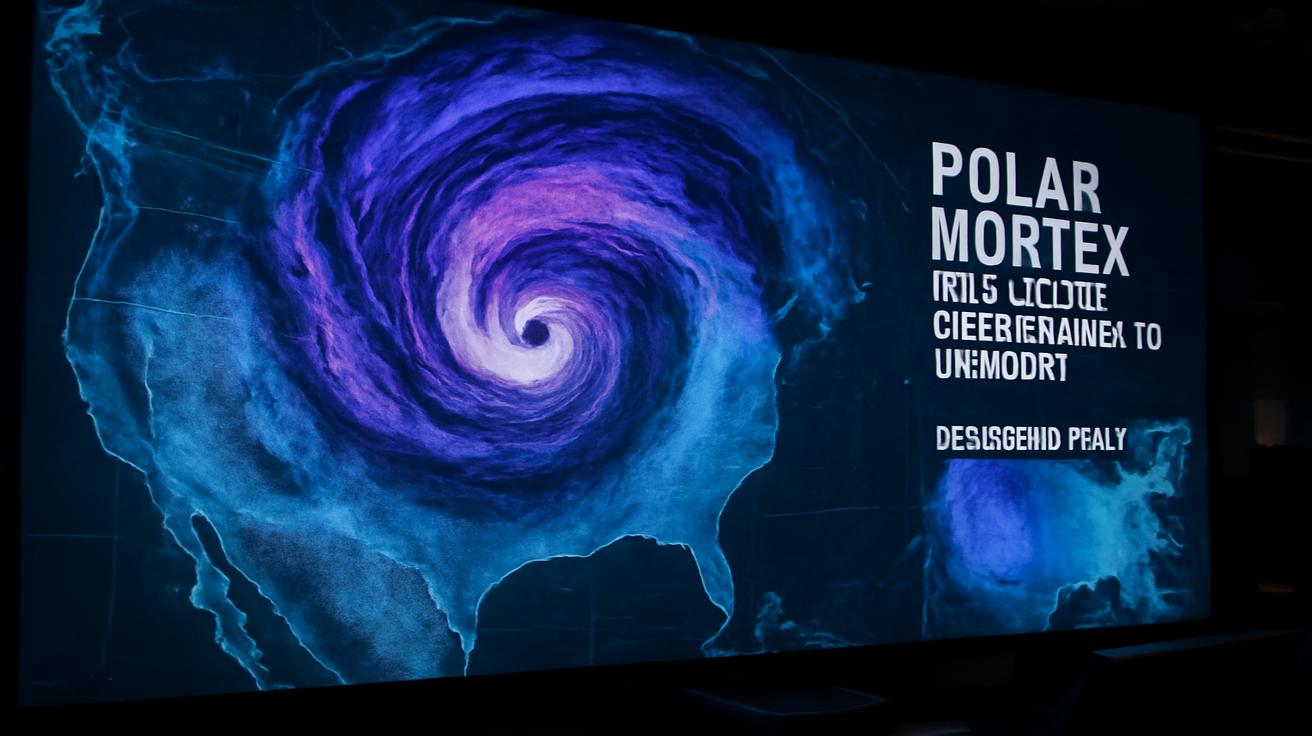
The sky had that particular kind of stillness that makes you suspicious. Not calm, exactly—more like a held breath. The trees were standing a little too still, the air a little too flat, as if the atmosphere were bracing itself. Somewhere far above that quiet February afternoon, the polar vortex was starting to twist, warp, and lean—reaching long, invisible fingers toward latitudes it usually ignores. Forecast models were lighting up in neon colors. Meteorologists were double-checking their charts. And the rest of us, scrolling through headlines about “record-breaking Arctic air,” felt an old, primal twinge: something big is coming.
When Winter Forgets the Rules
February is supposed to be the month when winter begins to loosen its grip, at least just a little. The sun hangs noticeably longer in the sky. Snowbanks, once squared like stone walls, start to slump and soften at the edges. The worst of the season’s fury, in theory, should be behind us.
But this February, the rules are bending.
A polar vortex anomaly—stronger, stranger, and more erratic than usual—is starting to slide and buckle, sending a mass of brutally cold air spiraling southward. If the forecasts hold, temperatures that belong at the top of the world will soon be spilling into cities and towns where crocuses are already flirting with the idea of blooming. The vortex isn’t a storm you can see on the horizon, no churning clouds or distant thunder. It’s a distortion in the vast machinery of the atmosphere, a lurch in the gears that keep the seasons more or less where they belong.
On satellite maps, the story looks like art: brilliant swirls of color wrapping around the polar region, tightening, then spilling open like a wound. On the ground, it will be something else entirely—ice crusting on windshields in places where February morning commutes had started to feel almost gentle, pipes groaning, wind finding its way through every careless crack around doors and windows. Somewhere, a kid will wake up and press their face to a window, breath fogging the glass, hoping school is canceled. Somewhere else, an older person will eye the electric bill and wonder if the house can be kept just warm enough.
What the Polar Vortex Really Is (And Isn’t)
The phrase “polar vortex” has become something of a winter villain in media headlines, a kind of shorthand for any deep freeze. But the reality is far more complex—and stranger, in a way, than the hype.
High above the Arctic, in the stratosphere, a huge whirl of cold, fast-moving air spins like a ghostly top around the pole. That’s the polar vortex. It’s not a storm you can see on radar, and it isn’t new. It has always been there, part of the atmosphere’s internal circulation, helping keep the coldest air bottled up near the top of the planet during the dark months.
Most winters, the vortex is relatively stable, a tight, frigid halo circling the Arctic like a crown. Jet streams—those powerful rivers of air snaking west to east—curve around its edges. Weather systems ride those jet streams, delivering familiar winter patterns: cold fronts, mild spells, snow, rain. At this scale, the planet’s climate machinery hums like a well‑worn engine.
But every so often, that engine misfires. The vortex can weaken, distort, or split. Warm air can surge upward from lower latitudes into the stratosphere, pushing and wobbling the vortex off center, like someone nudging a spinning top. When that happens, the vortex can bulge—or outright break—and fragments of its bone-deep Arctic air can plunge southward.
That plunge is what we’re staring down now.
A February That Feels Out of Place
Climatologists who study long-term patterns tend to choose their words carefully. They know winter is a season of wildness and variance; cold snaps happen, and not every weird event is a symptom of something larger. Yet, this time, there’s a subtle shift in their tone. The numbers coming out of forecast models, the anomalies painted across maps, the timing—so late in the season—are raising eyebrows even in the world of weather professionals who are conditioned to expect the unexpected.
The phrase “almost unheard of” is being used. That’s never casual in this field.
February cold waves are not rare in themselves, of course. But the intensity of the air expected to slide south, the depth of the temperature departures from normal, and the geographic spread being hinted at are remarkable. We’re not just talking about a quick shot of cold. We’re talking about an event that, in a warming world where winters are generally trending milder, stands out like a shard of ice in a cup of lukewarm water.
In many places, this vortex-driven chill will drop temperatures 20 to 30 degrees Celsius below what’s typical for mid to late February. That’s not the kind of difference you only see on paper. You feel it in your teeth when you inhale. You feel it in your fingers through your gloves, in the way your boots squeak on brutally dry, powdery snow. You hear it in the stillness after dark, when the snowpack stiffens and the world goes glassy and acute.
The Science Curling Under the Snowdrifts
What’s happening behind the scenes, high above our heads, is a symphony of physics and chaos.
Near the top of the atmosphere, in the stratosphere, something called a sudden stratospheric warming event can throw the polar vortex off balance. Paradoxically, it begins with warmth: huge planetary waves of air surge upward from the troposphere (where our weather lives) and disrupt the tight whirl of the vortex. Temperatures in the stratosphere can spike by tens of degrees Celsius in a matter of days.
As that happens, the vortex weakens, tilts, or splits. The jet stream, instead of cleanly circling the pole, begins to wobble, developing deep troughs and tall ridges. In the troughs, Arctic air spills south. In the ridges, unusually mild air can push north, bathing the Arctic itself in temperatures that would once have been unthinkable in the heart of winter.
It is entirely possible, during a polar vortex disruption, for one part of the world to be in life-threatening cold while another, closer to the pole, is edging above freezing. Extreme cold in one place does not disprove a warming planet; instead, it often rests on top of subtle, long-term shifts in background conditions.
Meteorologists express this dynamic in numbers and models, but for most of us, the experience is simpler. We feel the edge in the wind. We notice the creak in floors that never used to creak, the way window glass frosts from the corners inward, the way our breath lingers in the air like a question.
How This Vortex Anomaly Might Touch Daily Life
It’s one thing to know that cold air is coming; it’s another to imagine how it will actually shape the hours of a day. A polar vortex anomaly is an atmospheric event, but it very quickly becomes a human one.
| Impact Area | What You May Notice | Why It Matters |
|---|---|---|
| Home & Infrastructure | Frozen pipes, furnace strain, power flickers, ice on roofs and gutters | Burst pipes and heating failures can cause costly damage and displace people |
| Health & Safety | Frostbite risk, hazardous sidewalks, black ice, worsening air quality from wood burning | Increased emergency visits, accidents, and strain on vulnerable populations |
| Ecosystems | Winter-stressed birds, frost damage to early buds, wildlife shifting patterns | Sudden deep cold can reshape local wildlife survival and plant growth |
| Energy & Grid | Spikes in electricity and gas demand, rolling outages in worst cases | Grid stress can lead to large-scale disruptions during the coldest hours |
| Daily Routines | School closures, transit delays, canceled flights, quieter streets | Work, travel, and community life slow down or pause altogether |
In the quiet suburban streets, the vortex will sound like furnaces kicking on again and again, a deeper, more frequent hum beneath the usual neighborhood soundtrack. The air, so cold it begins to sparkle, will nip at any bit of exposed skin. Long-time residents will compare it to the winters “we used to have,” though even their memories might not fully match what the thermometers will show this time.
In cities, the air will take on that exhaust-laced sharpness, buses huffing clouds of steam at every stop, people standing a little farther back from the curb to avoid the dirty snow churned into brown slush. Metal handrails and doorknobs will sting bare fingers instantly. Thin coats that passed for winter wear a few days earlier will be revealed, instantly, for what they are: not enough.
Out in the open countryside, the cold will press down like a weight. Farm animals will huddle. Barn doors will creak and slam against their hinges. The snow, if it comes, won’t fall in lazy, cinematic flakes. It will hurtle sideways, driven by winds that scrape across fields and frozen streams, leaving sculpted drifts like frozen waves on a pale sea.
Memory, Climate, and the Stories We Tell About Cold
Whenever extreme cold hits, particularly now, a certain argument appears, almost on cue: If the planet is warming, people ask, how can it possibly be this cold?
The answer lies in the difference between weather and climate, but also in the subtlety of change. Climate is the long, slow arc of temperature and precipitation over decades and centuries. Weather is the specific mood of the sky this week, or this month. Even in a warming climate, weather can still produce brutal cold snaps. In fact, some researchers argue that a disrupted, warming Arctic can actually make polar vortex disturbances more frequent or more intense in some regions, by altering the temperature contrasts and wave patterns that shape the high atmosphere.
It’s not that global warming “causes” a polar vortex event in a simple sense. Instead, it tilts the background conditions, like quietly raising the floor of an ocean so that when a wave rises, it reaches farther up the beach than it used to. Over the last few decades, the Arctic has been warming roughly four times faster than the global average. Sea ice is thinning and retreating. Snow cover patterns are shifting. All of this changes the way heat and energy move between the surface and the atmosphere.
In that context, an extreme February cold wave doesn’t cancel out the broader warming trend. It sits atop it—as a kind of jagged spike in a graph whose overall line is still creeping upward. Summers are, on average, hotter. Heat waves are longer. Winters, globally, are milder than they once were. And amid that general softening of cold, these rare, intense eruptions of Arctic air stand out with even more psychological force, a reminder that nature still has teeth.
We are, in a way, living in a time when the stories we tell about weather are catching up with how fast it’s changing. Older generations remember the Great Blizzards, the winters of ice storms and snow tunnels. Younger people remember, perhaps, more rain than snow, more slushy holidays than postcard ones. This coming vortex anomaly will etch its own chapter into that shared memory, a point on the timeline people will reference years from now: “Do you remember that February when it felt like the Arctic moved in?”
Listening to the Wind for What Comes Next
If there’s an uncomfortable truth in this story, it’s that we’re still learning how these pieces fit together. We can model the paths of cold air, anticipate where the vortex will sag or snap. We can estimate how deeply temperatures will plunge and how long they may stay below freezing. But the deeper questions—the ones about how often this kind of event will happen in the coming decades, and how it will interact with other extremes—remain open, restless, unsettling.
What happens when you layer a late-season polar vortex event on top of soils that didn’t fully freeze, or on ecosystems that had already started to wake up? How do power grids, already strained by summer heat waves and increasing demand, cope with another mode of stress: week-long, landscape-wide deep freeze? How do people, especially those with the fewest resources, navigate a climate that can swing violently, from drought to flood, from record warmth to dangerous cold?
These are more than scientific questions. They are questions of infrastructure, justice, and imagination. The approaching anomaly is a kind of teacher, arriving uninvited. It shows us where our systems are brittle. It reveals which homes are drafty, which neighborhoods lose power first, which communities have robust mutual aid and which ones are stranded. It tests the threads between neighbors—who checks on whom, who has an extra blanket or space heater to lend, who leaves a box of groceries or pet food on a doorstep.
In all that discomfort, there is also an odd kind of clarity. Extremes like this strip away illusion. They remind us that we live on a planet whose atmosphere is not a vague backdrop but a breathing, shifting presence that we are now, unmistakably, reshaping—and that is, in turn, reshaping us.
Making Space for Awe Amid the Anomaly
When the cold finally arrives—truly arrives—you might feel it first as a quiet.
Snow muffles sound. So does dense, frigid air. Traffic noise dulls. Even the usual flutter of birds goes still; many retreat to sheltered eaves or evergreen thickets, puffing their feathers up like tiny quilts. At night, the stars burn a little sharper, the air so dry and clear that constellations feel closer, their ancient stories pressing down on this very new kind of winter we’re living through.
If you step outside, layered and cautious, you’ll notice the small, electric details. The way your footsteps squeak at certain temperatures but crunch at others. The way your eyelashes might freeze if you stay out a bit too long, or how your nostrils sting when you first inhale. The sound of ice expanding in the walls, in the ground, in the branches—a faint, intermittent ticking that runs like a secret beneath the usual soundtrack of daily life.
It may feel strange, in the face of such a dangerous and disruptive event, to talk about beauty. And yet, nature rarely offers us only one thing at a time. The same pattern that sends power companies into emergency mode also paints intricate frost ferns on windowpanes. The same cold that strains the lungs of the unhoused also carves crystalline halos around the moon. To acknowledge the wonder is not to ignore the harm; it’s to understand the full texture of what’s happening, and perhaps to deepen our motivation to protect one another within it.
The polar vortex anomaly bearing down this February is, in one sense, a meteorological event with charts, equations, warnings, and timelines. But in another sense, it’s a moment in our collective story—one of many chapters in how we’re coming to terms with a climate that is no longer the steady background our grandparents knew. It’s a reminder that, for all our technology and forecasting skill, we are still small beneath the sky, still huddling around heat and light, listening to the wind and hoping the roof holds.
When the worst of the cold has passed, when the thermometer begins its slow, hesitant climb back toward seasonal norms, we’ll remember this anomaly in fragments: the eerie stillness before the front arrived; the gust that slammed the door that one afternoon; the text from a neighbor asking, “You okay over there?”; the extra blanket laid at the end of a bed; the silence of a park under a hard blue sky. And somewhere, far above, the vortex will be spinning itself back into a tighter, calmer shape, retreating to the top of the world—until the next time the atmosphere decides to forget, for a while, where winter is supposed to live.
Frequently Asked Questions
What exactly is a polar vortex anomaly?
A polar vortex anomaly is an unusual disruption or distortion of the normal polar vortex—a large, persistent circulation of very cold air high above the Arctic. Instead of staying tightly wound near the pole, the vortex weakens, wobbles, or splits, allowing frigid Arctic air to spill far south into regions that are usually much milder, especially this late in winter.
Why is this event in February considered so unusual?
February typically marks the beginning of a gradual easing of winter’s grip, with increasing daylight and more moderate temperatures in many regions. While cold snaps can and do still happen, the intensity and geographic reach of the air associated with this particular event—combined with how far below normal the temperatures may fall—make it stand out as highly unusual for this time of year.
Does an extreme cold wave disprove global warming?
No. Weather and climate operate on different scales. Climate is the long-term trend; weather is the day-to-day or week-to-week variation. Even as the planet warms overall, short-lived bursts of extreme cold can still occur. In fact, some scientific studies suggest that changes in the Arctic linked to warming may increase the likelihood or character of polar vortex disruptions in certain regions.
How can I prepare for a severe polar vortex cold spell?
Preparation focuses on warmth, safety, and awareness. Insulate and protect pipes from freezing, check that your heating system is working efficiently, and seal drafts around doors and windows. Stock up on essentials—food, water, medications, batteries—and have extra blankets and layers available. Stay tuned to local forecasts and alerts, limit time outdoors during peak cold and strong winds, and check in on neighbors, especially elderly or vulnerable people.
Will these kinds of vortex events become more common in the future?
Scientists are still actively researching this question. There is evidence that rapid Arctic warming and changes in sea ice and snow cover may influence the behavior of the polar vortex and jet stream, but the exact relationships are complex and still debated. What is clear is that climate change is increasing many types of extremes, and understanding how cold outbreaks fit into that evolving pattern is an urgent area of study.






Leave a Comment