
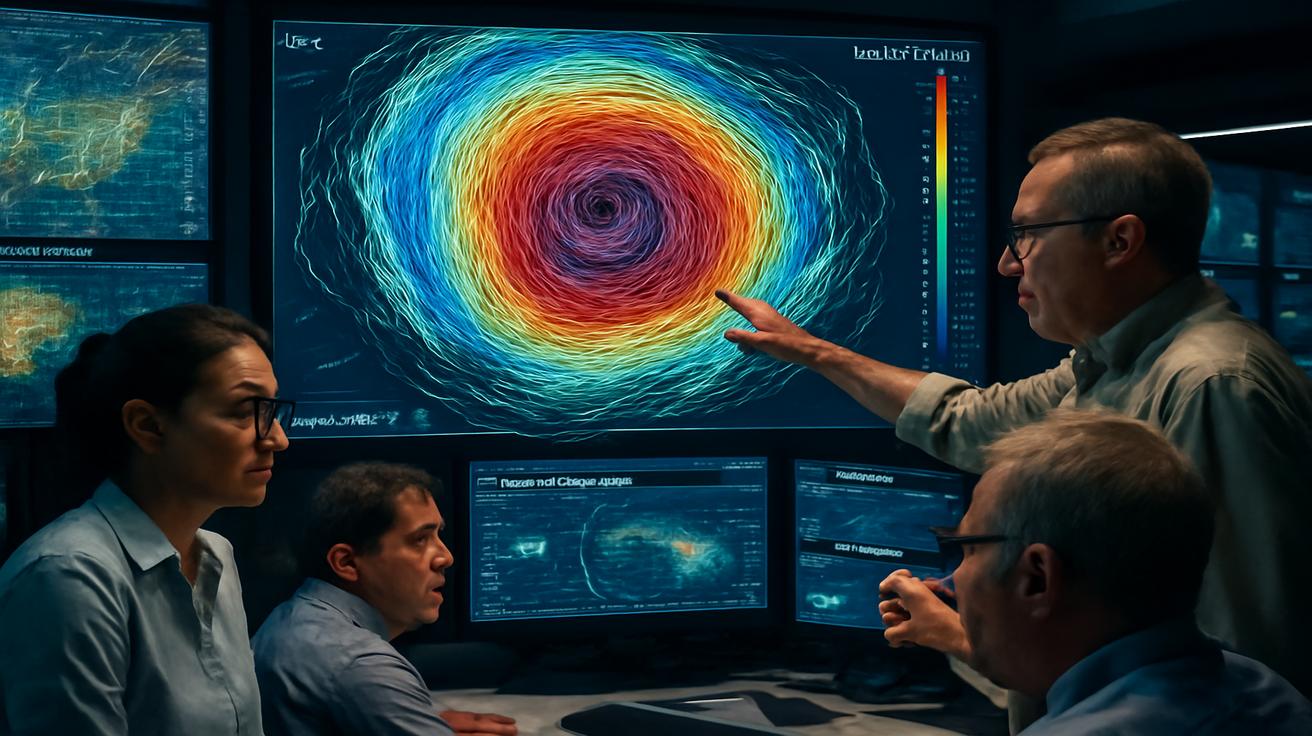
The news broke the way true winter stories often do—not with a bang, but with a low murmur that grew louder in group chats, weather apps, and strained conversations over coffee: a polar vortex anomaly is approaching. Somewhere above the swirl of office towers and bare trees, high in the atmosphere where jet streams draw invisible borders across hemispheres, something is shifting. Fast. Strangely fast. And the people whose lives revolve around reading these invisible lines are suddenly speaking in a register that sounds a lot like concern.
The Sky That Wouldn’t Behave
It starts—not surprisingly—where the air is thinnest and the cold is deepest: in the stratosphere, tens of kilometers above our heads. Picture a tangled ring of icy wind, spinning counterclockwise around the Arctic like a ghostly carousel. That is the polar vortex, a persistent wintertime feature that usually keeps the harshest cold locked near the pole, like a door bolted against the rest of the world.
But this year, that door is rattling on its hinges.
Meteorologists staring at columns of numbers and streaming satellite images noticed an oddity first in the flow, then in the speed. Wind velocities in the upper atmosphere began to dip and warp in ways that refused to fit comfortably inside long‑standing reference charts. Patterns that typically build and shift over weeks began to twist in days. Embedded in the data was a quiet alarm: the configuration of this polar vortex—its shape, its tilt, its rapid rearrangement—was out of step with decades of winter climate records.
“We have analogs, of course,” one long-time forecaster might say, leaning back from a bank of screens that reflect shifting bands of color across their glasses. “But we don’t have many analogs that look like this, at this speed.”
Outside, down at ground level, nothing seems particularly unusual yet. A brittle wind snakes around building corners. A few flurries drift sideways in the streetlights. But the atmosphere is layered, like a story told from the ending backward. What’s happening high above doesn’t arrive all at once. It comes in echoes: a wobble in the jet stream, an unexpected pressure drop, a sudden front that swings farther south than it “should.”
The Fast-Moving Puzzle Above Our Heads
Think of the polar vortex as a massive spinning top made of air, sitting atop the planet’s north pole. In a more typical winter, that top stays mostly upright and centered. Cold air stays bottled up. Storm tracks follow familiar paths. The atmosphere whispers a script that forecasters have learned to anticipate.
Now imagine that spinning top jolted sideways by invisible hands—warming events in the stratosphere, ocean temperature shifts, disrupted wave patterns rippling upward from below. It tilts, stretches, splits, and wobbles like it’s about to topple off its axis. Frigid air, once locked tightly over the Arctic, begins to leak south in expanding lobes.
This is where the anomaly lives: not just in what the vortex is doing, but in how quickly it’s doing it. Historically, major disruptions of the polar vortex build their tension like a slow wave. This time, the structure has flexed with a swiftness that has stunned even the more jaded meteorologists—those who have watched countless storms swirl into and out of the maps.
On a glowing forecast monitor, the jet stream no longer looks like a smooth band. Instead, it sags and buckles like a loose thread. One deep dip plunges toward lower latitudes, threatening to open a wide gate for Arctic air to pour into regions unaccustomed to such deep, sudden cold. The models, those endlessly humming engines of probability, keep spitting out unusual sequences. They don’t quite agree with each other—but what they share is an unsettling message: we are entering a configuration that lies at the thin edge of our historical experience.
Data That Refuses to Sit Still
Weather, by nature, is change. Still, climate scientists rely on decades of records to define the boundaries of “normal” and “rare.” That context is their compass. With this incoming vortex anomaly, the compass needle is jittering.
Wind speeds in the polar night jet—the high-altitude river of air encircling the pole—have decelerated and skewed. Temperature gradients between the Arctic and mid-latitudes, which help steer storm tracks, have narrowed in unexpected ways. And the speed at which these changes are unfolding is rattling some carefully built expectations.
One researcher likens it to watching a time-lapse of a glacier suddenly behaving like a mountain river. “You expect the glacier to move,” they explain, “but not like this. Not this fast, not in such a jagged pattern.”
Historical data sets, stretching back to the mid and late 20th century, do contain examples of polar vortex disruption: the brutal North American cold of 2014, the February freeze that bit into Texas in 2021, the notorious late-’80s outbreaks stamped into memory by frozen pipes and shuddering power lines. But within those analog years, the onset of disruption usually unfolded more gradually. This year’s configuration suggests a sharper pivot—like a door slamming instead of slowly creaking open.
To understand just how unusual this looks in context, it helps to see how these events compare across time.
| Winter Event | Key Polar Vortex Behavior | Onset Speed | Forecaster Confidence |
|---|---|---|---|
| Late 1980s Outbreaks | Vortex weakened and shifted, strong Arctic air surges southward | Gradual over weeks | Moderate – patterns fit known analogs |
| January 2014 Cold Wave | Vortex displaced from pole, deep trough over North America | Noticeable shift over ~2–3 weeks | High – strong model agreement |
| February 2021 Event | Vortex disrupted and elongated, extreme cold reaches southern U.S. | Complex evolution over a month+ | Mixed – higher uncertainty in regional impacts |
| Current Anomaly | Rapid reconfiguration, unusual tilt and stretch, challenging climatology | Accelerated – significant changes in days to a week | Cautious – system outside many historical bounds |
On paper, the anomalies show up as deviations and percentiles. On the ground, they arrive as something more tangible: ice on the inside of old windows, power lines humming under sudden weight, the raw bite of air that makes each breath feel edged in glass.
When the Atmosphere Forgets the Rules
There is a particular quiet that settles into a city or town on the eve of a major cold outbreak. The roads thin out earlier than usual. People hurry a little more between front doors and car doors. Hardware stores feel tense, their aisles threaded with last-minute shoppers in heavy coats, hands wrapped around space heaters, insulating tape, battery packs.
In anticipation of this approaching polar vortex anomaly, that hush feels different. For one thing, forecasters are more openly cautious in their language. Instead of the sharp certainty of “arctic blast incoming,” you hear phrases like “high-impact potential” and “rapidly evolving pattern” and “signals that push against our historical envelope.” They are, in essence, saying: we understand the broad strokes of what’s coming, but the details may surprise even us.
The speed of the reconfiguration matters deeply. Down here, on the surface, logistical time is everything. Municipal crews need days to prepare plows, brine roads, reinforce vulnerable infrastructure. Power grid operators must adjust load predictions. Hospitals and shelters brace for surges in patients and people seeking warmth. When the upper atmosphere redraws its map too quickly, those days shrink.
In the countryside, the approaching cold plays out in more intimate scenes. Farmers walk fence lines, attuned to the texture of the air, a sixth sense honed over generations. They stack extra feed closer to barns and check heaters in animal shelters that were last pushed to their limits in a winter nobody has forgotten yet. Water troughs are cleaned early, as if to bargain for a few extra hours before the ice thickens again and again.
Somewhere above, the stratosphere continues its strange contortions, indifferent to the quiet logistics below. But the two are connected: every wobble and eddy in that high, invisible windfield shapes who will wake to frozen roads, to snow loading branches to the point of fracture, to a grid creaking under the combined weight of heaters and fear.
Listening to the Wind Through Time
Ask a climatologist what unsettles them about this anomaly, and you may get an answer that sounds less like panic and more like a careful kind of unease. This is not the first odd winter. It will not be the last. But patterns used to drift; now they jerk.
In the global background, the Arctic is warming faster than many other parts of the planet. That warming, by shrinking the temperature contrast between pole and equator, can weaken and destabilize the jet stream. There is ongoing scientific debate about exactly how and when that translates into more frequent or more severe polar vortex disruptions—but this year’s strange choreography adds another data point to a growing, shifting archive.
Inside that archive are decades of hand-annotated maps, yellowing charts, and sprawling digital records. The polar vortex has always been a character in the story, but recently it feels more volatile, more improvisational. It stretches further south, or fractures in unfamiliar ways. It tangles with blocking highs and atmospheric rivers in combinations that strain even seasoned intuition.
In a way, this anomaly is a conversation between the atmosphere’s fast and slow motions. Weather is the quick language—fronts, squalls, storms that bloom and fade in days. Climate is the slow grammar behind it, the rules and patterns that build over years and decades. When forecasters say this system is “challenging decades of winter climate data,” what they mean is: we are hearing the weather speak in a dialect we have not fully translated yet.
The Human Scale of a High-Altitude Anomaly
For all its grand, planetary drama, a polar vortex event is ultimately felt at human scale: at your front door, on your skin, in the decisions you make as the forecast crystallizes into reality.
Imagine waking to a morning that feels oddly quiet. Sound behaves differently in deep cold; it carries sharper, farther, as if the air has been thinned to a clear, hard glass. Snow, if it has fallen, squeaks under boots in a high, dry note that soft winter days never produce. Your breath condenses instantly, swirling in front of you like a small, personal cloud system.
Light, too, changes. The low winter sun glances off crusted snow and frozen puddles with a fierce, white reflection that makes you squint. Overhead, the sky is an almost brittle blue, devoid of the soft haze of warmer seasons. The cold seeps not only through clothes but through time; minutes outdoors feel longer, stretched by the body’s insistence that this is not a place to linger.
Somewhere in your pocket buzzes a fresh alert from the weather service: wind chills dropping, infrastructure advisories, appeals to check on neighbors. The polar vortex, that abstract shape on a map, has resolved itself into the sting on your cheeks and the anxious text from a friend wondering whether the pipes in their 60-year-old building will hold.
In other regions, the anomaly manifests differently. Where the main lobe of cold doesn’t fully descend, strange warmth may surge instead, bending expectations in another direction: rain instead of snow, bare ground where drifts would normally rise, ice forming on rivers in irregular, fragile sheets. The same distorted jet stream that opens the gate for Arctic air in one place may pull in unseasonable mildness in another, trading classic winter landscapes for something more ambiguous.
Living in the Era of Edge Cases
What makes this vortex anomaly feel so emblematic of our time is not only its intensity, but its refusal to stay neatly inside the boxes drawn by past events. We live, increasingly, in the era of edge cases—heat domes that linger beyond expectation, storms that rapidly intensify near coasts, fire seasons that outrun their historical calendar.
Winter, too, is being rewritten in this language. Where once the cold seemed to operate under a set of unspoken rules—gradual onset, predictably coldest months, usual suspects for deep freezes—now the narrative has jagged edges. Records that stood for generations fall. Places that never worried about certain thresholds of cold find themselves scrambling in real time.
This is not to say we are blind. Forecasting has never been more technologically sophisticated, never better able to peer days and weeks ahead into the uncertain dark. Yet the atmosphere is not a machine to be perfectly solved; it is a living system, and like any living system, it responds to subtle shifts in ways that can surprise.
The approaching vortex anomaly is a reminder that we are sharing the planet with forces that do not always move at our convenience. It suggests that the baseline we quietly accepted as “normal winter” was, in fact, a specific chapter in a much longer, wilder book.
Preparing for a Winter That Doesn’t Read the Script
So what do you do when the experts say, in effect, “Something big is coming, and it’s not behaving quite like anything we’ve seen before”?
On a personal level, preparation shifts from a seasonal ritual to something more intentional. You dig out extra layers, not as a token nod to tradition but with a new seriousness. You think about redundancy: backup heat, backup light, backup ways to communicate if infrastructure is stressed. You move from a passive relationship with winter—something that happens around you—to a more active posture.
Communities feel this shift too. City planners talk more about resilience: how to build roads, water systems, and power networks that can flex under stresses that didn’t used to be on the design table. Emergency managers think not just in terms of “the worst storm in 30 years,” but scenario after scenario in which the past cannot be trusted to set the upper limit.
In the midst of all this, there is a quieter form of preparation that matters just as much: learning to read the sky with a different kind of attention. Understanding that a forecast is not a guarantee but a best guess in a changing game. Recognizing that phrases like “anomalous configuration” and “challenging decades of data” are not academic abstractions, but early warnings that the edges of our maps are being redrawn.
As this polar vortex anomaly approaches, forecasters continue to refine their projections hour by hour, feeding the latest observations into models that will, in turn, attempt to sketch the next week of your life: whether snow will drift against your door, whether the roads will glaze in black ice, whether the local grid will be asked to stretch beyond its design.
Above all, what emerges is a sense of shared vulnerability—and, perhaps, shared responsibility. The atmosphere is reminding us that the climate background is shifting, and with it, the behavior of the systems we once counted on to be at least somewhat predictable. Responding wisely means listening early, acting thoughtfully, and accepting that winter, like so much else, is entering a less familiar phase.
One morning, after the worst of the cold has passed, you might step outside to a world washed in that peculiar clarity that follows an extreme event. Branches glitter with lingering frost. Snowbanks are reshaped by wind. The air, while still sharp, feels softened at the edges. Somewhere in the distance, a plow makes one last slow pass.
Overhead, the polar vortex will already be sliding into its next configuration, still spinning, still restless, still conversing with the planet below in a language of wind and temperature and light. And somewhere, a forecaster will be watching, quietly recalibrating what they thought they knew about winter.
Frequently Asked Questions
What exactly is a polar vortex?
The polar vortex is a large-scale circulation of very cold, low-pressure air that forms in the stratosphere over the poles, mainly during winter. It normally acts like a containment ring, keeping the coldest Arctic air near the pole. When it weakens, stretches, or splits, lobes of that frigid air can spill southward into mid-latitudes.
Why is this particular polar vortex called an anomaly?
This event is called an anomaly because its speed and configuration differ significantly from patterns observed in decades of winter climate records. The vortex is reconfiguring more rapidly than usual, with an unusual tilt and shape, and the resulting jet stream behavior pushes beyond many historical analogs used by forecasters.
Does a polar vortex anomaly mean every place will get extreme cold?
No. While some regions may experience severe, sudden cold, others can end up milder than usual. The distorted jet stream can direct Arctic air into one area while pulling warmer air into another. Impacts are highly regional, which is why local forecasts and updates matter so much.
Is climate change causing more polar vortex disruptions?
The relationship is still an active area of research. Many studies suggest that rapid Arctic warming can weaken and destabilize the jet stream, potentially making certain kinds of polar vortex disruptions more likely. However, the atmosphere is complex, and scientists are cautious about drawing simple cause-and-effect lines for individual events.
How should people prepare for an approaching polar vortex event?
Preparation includes practical steps—insulating pipes, checking heating systems, stocking essentials, having backup light and heat sources—and staying closely tuned to updated forecasts and advisories. Communities and individuals can also plan to check on vulnerable neighbors and support local shelters, recognizing that sudden, intense cold can quickly become a public health issue.







Leave a Comment