
The Nobel laureate sits quietly by the lake, watching a dragonfly hover over the mirrored surface of the water. The shore is empty for a weekday afternoon. No lawn mowers. No leaf blowers. The park’s trash cans quietly ping when they’re full; a city drone comes by just once an hour to tidy up. Everything hums along with an invisible precision that almost feels like magic. “We’re seeing the early sketch,” he says, “of a world where most of the necessary work is done without us.” His voice is soft, but the words feel like a stone dropped into a very still pond. Ripples move outward: more free time, fewer jobs, and a future where our role in the great machine of society is no longer guaranteed.
When Work Starts Disappearing
Imagine your typical weekday morning ten years from now.
Your alarm doesn’t go off. It hasn’t for months. The calendar on your wall is still full, but the blocks of color are no longer meeting reminders. They’re hobbies, classes, visits, long walks, and open spaces you’ve started labeling only as “Think” or “Do Nothing.” The rent is still paid, groceries still arrive, your lights come on as always. But the way things get done has shifted in a quiet, decisive way.
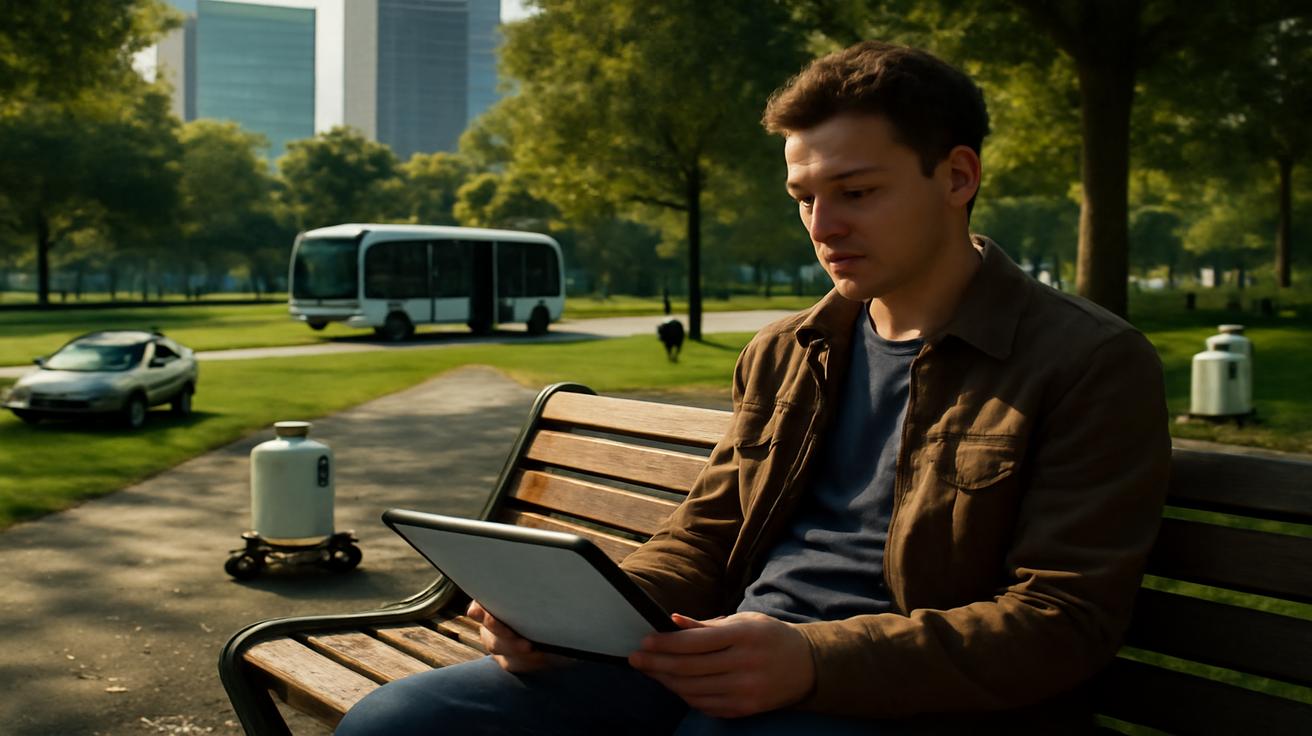
That grocery list you used to write? It’s now a negotiation between your health data and an AI that understands your tastes and allergies better than you do. The food is picked by robots; self-driving vehicles glide down the streets, like cautious beetles, stopping precisely in front of your building at the time your phone suggested. On the way, the trucks chat with each other in a silent, invisible language, avoiding traffic jams with the calm ease you always wished your city planners had.
You no longer “clock in.” You no longer tie your sense of time to a commute, a shift, or an office. And this, says a Nobel-winning physicist studying complex systems and technological evolution, is the crux of what people like Elon Musk and Bill Gates have been hinting at: the machines aren’t just coming for the boring tasks. They’re coming for the idea of “a job” as we know it.
Musk warns that artificial intelligence will make human labor economically unnecessary in vast sectors. Gates points out that when costs drop and software can do what accountants, translators, radiologists, and even coders do, companies will start to ask: why keep paying humans for this? The physicist listens to both of them, then looks further down the road, as someone used to thinking in centuries, not fiscal quarters. “From a physics and systems perspective,” he says, “this is not just automation. It’s a phase transition.”
The Physics of a Jobless, Busy World
Physicists love phase transitions—ice becoming water, water becoming steam. At certain thresholds, the rules of the game shift. Below freezing, you can walk on a lake. A few degrees above, you’ll drown trying. The Nobel laureate suggests we’re heading toward a similar boundary with technology and labor.
Human societies have always needed energy and organization. For thousands of years, most of that energy was muscle—ours or that of animals. The invention of engines and electricity replaced muscle with machines, but we still needed minds to design, coordinate, and repair those machines. Now, with advanced AI, both the muscle and the basic forms of “mind work”—pattern recognition, prediction, language processing—are shifting to non-human systems.
Think of the world as a giant river of tasks. For centuries, humans stood in the current, catching what needed to be done: weaving, digging, teaching, measuring, counting, guiding, deciding. Slowly, we’ve been handing buckets of that river to tools: looms, engines, computers, robots. Now that handoff is accelerating. The river doesn’t slow down; if anything, it grows. There are more things to do than ever before. But more and more of the catching is done by machines, not people.
The physicist explains it in simple terms: “If the system can perform all necessary economic functions with fewer and fewer humans involved, then from a purely mechanical perspective, jobs become optional. Not work. Not effort. Not creativity. Jobs.” Paid, structured labor as the central organizing principle of adult life begins to erode.
The Promise: More Free Time Than We Know What to Do With
Here is the strange, shimmering promise that both excites and terrifies futurists: a world in which you and almost everyone you know has more free time than at any point in human history.
At first, it looks like an extended vacation. Maybe your company offers a “hybrid automated” role where you just supervise software, answer occasional questions, click a few approvals. The work shrinks, the paycheck doesn’t—at least not immediately. You start cooking again. You pick up the guitar that’s been gathering dust. You plant tomatoes on the balcony. Afternoons stretch out, spacious, unfamiliar. There’s a novel half-written on your laptop and a watercolor set on your kitchen table.
On social media, you see the same pattern. Friends are taking more walks, organizing impromptu book circles, hosting movie afternoons in the middle of the week. Libraries begin to look like buzzing co-working cafes filled not with people wrestling spreadsheets, but with people learning ancient languages, designing small community gardens, tinkering with open-source software, composing music no one is paying them to write.
It’s intoxicating to imagine. No one is burdened with mind-numbing data entry. Trucks drive themselves. Warehouses are choreographed by robots. Drones deliver medicine to remote areas at nearly no cost. AI tutors sit with each child, adjusting to their pace and style of learning. Doctors rely on diagnostic systems that have read every paper ever published in their field. The amount of human suffering spared simply by removing drudgery and delay is staggering.
“If we do this right,” the physicist says, “you would have the equivalent of what only a few aristocrats had in previous centuries: time to think, to explore, to care for others, to build things that don’t have to pass a quarterly review.” He looks down at his hands. “But that’s if we do it right.”
The Threat: More People Than We Have Roles For
Here’s the shadow that follows the promise: our laws, cultures, and sense of self are still built around the idea that you earn your right to exist comfortably by having a job.
What happens when that link breaks?
Already, we’re seeing early tremors. Factories that once employed thousands now hum along with a handful of technicians. Retail stores close as algorithm-optimized warehouses and online interfaces take over. Customer service lines route calls to language models that never sleep, never take breaks, and never ask for a raise. Even creative industries—art, music, writing—have begun to feel the press of automated “good enough” content.
You can chart this shift in the quiet heartbreak of people who did everything “right.” They studied hard, went to the right universities, learned to code or to manage projects or to analyze data. Then they watch as the tasks that once separated them from the pack are handled in seconds by cloud-based systems.
The Nobel laureate’s research in complex adaptive systems leads him to a stark conclusion: “When you increase efficiency past a certain point, you don’t just make human workers more productive; you make many of them redundant. The system no longer needs as many nodes—people—to maintain its function.”
In this view, Musk and Gates are not making philosophical points. They’re reading the flow of capital and technology. Musk warns loudly about the need for universal basic income or something like it. Gates talks about taxing robots or automated services to slow the shock and fund the humans left in the wake. Both men see that as efficiency rises, traditional employment will contract, not expand.
The physicist nods, but adds another layer. “Biologically and socially, humans are not built to just be idle consumers. We derive meaning from being needed. From having a role in the tribe.” Take that away without replacing it, and you don’t just get unemployment. You get a crisis of identity.
A Future Measured in Minutes, Not Paychecks
In a world increasingly measured by time liberated from labor, rather than by wages earned, the metrics of success begin to warp and tilt.
Consider, for a moment, your normal day today and the one that might be waiting a decade or two down the line. The difference can be held in a simple comparison—not of money, but of minutes:
| Aspect | Today’s Typical Reality | High-Automation Future |
|---|---|---|
| Commute | 30–90 minutes in traffic or transit | 0–10 minutes; most work or tasks done remotely or handled by AI |
| Manual Admin Tasks | Email, scheduling, forms, bills take 1–3 hours daily | Automated by personal AIs; a few minutes of oversight |
| Household Chores | Cleaning, shopping, basic repairs several hours per week | Robots and services on demand; you intervene only for special tasks |
| Paid Work Hours | 35–60 hours per week | 5–20 “stewardship” hours, or none at all for many |
| Free Time | Fragmented evenings and weekends | Large continuous blocks; days or weeks at a stretch |
Seen this way, the physicist’s argument is less about robots “taking our jobs” and more about time being redistributed in a way no generation has ever experienced. If your survival is no longer tightly bound to the number of hours you sell to an employer, what, exactly, becomes the shape of your life?
He offers an image: “Think of today’s economy as a forest where every tree is competing for sunlight, stretching upward, each leaf a way to capture energy. Jobs are like branches. In the next forest, the sunlight itself changes. Some trees no longer need so many branches to survive. The forest doesn’t die, but it looks very different.”
In that new forest, free time is not a luxury; it’s the default condition. The problem is that our inner lives, our institutions, and our politics are not written for that script yet.
New Stories for a Post-Job World
Every society tells stories about what a “good life” looks like. For generations, those stories have been anchored in work: the profession you choose, the ladder you climb, the career you build, the retirement you earn. Parents ask children what they want to be when they grow up, and the answer is always framed as a job.
What happens to those stories when a Nobel physicist, a tech billionaire in California, and a software philanthropist in Seattle all quietly converge on a simple forecast: there will not be enough jobs for everyone, and the system may not need there to be?
Some people already live in the cracks of that future. The early retirees. The financially independent who left traditional careers in their 30s or 40s. The small communities where barter, shared tools, and automation have reduced the need for long hours of paid work. Many of them describe the first months as a kind of vertigo.
Days feel unmoored. Without a boss expecting them at a certain time, they drift. Without deadlines, projects expand or evaporate. The to-do list, once a source of stress, becomes, in its absence, a strange silence they don’t quite know how to fill. Meaning, it turns out, doesn’t automatically appear when time does.
And yet, after that first unsettling season, many of them discover other anchors. A local garden. A choir. A maker space. A community theater. Mentoring. Caregiving. Deep study. They begin to swap “What do you do?” for “What are you working on?” or “What are you learning?” The focus shifts quietly from job title to ongoing story.
The Nobel laureate believes this is where our deepest work will lie. Not in resisting automation, which he thinks is as futile as holding back the tide, but in reimagining the rites of passage and roles that give shape to a life. “We need new social contracts,” he says, “where contribution can be recognized in forms that are not tied to a paycheck. Care, art, discovery, restoration—these must count.”
The Quiet Choices We’re Making Now
For all the grand declarations, the future will not arrive as a single, dramatic event. It will creep in through workplace policies, software updates, municipal budgets, curriculum changes, and the algorithms that decide who gets training and who gets quietly routed toward obsolescence.
Right now, in offices and labs and city halls, tiny decisions are being made about whether a task should go to a human or a machine. Whether a laid-off worker is offered a robust retraining program or a polite, automated severance message. Whether increased profits from automation go to shareholders, national funds, or community projects.
These are not only technical or economic questions; they are ecological ones. They shape the landscape in which human lives unfold. The Nobel physicist, trained to watch for tipping points, warns that inequity can turn a promising phase transition into a fracture. “If only a small fraction of society benefits from the extra free time as a kind of luxury, while the rest are locked out, resentful, and precarious, the system becomes unstable.”
He imagines, instead, a deliberate balancing act. Policies like universal basic income, negative income tax, or public “dividends” from automated productivity. Legal frameworks that require companies to share automation gains with the communities whose demand and data made that automation profitable. Education systems that prepare young people less for specific jobs and more for a life that will likely include multiple roles, many of them not formally employed at all.
On the personal level, preparation looks different. It may mean cultivating skills that are hard to automate: deep empathy, hands-on craft, complex social coordination, original research, care. It may look like learning how to structure days without an external clock. How to find or build communities that don’t revolve solely around the workplace. How to answer, with some measure of calm, the question: “If I never again had to work for money, what would I grow toward?”
Standing by the lake, the Nobel laureate watches the dragonfly again, its transparent wings flickering, hovering seemingly weightless above the surface. “In nature,” he says, “systems that survive big shifts are the ones that diversify. They don’t cling to a single way of living. They experiment.”
The coming age of more free time and fewer jobs will demand that of us: a flurry of experiments in how to be human when the old certainties about labor, status, and survival begin to dissolve. Musk and Gates may be right about the economic trajectory. But what we do with the hours that opens up—that part of the story is still being written, one quiet, deliberate choice at a time.
FAQ
Will automation really eliminate most jobs?
Not all at once, and not everywhere, but many economists and technologists expect a large share of routine, predictable tasks—both physical and cognitive—to be automated. This could significantly reduce the number of traditional full-time jobs, even if new roles appear.
Does “no jobs” mean there will be no work to do?
No. There will still be plenty of work—caring for people, restoring ecosystems, creating art, doing research, building communities. The question is whether that work will be paid and recognized as “employment,” or supported in other ways.
How could people afford to live without jobs?
Proposals include universal basic income, social dividends from automation-driven profits, robot or automation taxes, and expanded public services. The exact mix will vary by country and political choices.
What kind of skills will matter in a post-job world?
Skills that are hard to automate: emotional intelligence, complex social coordination, hands-on craft, original research, systems thinking, and the ability to learn and adapt. The capacity to structure your own time will also become crucial.
Is this future inevitable?
The advance of automation is very likely, but how its benefits and burdens are distributed is not predetermined. Policies, cultural norms, and individual choices will shape whether “more free time, fewer jobs” becomes a crisis, an opportunity, or some mix of both.




Leave a Comment