
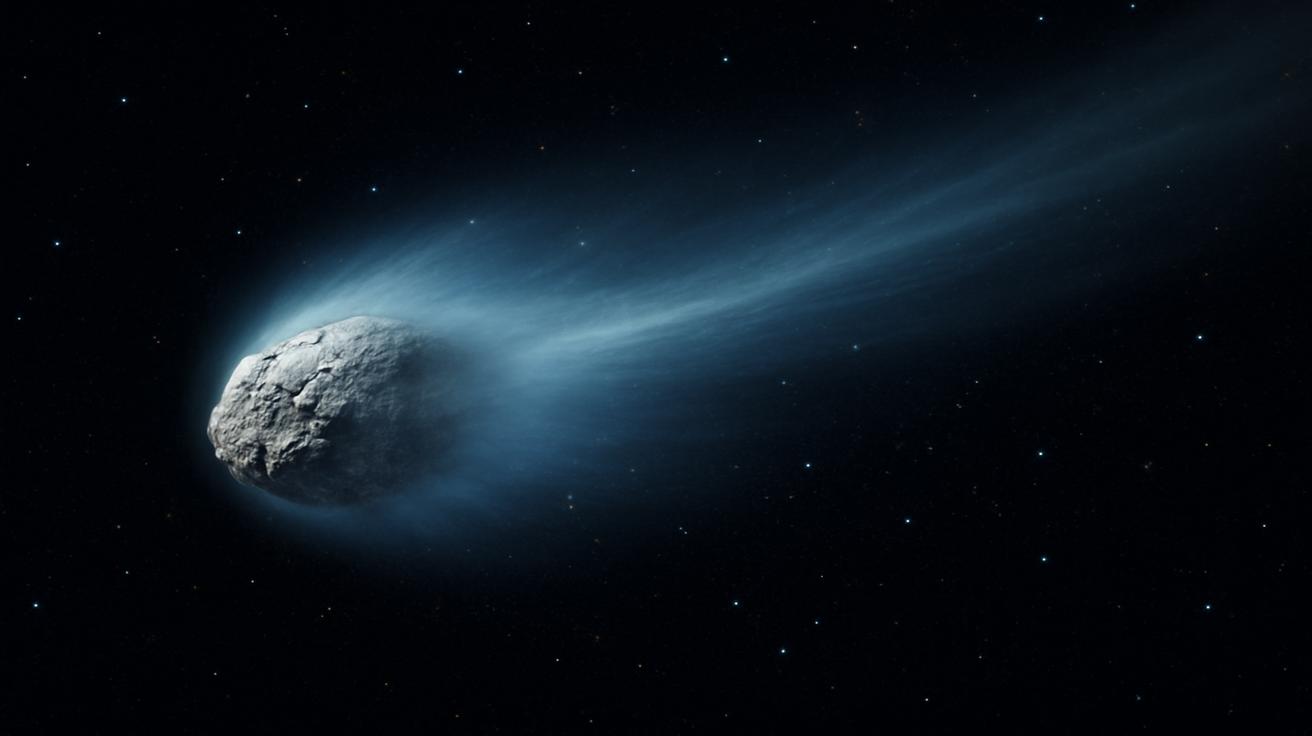
The comet does not look like it belongs here. It hangs on the screen like a splinter of dark glass slid into the fabric of our sky, framed by eight crisp, almost surgical images that feel less like astronomy and more like an autopsy of something alien. For a long breath, the room at the observatory is silent. No one speaks. You can almost hear the quiet electrical hum of the monitors and the faint vibration of the cooling fans as the new data settles in.
There it is: 3I ATLAS, only the third confirmed interstellar object ever seen passing through our solar system, caught in exquisite detail by a small fleet of spacecraft and telescopes working in concert. We have never seen an interstellar comet like this before—so close, so sharp, and so strange.
A Visitor With No Return Ticket
The story of 3I ATLAS begins with motion. Years ago, before its name carried the weight of mystery, it was a faint, anonymous point of light drifting against the stars—just one more whisper in the constant background chatter of the sky. Automated survey systems scanned millions of such points each night, logging them, measuring their drift, treating them as expected citizens of the solar system.
But then the calculations started to argue back. Astronomers noticed that its orbit refused to bend into the familiar shapes of ellipses and lazy loops around the Sun. Instead, 3I ATLAS traced a stark hyperbola, the mathematical signature of a one-way passage. This was not an object bound to our star; it was a passerby from the dark between suns, on a trajectory that would bring it near, let it taste a little sunlight, and then fling it back into the deep, never to return.
Even then, before the new images, there was a certain chill in the realization. An object whose story began under a different star was about to cut a shallow scar through our solar system, dropping hints and dust and questions. We had seen something like this twice before—first with the tumbling, cigar-like 1I/‘Oumuamua, then with the more familiar comet-like 2I/Borisov. But 3I ATLAS would be different, the scientists suspected. The timing was right, the instruments were ready, and the community was hungry for another look at a visitor from the outside.
The Eight Eyes on an Alien Comet
When the observing campaign was approved, it did not rely on one telescope or one spacecraft. It became a choreography of eight separate imaging systems—some orbiting Earth, some riding along in heliocentric orbits, some scanning the sky from cold mountaintops. Together, they formed a loose, collaborative array of eyes that could watch 3I ATLAS from different angles, wavelengths, and distances.
The new set of eight images now making the rounds in research circles—and, increasingly, on the public stage—came from that careful dance. They are not just snapshots; they are phases of an encounter. In the first, the comet is still a hard pinprick, its halo just beginning to swell. In another, a faint tail, almost shy, stretches out like a smear of smoke. By the last frames, the tail is sharpened, veined, and oddly knotted, like the wake of a boat tearing through a disturbing current.
Each image captures 3I ATLAS in a different light: visible, infrared, ultraviolet, and even narrow bands tuned to the spectral fingerprints of certain gases. Some show the coma glowing softly, almost pastel, around a dim, stubbornly unresolved core. Others reveal structure in the tail that looks wrong compared to solar-system comets, like threads pulled in directions that shouldn’t be possible.
The unsettling precision isn’t just about how crisp the comet appears—it’s in what that crispness refuses to hide. There are asymmetries, gaps, gradients that suggest a complicated, unfamiliar history. It is not the comfortable fuzzball of ice and dust we teach in schoolbooks. It is something more jagged in behavior, less obedient to the patterns we know.
| Image # | Instrument | Wavelength Focus | Key Feature Revealed |
|---|---|---|---|
| 1 | Deep-Sky Survey Imager | Visible light | Initial coma formation and stellar background contrast |
| 2 | Space Telescope Camera | Near-infrared | Thermal glow hinting at surface temperature variations |
| 3 | Solar-Orbiting Observatory | Ultraviolet | Gas jets emerging from localized active regions |
| 4 | High-Resolution Planetary Camera | Visible (high contrast) | Fine structure in inner coma, possible fragments |
| 5 | Infrared Survey Telescope | Mid-infrared | Dust distribution and size differences in the tail |
| 6 | Spectral Mapper Probe | Narrow-band spectral lines | Chemical signatures unlike typical solar-system comets |
| 7 | Wide-Field Space Imager | Visible and near-IR | Extended tail geometry over millions of kilometers |
| 8 | Heliospheric Monitor | Solar-scattered light | Interaction with solar wind, bending and twisting of dust stream |
The Texture of an Interstellar Stranger
What makes these images different from every comet portrait that came before is not just their sharpness, but their intimacy. Traditional comet photography often shows a blurred heart surrounded by an airy glow. With 3I ATLAS, the instruments bite deeper into the structure, peeling back layers of haze to expose something more textured and coarse.
Imagine standing in a dark room, watching a single shaft of light catch dust motes drifting and swirling. Now imagine that same beam revealing not dust, but grains launched from a surface carved by alien seasons. The coma around 3I ATLAS seems to carry such grains—chunks that scatter light in subtly different ways, hinting at mineral mixes and ice compositions that diverge from those we’re used to around homegrown comets.
Some of the spectral data suggests volatile materials that evaporate at different temperatures than our usual suspects. There are whispers of exotic ices, compounds that may never have formed in the Sun’s protoplanetary disk. Each pixel becomes a puzzle: How cold was the space where this object first coalesced? Under what color of star did its parent system glow? How long did it drift in interstellar darkness before crossing paths with our Sun?
The unsettling part lies in the familiarity of its basic shape—a nucleus, a coma, a tail—wrapped around an unfamiliar internal recipe. At a glance, you might mistake it for a run-of-the-mill comet from the Oort Cloud. But the closer you look, the more its foreignness bleeds through. The emission lines are off, the dust-to-gas ratio feels wrong, the tail’s curvature under solar pressure refuses to match the models that work so neatly for everything born here.
Listening to a Comet’s Silent Story
Viewed purely as images, the eight frames are already captivating. But astronomers are not content to just look; they want to listen—to extract a quiet, statistical narrative from the way light seeps out of 3I ATLAS. Over weeks and months, teams feed these images into models, teasing out the size of the nucleus (still frustratingly small, perhaps only a kilometer or two across), the rate at which it sheds material, the subtle spin that makes its jets flicker like a strobe when stitched into time-lapse sequences.
There is a poetic cruelty in this process. By the time our understanding of 3I ATLAS deepens, the comet itself will already be receding, pulling away along its hyperbolic path, shrinking back into a star-like point, and then into invisibility. The eight images are like photographs of a traveler you only meet once in your life: a few stolen moments, analyzed endlessly after they are gone.
As the models refine, a picture emerges: 3I ATLAS may have been battered long before we met it. Its surface appears unevenly active, with some regions blowing off gas violently under sunlight, while others remain stubbornly quiet. The variations suggest a patchwork history—eras of intense bombardment, slow freezing, perhaps even close brushes with other bodies in its home system. In some interpretations, the nucleus might even be fractured, a linked cluster of pieces rather than a single monolithic chunk.
The images, sharpened and enhanced, bring out those hints in eerie detail. Jets curve away from the nucleus like ghostly fingers. One jet flicks slightly off-angle, as if some internal torque is pushing it in directions we did not expect. When you overlay images from different instruments, the comet almost feels alive—a rotating, breathing engine of ice and dark rock that responds to sunlight in ways that defy our templates.
Unsettling Precision and the Human Imagination
There is a particular discomfort that comes with clarity. From a distance, unknown things can be safely romantic, wrapped in myth and speculation. But the eight high-resolution images of 3I ATLAS deny us that kind of comfortable distance. They show us enough to strip away the haze, yet not enough to fully explain what we see.
In a quiet control room or an office lit by the bluish glow of a laptop, a researcher zooms into one sector of the tail. The pixels tighten into a braided structure—streams interweaving like strands of hair twisted by a restless wind. Some strands brighten, some dim, and the models again fail to map these patterns perfectly. A graph window pops open, lines skittering across, searching for a match. There is always a residue of mystery, a remainder the equations can’t quite dissolve.
To a non-scientist looking at the processed image, the comet might simply appear beautiful and uncanny—a celestial plume frozen in motion. But for those steeped in the grammar of comet behavior, every misplaced grain of dust, every skewed curve of the tail, is a sentence in an unfamiliar dialect. 3I ATLAS is speaking with an accent carved by a star we will likely never see up close.
And this is where the perception shifts. The unsettling precision of these images does something to our sense of scale and belonging. The comet is no longer just a visitor; it’s evidence that our solar system is not sealed or solitary. It proves that material flows between stars, that fragments of foreign worlds can and do cross our skies. The universe stops being a backdrop and becomes a web of slow-moving migrations.
How 3I ATLAS Rewrites Our Idea of “Home”
For generations, most of us grew up with a solar system map that felt complete: Sun in the center, planets in their neat lines, comets and asteroids as local debris. Then, almost quietly, interstellar objects barged into that tidy diagram. ‘Oumuamua slipped through like an elongated ghost. Borisov blazed like a hyperactive comet on fast-forward. Now 3I ATLAS arrives, not just passing through, but allowing us to see its face in disarming detail.
Those eight frames of data are a reminder that our home system is not a gravitational island. Material from other nurseries can and does arrive here, occasionally close enough for us to image it, analyze it, argue about it late into the night. Home, in this sense, becomes less about boundaries and more about intersections—those brief crossings where the trajectory of some distant shard intersects our orbit and leaves behind its light for us to decode.
In classrooms and public talks, the images of 3I ATLAS are already finding their way onto slides. Students lean forward; people squint at the projected tail structure, the oddly bright plume. Someone raises a hand: “So where did it come from?” The honest answer is: we don’t know, not specifically. We can trace the path back in a rough sense, aim a ghostly arrow toward a patch of sky. But stars move, galactic tides sweep orbits around, and over the millions of years this comet may have wandered, its point of origin has shifted too much to name with confidence.
And perhaps that’s part of the power here. 3I ATLAS is not just an object; it’s an emissary from an unnamed elsewhere, carrying a chemical and structural memory of a system we can’t point to. It is a fragment of someone else’s night sky, come to drift through ours.
After the Visitor Leaves
In time, 3I ATLAS will recede. The images will remain, compressed into archives, traveling at a fraction of the speed of the object they captured. Papers will be written. Some theories about comet formation will bend; others will break and be rebuilt. New models of interstellar object populations will emerge, peppered with numbers anchored to those eight frames.
Future astronomers—perhaps ones who have grown up in an era of even more sensitive telescopes—will look back at 3I ATLAS the way we now look at early photographs of galaxies: grainy by their standards, but groundbreaking in spirit. Those eight images will be a chapter in an ongoing story of how we learned to look beyond the boundaries of our own birth cloud and recognize the traffic drifting between stars.
But there is also the quieter, more personal legacy of encounters like this. Somewhere, a person sits alone with the image of 3I ATLAS glowing on their phone late at night. They pinch to zoom, tracing the tail’s faint filaments with a fingertip on glass, feeling a strange mix of awe and vertigo. That smudge of light, that delicate plume, is a piece of matter that does not belong to our Sun—just passing through, visible for a brief moment in the long, indifferent time of the galaxy.
Then they lock the screen. The comet continues on its way, indifferent to our wonder, carving its precise, cold arc back into the dark between stars.
Frequently Asked Questions
What is 3I ATLAS?
3I ATLAS is the third confirmed interstellar object detected passing through our solar system. The “3I” designation marks it as the third known interstellar visitor, and “ATLAS” refers to the survey project that first identified it. Unlike typical comets, its orbit is hyperbolic, meaning it is not gravitationally bound to the Sun and will leave the solar system forever after its flyby.
Why are the new eight images so important?
The new set of eight spacecraft and telescope images captures 3I ATLAS at different times, wavelengths, and viewing angles. Together, they provide an unprecedentedly detailed view of its coma, tail, and activity. This allows scientists to infer its composition, surface behavior, and interaction with solar radiation and solar wind, offering rare insight into material formed around another star.
How is 3I ATLAS different from comets in our solar system?
While 3I ATLAS looks broadly comet-like, it shows key differences: its orbit is open-ended and hyperbolic; its spectral fingerprints hint at unusual ices or minerals; and its dust and tail structure don’t fully match patterns seen in local comets. These differences suggest it formed in a different stellar environment, under conditions not identical to those in our own protoplanetary disk.
Can 3I ATLAS be seen with the naked eye?
For most of its passage, 3I ATLAS is too faint to be seen without telescopes. Some interstellar objects might briefly brighten enough for keen amateur observers with good equipment, but 3I ATLAS is primarily a target for professional observatories with sensitive instruments and long exposure capabilities.
Will we ever send a spacecraft to an interstellar comet like this?
In principle, yes—but it’s extremely challenging. Interstellar objects like 3I ATLAS move fast and are usually discovered relatively late in their approach, leaving little time to design and launch a mission. Space agencies are studying concepts for rapid-response or pre-positioned spacecraft that could intercept future interstellar visitors. For now, though, our best data comes from remote imaging and spectroscopy, like the eight high-precision images used to study 3I ATLAS.








Leave a Comment