
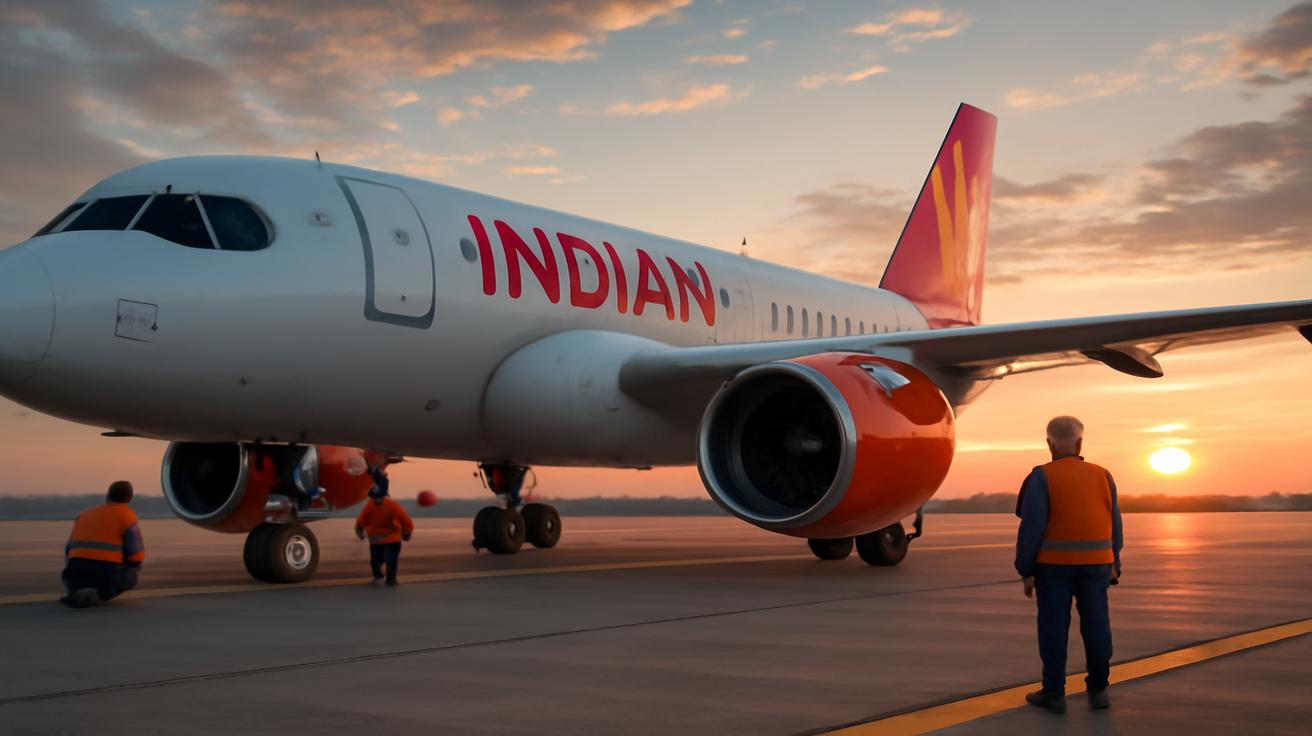
The first time you see it, you don’t think “India.” You think: silver bird, fine as a heron’s wing, sunlight glancing off a fuselage that looks more sculpture than machine. You hear the distant whine of engines spooling up, feel the faint tremor in your chest, smell that peculiar mix of jet fuel and hot tarmac. On the edge of a shimmering runway somewhere in southern India, a nation better known for packing airplanes is about to reveal that it can build them too.
When a Country Used to Only Watch the Skies
For decades, India’s main relationship with big passenger jets was as a customer—and a very good one. Its skies became busy late, compared to the US or Europe, but when they did, they changed fast. Budget airlines mushroomed. Airports expanded, terminal glass suddenly reflecting the faces of first-time flyers from small towns and distant villages. Families took selfies in front of aircraft emblazoned with foreign names: Boeing, Airbus, maybe the occasional Embraer.
On the departure boards, the world’s map rearranged itself for hundreds of millions of people: Dubai in the middle of the night, Singapore at dawn, London in the soft lull of a monsoon afternoon. India grew into one of the planet’s fastest-expanding aviation markets, but its role remained mostly the same—buyer, operator, passenger.
Ask anyone in the industry, and they’d tell you the story behind the story: as Indian airlines signed record orders with Boeing and Airbus, the real money—the deep, generational wealth—flowed outward. The country that filled cabins and airports did not own the designs or the intellectual property that made it all possible.
So the idea that a large, commercial, Indian-designed passenger jet could roll out of a hangar and line up for takeoff once felt closer to science fiction than to policy. Not anymore. Somewhere between ambition and necessity, between national pride and a cold-eyed reading of demand curves, India has quietly started to build something new: not just runways, but wings.
A Jet is Born: The Smell of Resin and Hot Metal
Step inside the assembly hall—any of several that now dot the country’s emerging aerospace corridor—and the air changes. There’s the chemical tang of curing resin, the faint sweetness of lubricants, the dusty metallic smell of milled titanium. Green primer coats large, curved panels that will one day form the smooth skin of a fuselage. Overhead, gantry cranes move with the pensive slowness of elephants, carrying wings and subassemblies as if they’re carrying something as fragile as a thought.
Technicians in blue and white overalls stand around a section of cabin floor, coaxing wiring bundles into place with the delicacy of people braiding hair. A quiet clatter comes from the far end, where a team is riveting. Somewhere, a torque wrench chirps; somewhere else, a laptop screen glows with a 3D model of the entire aircraft—a ghostly digital twin of the metal rising on the factory floor.
The jet itself—India’s first serious entry into the global single-aisle market—is easy to recognize even in incomplete form. Twin engines slung under long, slightly upswept wings. A cabin sized for the dense, high-demand routes of Asia and the Middle East. Enough range to knit together the Indian Ocean rim and reach deep into Africa. Its exact configuration varies by airline, but the bones are the same: an aircraft intended to stand shoulder-to-shoulder with the Boeing 737 and Airbus A320 families.
It doesn’t yet arrive with the fanfare of a brand name known to every traveler. There is no childhood memory attached to it, no phrase like “jumbo jet” to lodge in the imagination. Instead, there is something quieter, but no less powerful: the calm, stubborn conviction of a country that has decided it will no longer be just a passenger in the aviation story.
The Quiet Rise of an Unlikely Plane-Maker
India’s leap into passenger jet manufacturing didn’t start with a single announcement. It began with a slow accretion of capabilities. A wing component here for Airbus. A fuselage section there for Boeing. Over time, Indian firms became key suppliers, their factories producing parts that flew on thousands of aircraft worldwide. The world’s giants trusted Indian engineering and cost discipline, even if many travelers never knew the origin of the pieces holding their flights together.
Then came the next steps: indigenous regional aircraft projects, trainer jets for the military, work on advanced engines and avionics. Each success nudged the line of the possible a little further out. An ecosystem began to coalesce—public labs, private startups, big conglomerates, design studios, and tooling firms. What was once a constellation of discrete vendors started to look suspiciously like a supply chain ready to feed a full-scale aircraft program.
The tipping point was not dramatic; it was pragmatic. India’s air traffic projections showed the same graph over and over: a steep, relentless curve upward. Billions of journeys in coming decades. Gigantic import bills for foreign aircraft. Long waiting lists as Boeing and Airbus struggled with capacity and technical snags. Somewhere in those lines, policymakers, engineers, and investors all started asking the same question: what if we became a maker, not just a buyer?
The answer didn’t need to be as big as Boeing, not initially. It only needed to be big enough—big enough to build a competitive, efficient single-aisle jet that could earn its place on routes from Bengaluru to Bangkok, from Delhi to Dubai, from Nairobi to Mumbai. Big enough to begin.
What Makes This Jet Different? Look Closer at the Details
Walk down the length of the cabin mock-up, and you see where the new Indian jet is trying to carve out its own personality. The aisle feels fractionally wider, a breathing space in a part of the plane where travelers most often feel squeezed. Overhead bins are contoured to swallow the inevitable overstuffed carry-ons of price-sensitive flyers. The windows are set just a little higher than usual, catching more sky and less wing, a psychological trick that makes the cabin feel less like a tube and more like a gallery of views.
The seats don’t promise miracles—the laws of economics are as unforgiving as the laws of physics—but they do offer a better compromise: firm without being harsh, with slightly configurable headrests designed for the long, half-sleeping flights that define so much of Asian travel. Lighting shifts subtly through hues that echo dawn and dusk rather than nightclub neon. The quiet is what surprises you most. Modern engines and careful insulation mean conversations stay at the level of murmurs, not shouts.
The real work, however, lies beyond the senses. Fuel efficiency matters more than mood lighting. The aircraft’s wings are shaped and tweaked in wind tunnels and supercomputers to shave percentages off drag. Its materials are a careful balance of composites and alloys, each chosen as much for ease of maintenance in dustier, hotter climates as for their performance aloft. The avionics suite in the cockpit blends global standards with customizations tuned to the complexities of India’s crowded air corridors and monsoon weather patterns.
Then there’s the engine. India does not yet build a world-beating commercial turbofan entirely on its own—but it no longer has to be a passive consumer, either. Joint ventures, technology-sharing deals, and a growing ecosystem of homegrown engine-component makers mean this aircraft is as much a classroom as it is a product. Each takeoff feeds a cycle of data, and each byte of that data becomes a stepping stone toward deeper, more independent capability.
Why the World is Paying Attention
No one builds passenger jets casually. The world still has only a tiny handful of full-spectrum commercial airliner manufacturers. China’s COMAC has spent years and billions trying to become the third big pillar alongside Boeing and Airbus, and its efforts are watched with both caution and curiosity. That’s why the rise of a credible Indian entrant sends a different kind of tremor through the industry—less headline-grabbing than China’s, perhaps, but in some ways more quietly potent.
The market backdrop couldn’t be more favorable. Airlines everywhere are under pressure to renew fleets with more efficient aircraft, to hedge against fuel price swings, and to reduce emissions under tightening regulations. Supply chains for existing models remain stretched. Order books are full deep into the next decade. In that context, a new manufacturer isn’t merely a patriotic project; it’s a potential lifeline for carriers desperate for more options.
And then there is geography. India sits at the crossroads of global travel—between East and West, North and South. Its airlines already serve as bridges between smaller cities in Asia, the Gulf, and Africa. A domestically produced aircraft tailored to those thick, medium-haul routes could become a natural choice not just for Indian carriers, but for many airlines across the Global South, where cost, reliability, and durability in rugged conditions matter just as much as cutting-edge tech.
India arrives in this space with a reputation for something that doesn’t always get headlines: patient, iterative engineering. The same discipline that sends orbiters to Mars on budgets smaller than a blockbuster movie is now being pointed at a new frontier of complexity—creating a people-moving machine that must work not only brilliantly, but relentlessly, for decades.
| Aspect | Indian Jet | Typical Single-Aisle Rival |
|---|---|---|
| Seating Capacity | 150–190 passengers | 150–200 passengers |
| Range | 3,000–3,500 nautical miles | 3,000–3,700 nautical miles |
| Target Markets | India, Asia, Middle East, Africa | Global |
| Key Focus | Cost efficiency, hot-and-high performance | Fuel burn optimization, global fleet commonality |
| Manufacturing Footprint | India-centric with growing global suppliers | Distributed across multiple continents |
More Than Metal: The Ecosystem Taking Flight
Look beyond the aircraft itself, and you start to see the outlines of an ecosystem that stretches far beyond the runway. A jetliner is not just a product; it is a web of relationships, certifications, logistics, repairs, and upgrades that lasts for 30 or 40 years. If India truly wants to be a maker of passenger jets, it has to tend this entire web.
In tier-two cities once known mainly for textiles or agriculture, small firms are learning to machine aerospace-grade parts. Universities are spinning up aerospace design programs. Startups are working on niche components: advanced sensors that cope with desert dust, cabin air systems tuned to humid tropic conditions, predictive maintenance software that uses India’s strength in data science to catch problems before they ground flights.
Maintenance, repair, and overhaul facilities—MROs, in industry jargon—are expanding, smelling faintly of solvents, hot metal, and fresh paint. Over time, they will not just service the new Indian jets, but compete for global business, turning India into a kind of workshop for the world’s fleets. Every aircraft that flies in and out for heavy maintenance is also a quiet acknowledgement that the country has joined an exclusive league of nations capable of stewarding these complex, high-stakes machines.
It isn’t just industry that shifts. A generation of young Indians begins to dream in new shapes. Not just of becoming pilots and cabin crew, but of becoming aerospace engineers, composites specialists, structural analysts, test pilots, and certification experts. The arrival of a homegrown passenger jet doesn’t just add one more aircraft to the sky; it expands the sky itself, as a place where their own hands and minds can belong.
India’s Jet in a Changing Global Sky
The sky into which this Indian jet rises is not the innocent blue of aviation’s early days. It is crisscrossed by contrails of climate anxiety and geopolitical fault lines. Every new aircraft is born into a conversation about emissions. Every supply chain carries the weight of resilience and rivalry. There is no way to tell this story without weaving in those threads.
On the climate front, the new jet is India’s attempt to show that growth doesn’t have to be a straight-line curve of carbon. Its designers obsess over fuel burn, weight, and aerodynamics, knowing that regulators and passengers alike are watching. Sustainable aviation fuels—still expensive, still emerging—feature prominently in its long-term roadmap. The goal is not to build a perfect aircraft, but a better one, in a world where “better” has to mean “less damaging” as much as it means “more profitable.”
On the geopolitical front, the arrival of an Indian passenger jet shifts balances in subtler ways. It gives airlines, especially in the Global South, another bargaining chip when negotiating prices and delivery slots with Western manufacturers. It offers countries wary of over-reliance on any single bloc a different kind of partnership: a machine born of a democracy with its own instincts, its own vulnerabilities, its own rhythms.
And yet, for all its global implications, the most powerful image remains intensely local: a boarding gate at dawn in an Indian city, the glass still fogged from the night’s humidity, the first boarding call echoing over a sleepy crowd. People gather in front of an aircraft whose nameplate, for the first time, does not belong to Seattle or Toulouse, but to a place much closer to home.
In that small moment—half coffee, half yawn—something invisible shifts. A child presses a nose to the window, looking not just at a plane, but at a mirror of what their country has become capable of making. A ground handler runs a practiced hand across the smooth curve of metal and composite, recognizing the work of neighbors, cousins, maybe even friends. A pilot runs through the checklist, aware that the flight deck’s language of switches and displays now includes choices made in Indian labs and studios.
As the aircraft lifts off, the land below unscrolls: rivers thick with monsoon water, cities pulsing with traffic, fields already baking in the morning sun. Somewhere among them, future engineers and technicians and designers look up at the contrail and feel, in a way that’s subtle but unmistakable, that this sky belongs to them in a new way.
It is not a victory lap; there are too many hurdles ahead for that. Certification processes will be relentless. Competition will be fierce. Setbacks are inevitable. But the first step has been taken—the step from buying wings to building them. India, long a nation of passengers, has taken its place in the narrow, demanding, endlessly fascinating world of passenger jet makers.
And now, when the silver bird turns into the sun and vanishes into the high, thin air, you can almost hear a different kind of echo under the roar of its engines: not just the applause of national pride, but the quiet, determined hum of a new industry finding its altitude.
Frequently Asked Questions
Is India really building its own large passenger jets?
Yes. After years of supplying parts and developing regional and military aircraft, India is now moving into the design and production of larger single-aisle passenger jets aimed at domestic and regional routes.
How is this different from China’s COMAC program?
China’s COMAC has focused heavily on state-driven programs with strong domestic deployment first. India’s approach leans more on mixed public–private ecosystems, international partnerships, and gradual expansion from an already deep supplier base.
Will Indian-made jets be as safe as Boeing or Airbus aircraft?
To operate globally, any Indian jet must meet strict international safety and certification standards. That means rigorous testing, regulatory scrutiny, and continuous oversight, similar to what Western manufacturers face.
Who will be the first customers for these Indian passenger jets?
Early customers are expected to be Indian airlines and carriers across Asia, the Middle East, and Africa that operate dense regional routes and are looking for cost-efficient, reliable aircraft.
When might travelers actually fly on an Indian-built jet?
Commercial aviation timelines are long. From prototype to certification and full service can take several years. But given existing momentum in India’s aerospace sector, seeing Indian-built jets in regular passenger service within the next decade is increasingly plausible.







Leave a Comment