
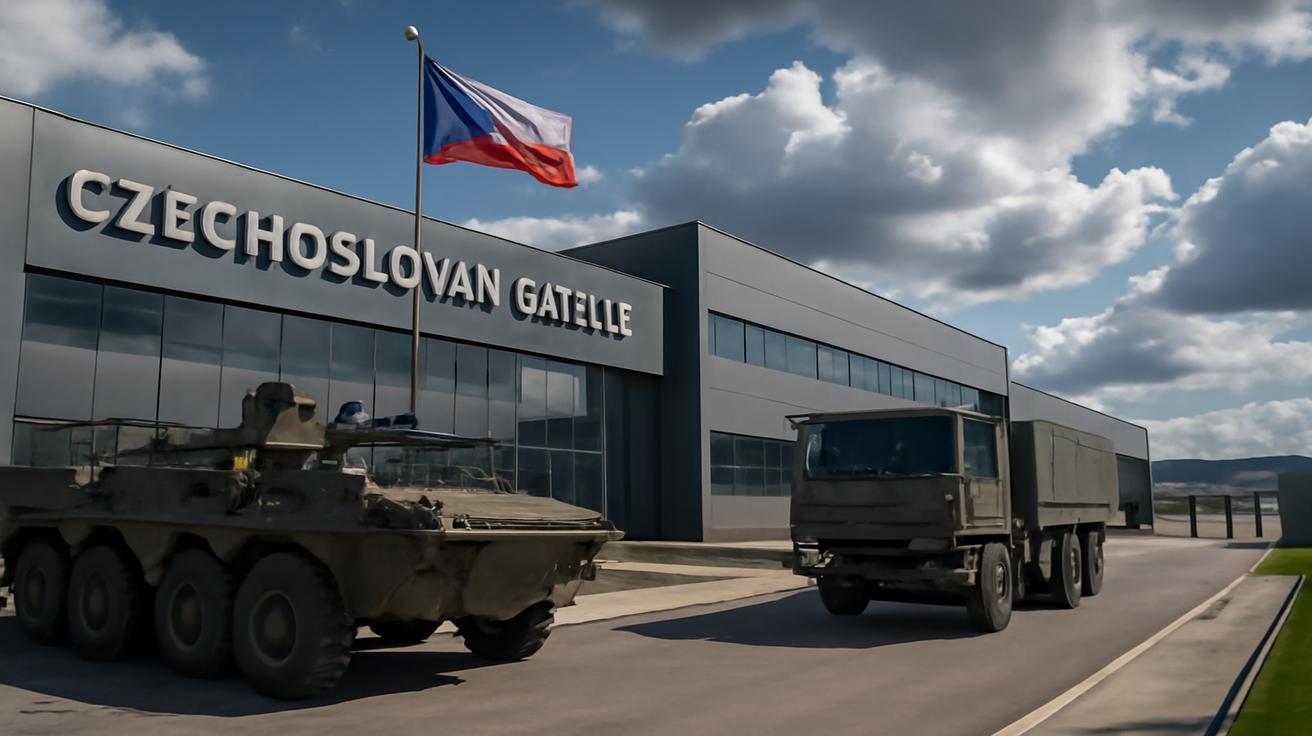
The wind comes in low over the Elbe, heavy with November mist and the metallic tang of cold steel. In the old industrial heartlands of Central Europe, factory roofs glisten, rail sidings hum, and men and women in oil-stained overalls finish another shift beneath the orange glow of sodium lamps. This is not the Europe of glossy brochures and café terraces; this is the Europe of foundries, furnaces, testing grounds—and increasingly, of weapons. Somewhere between the clang of metal and the quiet tapping of keyboards in glass-walled offices, a new European defence giant is taking shape. Not in Paris or Berlin, but in Prague, in Ostrava, in nameless industrial towns scattered across the Czech landscape. Its name is Czechoslovak Group, and it is getting ready to step under the brightest of spotlights: a landmark IPO that could redraw the map of Europe’s defence industry.
Forged in a Quiet Corner of Europe
If you had driven through Central Europe in the 1990s, you might have passed the bones of what Czechoslovak Group would one day become without ever knowing it. Shuttered arms factories, silent rail yards, rusting machine tools—remnants of a defence ecosystem that once fed the Warsaw Pact and seemed destined to fade into irrelevance after the Cold War ended. Yet inside those hollow shells, and in the memories of the people who had worked there, the know-how never really disappeared.
In the Czech Republic, the story of Czechoslovak Group (CSG) begins here: with a network of legacy plants, niche engineering workshops, and small trading companies, gradually pulled together under one vision. Where others saw scrap metal and obsolete blueprints, a few people saw continuity—and opportunity. The global defence cycle, after all, never truly ends; it just changes tempo.
CSG’s rise has been a slow, almost quiet accumulation of capabilities. Ammunition lines modernized. Heavy vehicles reimagined. Precision optics, radar systems, and munitions integrated into a wider, coherent portfolio. If France has Dassault and Germany has Rheinmetall, the Czech Republic now has CSG—a company with roots in the old Czechoslovak engineering tradition, branches reaching across Europe, and ambitions pushing far beyond the confines of a small landlocked state.
Yet what transforms a large, successful private group into a “giant” is not just scale; it is visibility, access to capital, and a seat at the big table. That is exactly what its planned IPO is designed to secure.
From Workshop to Trading Floor: The Logic of a Landmark IPO
Walk into the company’s test grounds on a crisp winter morning and you can feel, more than see, the shift underway. The staccato rattle of automatic weapons testing, the heavy thud of artillery, the crackle of radios—these are set against something entirely different: the soft murmur of institutional investors, the steady stream of spreadsheets, the quiet pressure of global markets.
An IPO is, at its simplest, a moment when a company opens its doors to the public markets and says: “Come in. Judge us. Own a piece of this.” For a defence company, especially in Central Europe, that invitation carries special weight. Transparency meets secrecy. National security meets shareholder value. Long-term government contracts meet quarterly earnings calls.
CSG’s planned listing is framed as a “landmark” for a reason. It promises to be:
- One of the largest defence-related IPOs ever to come out of Central or Eastern Europe.
- A rare case of a major defence industrial player emerging outside the traditional Franco-German axis.
- A test of how European capital markets value security in an era that suddenly feels less safe.
In the corridors of Prague’s financial district, the air has subtly changed. Bankers talk about order backlogs and EBITDA margins, but also about artillery shell shortages and air defence gaps. Risk models now include not just interest rates and FX exposure, but the unpredictable tempo of war on the continent’s eastern flank. For investors, CSG is not just another industrial issuer; it is a bet on Europe’s ability to rearm, reorganize, and recalibrate its place in a world of renewed geopolitical tension.
The Numbers Behind the Narrative
Strip away the romance of smokestacks and steel, and the logic of the IPO crystallizes. Defence demand across Europe has surged. NATO members are racing toward, and often beyond, the 2% of GDP defence-spending benchmark. Armour and artillery, once relegated to low priority, are suddenly urgent again.
CSG sits in the slipstream of this changing tide, with a portfolio that touches many of the things Europe now realizes it needs in a hurry: ammunition, armoured vehicles, artillery systems, electronic warfare components, radar, and specialized logistics. Opening itself to the public markets is a way to:
- Raise capital to expand production capacity and modernize plants.
- Fund acquisitions within Europe and potentially beyond.
- Strengthen credibility with government and institutional clients.
- Give a clearer valuation benchmark to a sprawling, diversified group.
The move also carries symbolism. For decades, Europe’s defence narrative has revolved around its largest western economies. With the Czech-based CSG stepping onto a public exchange, a new centre of gravity begins to glow on the map, somewhere between the Rhine and the Ukrainian border.
Central Europe Steps Into the Strategic Light
There is a particular feeling you get in Prague’s older industrial districts in late afternoon. The smell of coal from distant heating plants mixes with diesel fumes and the faint ozone of welding arcs. It is a sensory reminder of the Czech Republic’s long romance with making things—precision machinery, trucks, weapon systems. This is a country that learned long ago how to take metal and turn it into something that moves, protects, or, when necessary, destroys.
For years, that industrial gene pool was overshadowed by Western Europe’s defence giants. Big deals were signed in Berlin, Paris, London, Rome. Central Europe supplied parts, subcontracting, or modest export brands. Now, something is shifting. The geography of security has moved east. The threats are closer to Warsaw and Bratislava than to Brussels. And the political will to build robust local capabilities is stronger than it has been in decades.
CSG has positioned itself deliberately in this emerging landscape. Rather than trying to become a clone of a French or German champion, it leans into its own strengths:
- Agility born of a mid-sized country, used to improvising.
- Legacy plants that can be upgraded faster than building from scratch.
- A workforce steeped in mechanical and electrical engineering traditions.
- Existing footholds in both NATO and non-NATO markets.
Outsiders sometimes underestimate Central Europe, focusing on GDP rankings or population size. But inside the region, there is a palpable sense that it has grown too big, too capable, and too exposed to remain a mere peripheral player. With its IPO, CSG is in effect saying, “We are here, and we are ready to compete at the highest level.”
Not Just Bullets and Tanks: A Broader Industrial Ecosystem
Step through the company’s portfolio on paper and you notice something important: CSG is not just a “guns and ammo” story. Its holdings span rail, aerospace, automotive, and civilian engineering domains. That breadth is not accidental. The same metallurgical expertise that forms a tank’s armour can produce heavy rail components. The electronics that guide a missile can be cousins of the systems that support air traffic or complex industrial automation.
This industrial cross-pollination is part of what makes CSG’s growth story compelling. It allows the group to smooth the cyclical ups and downs of pure defence spending while keeping a strong dual-use foundation. It also means that an IPO investor is not just buying current conflict-driven demand, but a longer-term platform of Central European industrial capability.
How Czechoslovak Group Stacks Up in Europe’s Defence Landscape
Imagine for a moment a map of Europe dotted with its big defence houses. In Germany, names like Rheinmetall and Hensoldt. In France, Thales, Dassault, Safran, Naval Group. In Italy, Leonardo. In the Nordics, Saab. Until recently, Central Europe was largely absent from this club. CSG’s listing changes the silhouette of that map, putting a new bright point in the Czech Republic and subtly altering the conversation about where Europe’s defence brain—and muscle—resides.
Of course, “giant” is a relative term. Measured against the largest Western European primes, CSG is smaller. But size is only one dimension. Momentum, specialization, and geography matter too. In several high-demand niches—ammunition, land systems, and support equipment—CSG already plays in the same leagues as its bigger cousins, especially for customers looking for fast, reliable supply and cost-effective solutions.
To grasp the emerging picture, it helps to zoom out and compare how different regions contribute to Europe’s security industrial base.
| Region | Key Defence Role | Representative Players |
|---|---|---|
| Western Europe (Germany, France, Italy, UK) | High-end aerospace, naval systems, advanced electronics, large integrated platforms. | Rheinmetall, Thales, Dassault, Leonardo, BAE Systems. |
| Nordic Countries | Specialized aerospace, sensors, missiles, niche land and naval systems. | Saab, Kongsberg, Nammo. |
| Central Europe (Czech Republic, Poland, Slovakia) | Land systems, ammunition, overhauls, upgrades, dual-use heavy industry. | Czechoslovak Group, PGZ, emerging private players. |
| Southern and Eastern Europe | Niche systems, small arms, legacy platforms, regional support. | Various national champions and state-owned enterprises. |
Within this mosaic, CSG’s planned IPO is less a standalone event and more a sign that Central Europe’s defence engine is finally being recognized, valued, and capitalized in a way that fits its real strategic weight.
Competition, Collaboration, and the Franco-German Question
Any time a new heavyweight steps into the ring, the obvious question follows: Will it challenge the incumbents? In Europe, that often translates into: What does this mean for Germany and France?
The answer is subtle. CSG is unlikely to supplant French or German champions; the scale and technology gap in some domains is too great. But it doesn’t have to. Instead, it can become a crucial complementary pillar in a more geographically balanced European defence architecture.
Joint programs, co-development of systems, licensed production, and shared supply chains are already a reality in European defence. A publicly listed, well-capitalized CSG offers Western European primes an attractive partner in Central Europe—one that brings industrial capacity and political proximity to Eastern front-line states. In an era when the biggest problem is often not designing new weapons, but producing enough of the existing ones fast enough, that matters.
The Human and Ethical Undercurrent
Defence stories are never just about steel and capital. They are also about ethics, politics, and the quiet discomfort that many Europeans still feel when they see their continent’s arms factories running at full tilt. In Prague’s cafés and in Brussels committee rooms, you will hear the same uneasy questions: How do we reconcile the need to prepare for conflict with the desire to avoid it at all costs? How do we ensure that new industrial giants like CSG are accountable, transparent, and aligned with democratic values?
Going public forces some of those questions into the open. Listed defence companies must disclose more, justify more, submit to the judgment of a wider pool of stakeholders. Investors care about governance, export controls, and environmental impact. Civil society groups track where weapons end up. Governments, under the gaze of their voters, are more cautious about the deals they sign.
Inside CSG’s facilities, the tension is less abstract. Workers know that the shells they load and the vehicles they assemble may one day be shipped eastward, toward places where real people are fighting and dying. For some, that is a source of pride: a feeling of contributing to deterrence, to the defence of vulnerable allies. For others, it is more complicated. The IPO will not resolve that ambiguity, but it will place the company under a brighter light, where arguments about security, responsibility, and profit must all share the same stage.
Resilience, Not Just Revenue
There is another, quieter dimension to CSG’s rise that matters for Europe as a whole: resilience. The pandemic, supply-chain disruptions, and renewed conflict have forced Europeans to ask hard questions about what they can still make at home. Can they produce enough critical components and munitions without relying on long, fragile, global supply lines?
In this context, the strengthening of a multi-domain industrial player in Central Europe is not just a financial event; it is a strategic adaptation. A more diversified defence base, anchored in several regions, makes Europe less vulnerable to single points of failure. If a crisis disrupts one corridor, others can compensate. If one political capital hesitates, another may be ready to step forward.
In the long run, that distributed resilience may be the real legacy of CSG’s IPO, beyond its initial share price or market capitalization.
A Moment on the Threshold
Dusk settles over the Czech landscape as trains loaded with anonymized containers slide silently past graffiti-tagged walls. Somewhere inside those containers lie the tangible expressions of Europe’s new strategic realism: shells, spare parts, components, tools. In a meeting room not far away, a different kind of container is being prepared—the prospectus, that dense, careful document in which Czechoslovak Group will present itself to the world’s capital markets.
It will speak in numbers: revenue, backlog, margins, growth. It will speak in acronyms and regulatory jargon. It will understate, as such documents must, the drama of what is really happening: a mid-sized Central European country taking a bolder role in shaping the continent’s security, not just as a consumer of protection, but as a producer of it.
As the IPO approaches, investors will ask whether the timing is right, whether the valuation is fair, whether defence spending will remain elevated. Politicians will debate the balance between national control and international capital. Ordinary citizens will weigh their discomfort with the business of war against their sudden, visceral awareness that peace also has a price—and that someone must pay to keep the machinery of deterrence running.
In that conversation, CSG stands at a threshold. On one side lies the world of semi-obscure industrial holdings, known mostly to procurement officers and niche analysts. On the other side lies the realm of public accountability, analyst calls, global investor roadshows, and headlines. Crossing that line will not change the rumble of the test range or the glow of the foundry, but it will change the story Europe tells itself about who makes its weapons, and where.
Outside Germany and France, in a country whose name once evoked tanks rolling in under foreign flags, a new defence giant is quietly, firmly stepping into the open. The mist over the Elbe and the Vltava will continue to rise and fall, indifferent. But in the echo of machinery, in the nervous shuffle of investors’ notes, and in the silent calculations of defence planners from Brussels to Bucharest, the emergence of Czechoslovak Group on the public stage will be felt as something new: a rebalancing, a recognition, and perhaps the first clear sign that Europe’s industrial heart is beating faster in places many once overlooked.
FAQ
What is Czechoslovak Group (CSG)?
Czechoslovak Group is a Czech-based industrial and defence conglomerate with activities in ammunition, land systems, aerospace, rail, and other engineering sectors. It has grown by consolidating legacy Czechoslovak industrial assets and building a modern, export-oriented portfolio.
Why is CSG’s planned IPO considered a landmark?
The IPO is seen as a landmark because it would create one of the largest publicly listed defence players emerging from Central Europe, outside the traditional defence hubs of Germany and France. It signals a broader recognition of Central Europe’s strategic industrial role.
How does CSG compare to major Western European defence companies?
CSG is smaller than large primes like Rheinmetall, Thales, or Leonardo, but it is significant in specific niches such as ammunition, land systems, and dual-use heavy industry. Its geographic position and industrial agility give it a complementary role in Europe’s defence ecosystem.
What are the main goals of CSG’s IPO?
The IPO aims to raise capital for expanding production, modernizing facilities, and pursuing acquisitions. It also seeks to enhance transparency, improve access to international finance, and strengthen CSG’s credibility with both customers and partners.
Why is the emergence of a Czech defence giant important for Europe?
It diversifies Europe’s defence industrial base, reduces overreliance on a few Western countries, and builds resilience by anchoring significant production capacity in Central Europe—closer to the continent’s current security front lines.







Leave a Comment