
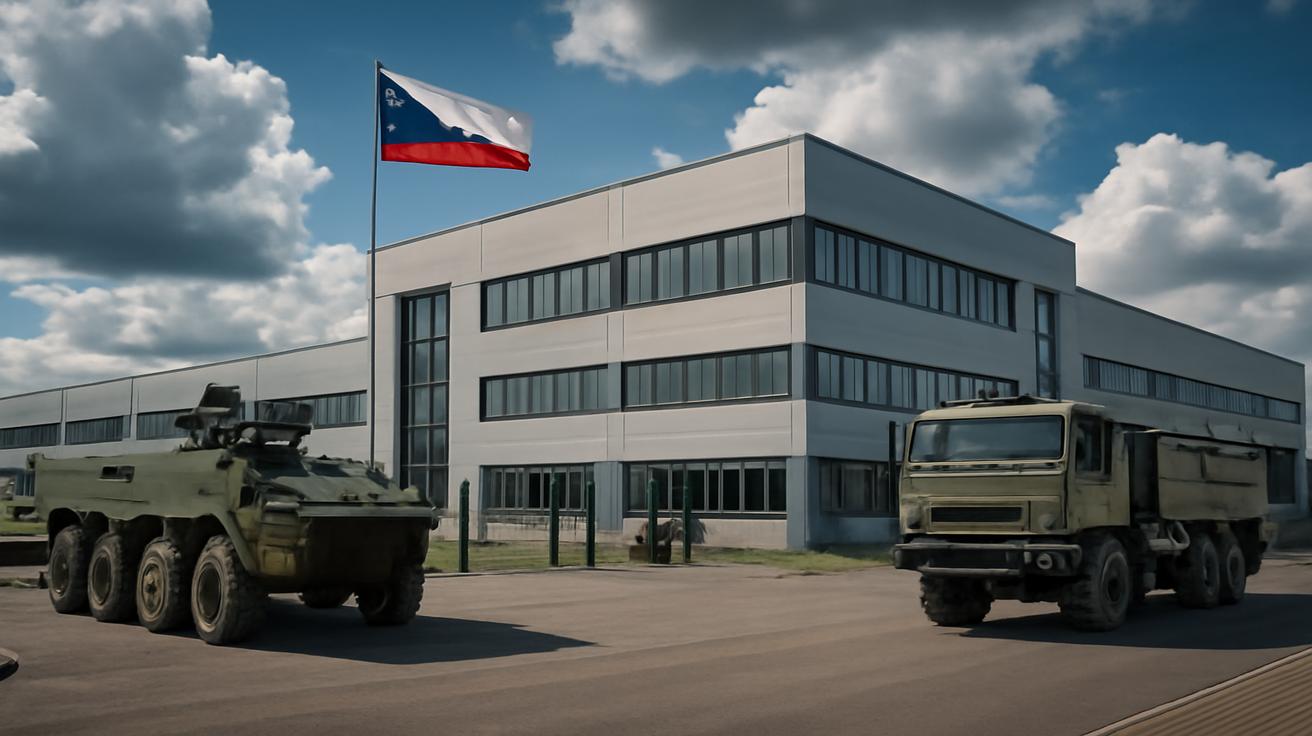
The first time you hear the name “Czechoslovak Group,” it doesn’t exactly sound like the kind of brand that might reshape the European defence landscape. It sounds a bit vintage, a bit industrial, like something you’d see stamped on a steel part in a railway museum. Yet in the quiet hills and industrial towns of the Czech Republic, far from the command centres of Berlin and Paris, a new European defence giant has been quietly assembling itself, piece by piece, contract by contract, until suddenly the rest of the continent has had to look up and pay attention. Now, with a landmark IPO on the horizon, that attention is about to intensify.
The rise of a quiet giant
If you walk through some of Central Europe’s older industrial districts, there’s a particular sound that lingers: the metallic rhythm of presses, the hiss of welding torches, the smell of oil and steel. Czechoslovak Group, or CSG, is rooted deeply in that world. It grew not from glossy headquarters or sleek campuses, but from legacy factories, repaired machine tools, and neglected capabilities left behind after the fall of communism and the breakup of Czechoslovakia.
In the chaos of the 1990s and early 2000s, many of these factories were written off as relics. But where others saw rust, CSG’s founders saw muscle. They began acquiring companies that had once supplied armies behind the Iron Curtain: ammunition makers, vehicle manufacturers, radar specialists, heavy engineering firms. At first, it was a slow, almost invisible process—local headlines, regional deals, not the kind of news that typically shakes the halls of Brussels or London.
Yet while Western Europe was busy consolidating its own defence champions—Germany with Rheinmetall, France with Thales and Dassault—CSG was building something more hybrid, more opportunistic. It didn’t inherit an empire; it stitched one together across multiple domains: land systems, ammunition, aerospace, rail and industrial technologies. The company’s model was less about grand design and more about adaptive reuse of capability: reviving plants, retraining workers, modernising old product lines, and then quietly selling into markets that still needed rugged, reliable hardware.
The turning point came when Europe’s security assumptions began to crack. The annexation of Crimea in 2014 was one tremor. The full-scale Russian invasion of Ukraine in 2022 was the earthquake. Suddenly, the sleepy niche of Central European defence manufacturing became a central artery in Europe’s rearmament effort—and CSG was right there, hands already on the machinery.
War on the doorstep and a surge in demand
On a cold winter morning, trains loaded with military supplies now rumble more frequently along Central European tracks. Shells, armoured vehicles, spare parts—all the unglamorous hardware that keeps modern armies moving. The war in Ukraine has stripped away illusions about the “post-war” European order. It has forced defence ministries from Prague to Paris to ask basic questions: Who can still produce artillery ammunition at scale? Where can we get armoured vehicles fast? Which plants can adapt to NATO standards quickly enough?
CSG’s answer has been simple: right here.
The company has become one of the most important suppliers of artillery ammunition and ground systems to Ukraine and to NATO countries replenishing their stockpiles. It has rehabilitated and upgraded Soviet-era equipment, provided Western-standard systems, and bridged a technological gap between past and present. Its facilities have been running hot—factories that once seemed oversized in peacetime now suddenly feel barely large enough.
What makes this especially striking is that the centre of gravity is not in Germany or France, the traditional anchors of European defence industry, but in a mid-sized Central European country that, only a few decades ago, was itself shaking off the grip of Moscow. The symbolism is hard to ignore: the Czech Republic, once a cog in the Warsaw Pact machine, now hosts a company poised to become a central pillar of NATO’s European industrial base.
Defence spending across Europe has surged since 2022. Countries that had long hovered below NATO’s 2% of GDP target are scrambling to catch up. Procurement pipelines are being unclogged, old projects revived, new ones rushed through. And in this sudden rush, agility matters. This is where CSG’s patchwork, opportunistic DNA becomes an advantage. It is used to improvisation, to stitching different systems together, to taking something that exists and making it work under new constraints.
From family-owned to the public markets
Behind the machinery and the contracts lies a surprisingly personal story. CSG is not a faceless bureaucratic creation; it has long been controlled by a Czech entrepreneurial family that methodically built the group over years, often under the radar of international investors. For much of its history, the company felt more like an extended industrial clan than a polished corporation.
That’s about to change. The upcoming IPO marks a clear turning of the page—from a family-led, privately held industrial group to a publicly listed, scrutinised, benchmarked European defence heavyweight. And not in Frankfurt or Paris, but via a listing that puts Central Europe squarely on Europe’s financial and strategic map.
This move is not happening in a vacuum. Investors who once shied away from defence stocks—worried about political risk, public perception, or low margins—are reassessing. Defence is no longer seen as a controversial niche but as critical infrastructure for national survival. Pension funds and institutional investors, especially in Europe, are gingerly stepping back into a sector they once held at arm’s length.
CSG’s IPO, then, is more than a capital-raising exercise. It’s a stress test of Europe’s evolving relationship with defence investment. How eagerly will markets embrace a new, Central European player? How will valuations compare to established giants like BAE Systems or Rheinmetall? And what will it mean when a Czech group can tap international capital to scale up production that directly shapes the security calculus on NATO’s eastern flank?
Why this IPO matters beyond the balance sheet
There’s a larger strategic story playing out here. For years, European defence integration has been a political talking point more than an industrial reality. Different countries guarded their “national champions,” fragmenting the market and slowing joint projects. Germany and France dominated the narrative; smaller nations played supporting roles.
CSG’s emergence as a potential “third pole” outside the German-French axis starts to redraw that map. A robust, well-capitalised defence group headquartered in the Czech Republic suggests a more polycentric European industrial base—one that better reflects the geography of the continent’s current security risks.
Eastern and Central European states are closer to the front line, more attuned to the realities of Russian aggression, and often more pragmatic about defence needs. The rise of a major defence player from this region can tilt priorities: more focus on land warfare, artillery, logistics, and the gritty, consumable side of conflict, not just high-end prestige projects.
As CSG goes public, it becomes a visible barometer of how far Europe is willing to go in turning that strategic rhetoric into industrial substance.
Inside the machine: what CSG actually does
To understand the scale of the shift, it helps to look at what CSG’s portfolio really contains. This is not just a “bullet factory” or a maker of niche components. It is a layered ecosystem of capabilities, many of them deeply rooted in decades of Central European engineering know-how.
Its companies produce artillery shells and ammunition of various calibres—precisely the items in highest demand as Ukraine and its supporters face a grinding war of attrition. It refurbishes and upgrades armoured vehicles and multiple launch rocket systems. It is involved in radar, command-and-control technologies, and aerospace components. Beyond defence, it has stakes in rail, heavy transport, and industrial technology—sectors that share a common backbone of mechanical and systems engineering.
What sets this ecosystem apart is that it grew in a world where cost-effectiveness mattered as much as cutting-edge sophistication. The result is an industrial culture that understands rugged design, maintainability, and adaptation in resource-constrained conditions. That’s exactly the kind of mindset required when a continent needs to rapidly increase production without infinite budgets or time.
To get a feel for how CSG fits into the broader European defence space, imagine a simplified snapshot of where the hardware and know-how are coming from today:
| Region | Notable Defence Strengths | Role in Current European Security |
|---|---|---|
| Germany & France | High-end systems: tanks, aircraft, missiles, electronics | Strategic projects, long-term capability development |
| United Kingdom | Naval power, advanced aerospace and missiles | Maritime security, high-technology exports |
| Central Europe (incl. Czech Republic) | Artillery, vehicles, munitions, upgrades, repairs | Rapid scaling of ground warfare capacity, support to Ukraine |
| Northern & Eastern Europe | Air defence, drones, niche high-tech and local production | Front-line resilience, integration with NATO systems |
CSG, firmly in the Central European row, has become the connective tissue between legacy Soviet-era platforms and NATO-standard equipment. As its IPO unlocks new capital, that connective role is likely to expand—potentially spilling into joint ventures, new R&D, and deeper integration into European supply chains.
Balancing ethics, economics, and security
Whenever a defence company goes public, a familiar set of questions arises. Is it right to profit from war? Can investors support defence without endorsing conflict? How do you build weapons in a way that is compatible with democratic values?
Europe’s answer, increasingly, is that failing to invest in credible defence has its own moral cost. The Russian invasion of Ukraine has made this painfully concrete. Countries that once outsourced much of their security burden to the United States now recognise that if they want peace, they must underwrite the tools that deter aggression—and sometimes, the tools that repel it in real time.
CSG finds itself at the intersection of those ethical, economic, and security pressures. As it steps into the public market, it will face new layers of scrutiny: environmental, social, and governance (ESG) criteria; shareholder resolutions; questions about export policies; debates over where its products end up. Unlike a private family asset, a listed company must answer to a wide gallery of voices.
Yet this transition may also drive positive change. Public markets can push for clearer transparency, more robust compliance regimes, and tighter alignment with NATO and EU export rules. If CSG can successfully navigate this, it could become a model for how to run a large defence manufacturer in an era when citizens demand both security and accountability.
Central Europe steps onto the main stage
For the Czech Republic, CSG’s IPO is more than a corporate milestone; it’s a statement of arrival. A country once known in global headlines for beer, Prague’s spires, and budget tourism is now increasingly associated with precision engineering, high-tech manufacturing, and strategic industries. The roots of this shift go back generations. Czechoslovakia was, before World War II, one of Europe’s most industrialised and technologically advanced countries, with a strong arms industry of its own.
The fall of communism shattered much of that ecosystem, but the skills never fully vanished. They hid in smaller workshops, vocational schools, and a cultural familiarity with metal, mechanics, and systems. CSG has, in many ways, been a vehicle for reawakening that dormant capability and plugging it into today’s geopolitical reality.
On a political level, this matters. As Central European countries like the Czech Republic, Poland, and Slovakia push for a tougher line on Russian aggression and a more serious European defence posture, having a locally headquartered defence giant adds weight to their arguments. It’s one thing to call for more artillery; it’s another to have the factories ready to produce it just over the border.
For ordinary Czechs, the story has a different flavour. It means industrial jobs preserved and created, technical education valued, and a sense that their country is not just a consumer of security decisions made elsewhere, but a maker of the tools that underpin those decisions. It’s a complex pride—tinged with the knowledge that their prosperity is tied, in part, to a world that has grown more dangerous.
Looking ahead: from IPO to influence
As the date of the IPO draws closer, the mood around CSG is a mix of anticipation and calculation. Bankers talk of valuation ranges and investor roadshows. Analysts compare multiples to peers. Defence officials quietly consider what a better-capitalised CSG might mean for procurement choices and alliance planning.
There is a sense that the offering will be a test—not just for CSG, but for how far Europe has travelled in accepting that defence is not an awkward necessity to be hidden in the shadows, but a core strategic industry that must be financed, modernised, and scaled.
If the IPO goes well, a series of knock-on effects becomes plausible. Other Central and Eastern European defence firms might explore listings or mergers, accelerating consolidation. Joint ventures with Western European giants could deepen, combining Central Europe’s agility and cost base with Western Europe’s technology and capital. A more integrated, pan-European defence ecosystem could begin to emerge—more flexible than the old, West European-dominated model, and more closely aligned with the geography of actual risk.
And if it stumbles? That, too, will send a message—about lingering investor hesitation, political ambivalence, or the difficulty of pricing risk in a world where front lines are uncomfortably close.
But regardless of market jitters, one thing is no longer in doubt: a new centre of gravity has appeared on Europe’s defence map, and it is not in the usual places. It is in factories humming in Czech towns; in engineers puzzling over how to extend the life of an artillery barrel; in rolling stock that carries shells eastward under winter skies.
In those sounds and scenes, you can almost hear the contours of a new European order being forged—not in summit communiqués, but in steel and sweat. Czechoslovak Group’s IPO is simply the moment when that quiet transformation steps out into the lights, invites a ticker symbol, and asks the rest of Europe, and the world, a straightforward question: are you ready to invest in this new reality?
Frequently Asked Questions
What is Czechoslovak Group (CSG)?
Czechoslovak Group is a Czech-based industrial and defence holding company. It owns and manages a portfolio of firms active in defence (ammunition, vehicles, radar, aerospace) as well as rail, transport, and other engineering sectors. Over time, it has become a key supplier of artillery ammunition and ground systems for European countries and Ukraine.
Why is CSG’s IPO considered a landmark event?
The IPO is significant because it marks the emergence of a major European defence player headquartered outside the traditional power centres of Germany and France. It tests investor appetite for defence in a new geopolitical environment and underscores Central Europe’s growing role in Europe’s security architecture.
How does the war in Ukraine affect CSG?
The war in Ukraine has sharply increased demand for artillery ammunition, armoured vehicles, and support systems—areas where CSG is particularly strong. As European countries replenish stockpiles and support Ukraine, CSG’s production facilities have become strategically important, driving both growth and global attention.
Is investing in defence companies becoming more acceptable in Europe?
Yes, attitudes are shifting. While defence was once seen as a controversial sector, the renewed security threats facing Europe have led many policymakers and investors to view defence as critical infrastructure. There is still debate, but more institutional investors are reconsidering their stance as national security rises on the agenda.
What could CSG’s IPO mean for Central and Eastern Europe?
If successful, the IPO could cement Central and Eastern Europe as not just a frontline region, but also a core industrial base for European defence. It may encourage further consolidation, investment, and innovation in the region’s defence sector, giving local governments more weight in shaping Europe’s overall security posture.







Leave a Comment