
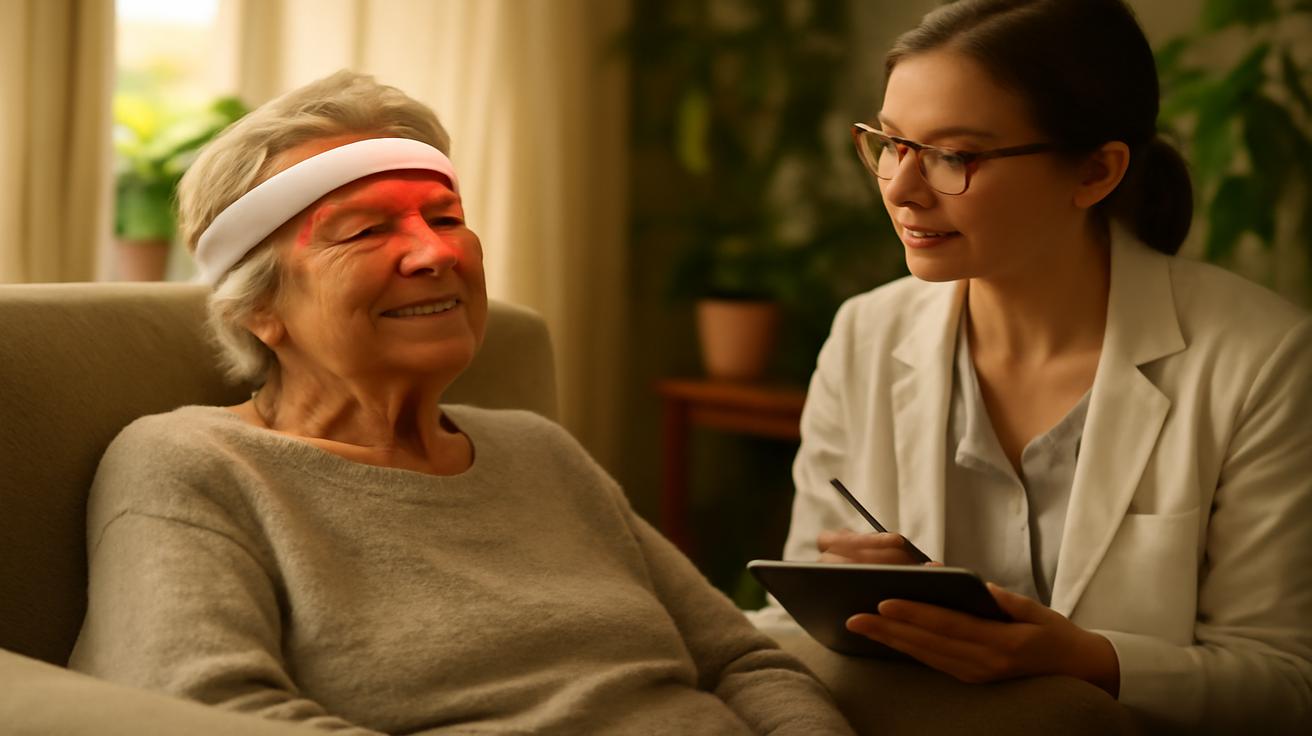
The lab looks nothing like a memory clinic. There are no crossword puzzles, no laminated brain-health tips on the walls. Instead, the room glows with an otherworldly shimmer—soft pulses of light from a strange-looking visor, a faint hum from a low, boxy device in the corner, and on a nearby screen, the ghostly outlines of a human brain flickering in real time. This is where Dr. Elena Ríos, a neuroscientist who once studied the brains of bats, is quietly trying to nudge human memory back from the edge of Alzheimer’s disease—using light.
A room full of flicker and hope
“You might feel a little silly wearing it,” Elena tells her volunteer, a retired math teacher in his early seventies. He laughs, patting his thinning gray hair. He has early symptoms of Alzheimer’s: misplaced keys, forgotten names, the nagging feeling that a once-sharp mind has grown foggy at the edges.
On the table in front of him lies the device: a lightweight band of LEDs designed to bathe his eyes and, through them, his brain, in a very specific rhythm of flickering light. It doesn’t look like medicine. There’s no needle, no pill, nothing that would pass for a classic treatment. It looks more like an odd piece of wellness tech you’d see in a luxury spa brochure.
Elena adjusts the strap, checks the settings—40 hertz, just as the protocol demands—then dims the room lights. The visor begins to pulse, too fast for the eye to consciously register, but fast enough that neurons, deep inside his brain, will begin to dance in time with it. She watches the volunteer’s face: calm, a little curious, a little skeptical. On the monitor, a gentle storm of electrical activity starts to build.
“We’re trying to talk to the brain in its own language,” she says, almost to herself. “And that language is rhythm.”
How brain rhythms quietly hold our memories together
When we talk about Alzheimer’s, we usually think in terms of plaques and tangles—those sticky clumps of amyloid protein and the twisted fibers of tau that clog the brain. But to scientists like Elena, there’s another story playing out: the story of brainwaves.
Imagine standing at the edge of an ocean at night. When your brain is healthy, your electrical activity moves like well-timed waves—some slow and rolling, some quick and rippling, all layered on each other. These rhythms help different parts of your brain talk. Memory centers in the hippocampus signal to the cortex; sensory areas share what your eyes and ears are picking up; networks that handle attention and emotion pulse in patterns that guide what you notice and what you forget.
Among these rhythms, one band has become a star suspect in early Alzheimer’s: gamma waves, especially around 40 hertz. These are the fast, precise ripples that shine brightest when you focus, when you learn something new, or when you’re knitting together new memories with old ones. In people with Alzheimer’s, these gamma rhythms often fade or become disorganized, even before memory problems become obvious.
“If you listen to a healthy brain, gamma is like a tight jazz ensemble,” Elena explains. “Everyone knows when to come in, when to drop back, how to stay on beat. In early Alzheimer’s, it starts to sound like a rehearsal where half the band is late and the drummer’s off tempo.”
The radical idea behind light therapy is almost childishly simple: what if you could guide the band back into rhythm from the outside, just by giving the brain a beat to follow?
The strange discovery that flickering light could clean the brain
The story really took off with a group of mice.
In a now-famous experiment, researchers exposed mice predisposed to develop Alzheimer’s-like brain changes to a flickering light at exactly 40 hertz. The mice weren’t given drugs. They didn’t do memory exercises. They just sat in front of a light that flashed on and off, just fast enough to entrain their visual systems and the brain areas tied to them.
What happened next startled even seasoned neuroscientists. Those mice, after repeated sessions, showed fewer amyloid plaques in some brain regions. Microglia—the brain’s innate cleanup crew—became more active, as if woken from a long nap. Blood flow patterns shifted. In some tests, the mice even performed better on memory tasks.
“It was like we’d found a dimmer switch somewhere in the neural circuitry,” Elena says. “We weren’t adding a drug or blocking a receptor. We were just giving the brain a rhythm and watching the cells respond.”
Other labs pushed the idea further. They combined 40-hertz light and 40-hertz sound, sending gentle pulses not just into the visual system but into auditory circuits as well. The effects spread more widely through the brain. Synapses—the junctions where neurons chat with each other—looked healthier. Inflammation markers dropped. New neurons in memory-related regions seemed to survive longer.
There was a catch, of course. Mice are not people. Their skulls are thinner, their brains smaller and differently wired. What works through a mouse’s eyes or ears may not penetrate a human cortex quite the same way. Still, the data spoke a tantalizing language: somehow, driving gamma rhythms at 40 hertz from the outside seemed to trigger internal housekeeping programs the brain had let slip.
That’s how more clinicians, like Elena, found themselves standing in darkened rooms, convincing anxious patients to put on blinking visors and sit still while their brains tried to sway back into sync.
The delicate move from mouse to human
Translating this flicker magic from animals to humans is like translating poetry into a new language—beautiful in theory, messy in practice. The first challenge was safety. Could flickering light at 40 hertz trigger headaches? Nausea? Seizures in people prone to epilepsy?
Small early trials suggested it was surprisingly well tolerated. Participants usually described the experience as strange but not uncomfortable, more like sitting in a dim room with an oddly “busy” sensation behind their eyes. Some said they felt a calm, almost meditative fog. A few felt mild eye strain that faded quickly.
Then came the other big question: could they even reach the right parts of the brain?
The visual cortex at the back of the skull is the first stop for flickering light. But Alzheimer’s doesn’t politely start only there. It tends to haunt deep memory structures first: the hippocampus, the entorhinal cortex, the networks that quietly knit together your yesterday and your tomorrow. Light, even cleverly flickered light, has to travel a long way in the brain’s circuitry to influence those areas.
This is where scientists leaned on the concept of entrainment. If you give neurons a steady beat to follow—light flashing at 40 hertz, or sound pulsing at 40 hertz—they often start firing in a synchronized way. That synchronized firing can spread through connected networks, like ripples fanning out from a single pebble tossed in a lake.
To test whether this really happens, Elena’s group and others started measuring brainwaves while people wore the visors. Electrodes placed on the scalp painted a rough but telling map. And in many early participants, something reassuring appeared: those fragile gamma waves, so dulled in early Alzheimer’s, began to brighten. Not just in the occipital lobes that handle vision, but in frontal and temporal areas tied to attention and memory.
“It’s like giving the brain a metronome,” Elena says. “Once we saw that, the next question was obvious: does that actually help people remember?”
Inside the clinical trials: quiet rituals of daily light
Most of the human trials now unfolding are small and cautious. They’re not miracle-hunting; they’re safety-testing, dose-finding, expectation-taming. But if you could sit quietly in one of these living rooms or clinics, you’d see a pattern emerge—a new ritual of daily light.
In some studies, participants take home a device that looks like a minimalist lamp or visor. They sit in front of it for an assigned period—often around 30 to 60 minutes a day—while it pulses at 40 hertz. They do this for weeks, then months. Their caregivers keep logbooks. Researchers check in, adjusting settings, asking about any side effects.
Cognitive tests are repeated: word lists to memorize, stories to recall, pictures to recognize, tasks that many people with early Alzheimer’s find frustrating. Brain scans are taken before and after the trial—sometimes structural MRI, sometimes functional imaging, sometimes PET scans tracking amyloid or tau. Some studies add blood tests looking for subtle changes in biomarkers of inflammation or neurodegeneration.
“It’s not dramatic,” Elena admits. “We’re not watching someone suddenly remember their wedding day after one session of light. It’s quieter than that.”
What her team and others are looking for is something more modest and arguably more precious: a slowdown. Less decline on memory scores over time compared with people using a sham (placebo) device that looks similar but doesn’t deliver true 40-hertz stimulation. Subtle improvements in attention. Stabilization where you’d otherwise expect a slide.
Early signals, while far from definitive, have been encouraging in some trials. A few groups have reported slower brain shrinkage in certain regions, small boosts in sleep quality, or improved daily functioning. Others saw changes in EEG patterns that suggest brain networks are communicating more efficiently again.
But results have not been uniformly glowing. Some trials show no clear cognitive benefit. Some improvements are so small that they’re easy to miss in real life. And no one yet can say how long any benefits might last once the daily flicker stops.
What exactly does the light seem to change in the brain?
When you dig into the emerging data, a cluster of possible mechanisms begins to take shape—still fuzzy at the edges, but intriguing.
| Potential Effect of 40 Hz Light | What Early Research Suggests |
|---|---|
| Boosted gamma brain rhythms | EEG studies show stronger, more synchronized gamma waves in people using 40 Hz light compared with controls. |
| More active microglia | Animal studies indicate microglia become more efficient at clearing amyloid when gamma is driven at 40 Hz. |
| Reduced inflammation | Some models show lower levels of inflammatory molecules in brain tissue after regular 40 Hz stimulation. |
| Improved network connectivity | Functional imaging hints that key memory and attention networks may communicate more smoothly. |
| Possible impact on plaques and tangles | In mice, amyloid plaques decrease; in humans, any effects on amyloid or tau are still being carefully studied. |
Not all of these findings have been replicated across studies, and many remain confined to animal models or very small human samples. Yet together, they paint an intriguing, almost cinematic picture: a brain whose most fragile rhythms are gently coaxed back into line, cellular cleanup teams roused, clogged pathways flushed, connections tuned.
“I don’t think light therapy will erase Alzheimer’s,” Elena says. “But if it can delay the worst of it—even by a year or two—that’s a lifetime of birthdays and conversations people might otherwise lose.”
The ethical tension: hope, hype, and desperation
Walk into any support group for families facing Alzheimer’s, and you will feel it immediately: the ache for something—anything—that might help. That deep longing is exactly what makes emerging therapies like light so vulnerable to hype.
Already, devices claiming to “reverse cognitive decline” with flickering light have begun to appear on the consumer market, often far ahead of the science. Glossy photos show smiling older adults bathed in a soft glow. Taglines promise “brain rejuvenation,” “age reversal,” or “drug-free cure.” Prices climb into the thousands.
Elena finds this both maddening and heartbreaking. “We’re still in the stage where we’re asking: which patients, at what stage, with what protocol, and for how long? We don’t know those answers. We’re learning. But the commercial world doesn’t like to wait.”
There’s also the risk of distraction. Alzheimer’s is a complex disease with multiple pathways: genetics, vascular health, immune responses, lifestyle factors, sleep, even gut bacteria. Light therapy may target one of these routes—brain rhythms and microglial cleanup—but it cannot rewrite all of them at once.
“Light isn’t a replacement for everything else,” Elena says. “Not for exercise, or good sleep, or managing blood pressure, or medications that address other aspects of the disease. The brain is an ecosystem. You can’t water just one plant and assume the forest will thrive.”
Still, for people facing a diagnosis that has long felt like a one-way road, even a small, noninvasive intervention that might slow the journey is worth exploring. And there’s something almost poetic, almost symbolic, in the idea that after decades of darkening synapses, perhaps it will be light—simple, rhythmic, pulsing light—that lends the brain a hand.
What this could mean for the future of Alzheimer’s care
If the ongoing trials pan out—even modestly—light therapy might find a home in a very different kind of clinic visit. Instead of leaving with only a prescription bottle, a person with early Alzheimer’s might leave with a carefully programmed light and sound device, plus a calendar of daily “brain sessions.”
Caregivers might learn to build flicker time into their loved one’s day the way we now build in a morning walk or evening medications. Imagine an early afternoon ritual: the house quiet, curtains partly drawn, the gentle blink of 40-hertz light filling the room while a soft hum of matching sound plays. The dog settles at someone’s feet. A grandchild sprawls on the carpet with homework. The treatment is quiet, almost invisible, but it’s there—tapping out a rhythm the brain remembers, even if the person sometimes forgets what they came into the room to do.
Integrating light therapy could also reshape how we think about diagnosis. If timing matters—as many researchers suspect—then detecting Alzheimer’s sooner becomes even more urgent. Tests that pick up subtle changes in brainwaves or retinal responses might join memory tests as early-warning systems, flagging people who could benefit most from these noninvasive rhythms before too much damage is done.
And beyond Alzheimer’s, the success or failure of this approach will inform a bigger scientific gamble: can we systematically use rhythm—light, sound, gentle electrical pulses—not just to observe the brain, but to tune it? For depression, for Parkinson’s disease, for sleep disorders? Light therapy for mood has already found a firm footing; gamma-focused interventions are simply the next frontier.
In the half-light, a new kind of medicine
Back in the lab, the session is nearly finished. The visor still flickers at 40 hertz. On the screen, the volunteer’s gamma waves ripple in quiet alignment, a thin silver signal threading across the landscape of his brain. He can’t feel his neurons syncing up. To him, it’s just a strange half-hour in a dim room with a scientist watching quietly from behind a monitor.
When the device finally powers down, the room seems suddenly brighter, even though the overhead lights haven’t changed. The volunteer blinks, takes off the visor, and runs a hand across his forehead.
“That’s it?” he asks.
“That’s it, for today,” Elena replies. She knows the hope he’s carrying, the unspoken questions: Will this help me remember my daughter’s birthday? Will it keep me myself a little longer?
Science doesn’t yet have complete answers. What it has instead is a growing web of data, a series of cautious steps, and an unexpected new tool that feels strangely gentle compared to the weight of the disease it’s trying to face. No scalpels. No harsh side effects, at least so far. Just light, flickering at a frequency that speaks to neurons in their oldest, most fundamental language.
In that quiet space between what we know and what we’re still daring to test, a new kind of Alzheimer’s medicine is being born. Not in the form of a miracle cure, but as a rhythm—a subtle, pulsing invitation for the brain to remember how to be itself.
Frequently Asked Questions
Is light therapy for Alzheimer’s approved as a standard treatment?
No. As of now, 40-hertz light therapy for Alzheimer’s is still considered experimental. It is being tested in clinical trials to evaluate safety, feasibility, and potential benefits, but it has not been approved as a standard medical treatment by major regulatory agencies.
Can I buy a light device and use it at home to prevent Alzheimer’s?
Consumer devices are already marketed for “brain health,” but using them without medical guidance is risky and may not be effective. The exact frequency, intensity, duration, and timing of stimulation matter, and these parameters are still being studied. If you’re interested, talk with a neurologist or memory specialist and ask about ongoing clinical trials rather than self-experimenting.
Does light therapy work better in early stages of Alzheimer’s?
Most current studies are focused on people with mild cognitive impairment or early-stage Alzheimer’s, where there is still substantial brain network function to support. The hope is that the technique can slow decline rather than reverse severe damage. How well it works at different stages is still an open research question.
Are there side effects from 40-hertz light therapy?
In early human trials, side effects have generally been mild: occasional eye strain, slight headaches, or discomfort from the flicker. People with a history of photosensitive epilepsy or certain visual disorders may be at higher risk and should be screened carefully. Larger studies are underway to better understand long-term safety.
Will light therapy replace medications for Alzheimer’s?
Unlikely. Most experts see it as a potential add-on therapy, not a replacement. Alzheimer’s arises from multiple overlapping processes—protein buildup, inflammation, vascular changes, and more. Light therapy may help with some of these, particularly brain rhythms and cellular cleanup, but it will probably be most effective when combined with medications, lifestyle changes, and other non-drug interventions.
How long would someone need to use light therapy to see benefits?
We don’t know for sure yet. Many trials use daily sessions over several months and then track changes. It’s possible that benefits, if they occur, may depend on consistent, long-term use—more like physical therapy for the brain than a one-time procedure.
How can I find out if there’s a light therapy trial near me?
The best starting point is to talk with a neurologist, geriatrician, or memory clinic. They can tell you whether they’re involved in such studies or refer you to research centers that are. Many major academic hospitals maintain registries for people interested in participating in Alzheimer’s research, including trials testing light and sound stimulation.








Leave a Comment