
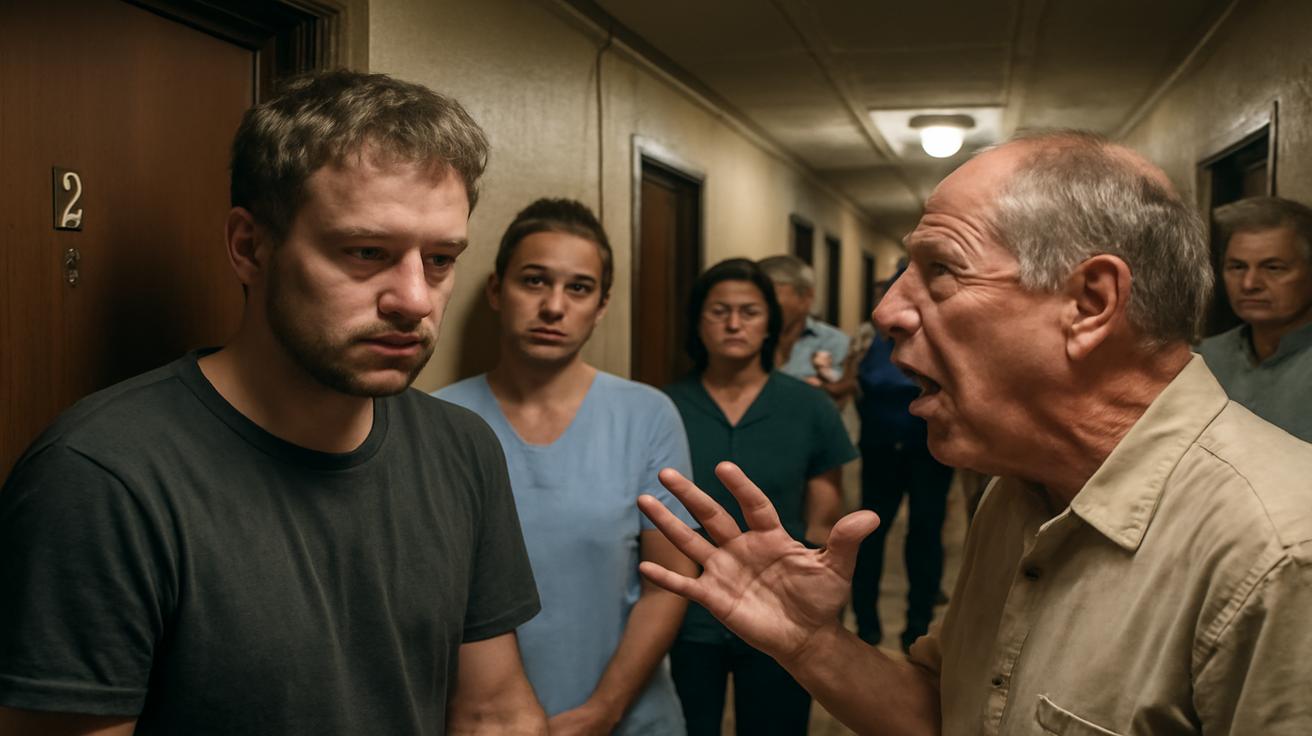
The night it began, the oxygen machine made a sound like distant surf—soft, steady, relentless. Beside it, my father’s chest rose and fell beneath the thin hospice blanket, each breath a negotiation with the dark. Our small living room was thick with the smell of antiseptic wipes and chamomile tea, the windows cracked just enough to let in the cold November air and the murmured traffic five stories below. It was almost midnight when the knock came—sharp, impatient, and nothing like the gentle tap of a neighbor checking to see if we needed anything.
The Last Week
By then, we were already counting time in breaths instead of hours.
Hospice had started three days earlier. The nurses came in shifts—soft shoes, clipped badges, their canvas bags rustling with syringes, gauze, and tiny bottles of morphine that I learned to measure with shaking hands. They spoke in low, practiced tones, the way people do in art galleries and hospital corridors. Their presence filled the apartment, not just with movement but with a new, fragile kind of order in the chaos of dying.
My father’s world had shrunk to this two-bedroom apartment with its scuffed parquet floors, the crooked blinds that never quite closed, the humming refrigerator that sounded too loud in the thick night. Outside our door, the building lived its usual life—dogs barking at delivery drivers, the upstairs couple fighting over misplaced keys, the teenager on the third floor practicing saxophone scales too late into the evening. All the usual noise of people living stacked on top of one another.
Inside, though, time felt suspended. The hospice nurse that night, Marisol, stood by the sofa that had become a hospital bed. She adjusted the thin tube under my father’s nose and murmured to him in a soothing mix of English and Spanish, her voice a soft river in the dim light. The TV flickered silent images of an old movie he used to love, the sound turned low so he could rest but loud enough, I hoped, to reach him somewhere I could not.
We’d been told hospice at home was “the compassionate choice.” They said it like a gentle assurance, but no one mentioned what it would mean in an old building with thin walls, where every footstep and cough passed easily from home to home like rumors in a small town.
The Knock That Shook the Walls
The knock came again—three quick, hard raps against the wood—and this time my father’s eyelids fluttered. Marisol glanced at me, her brows knitting, then back at him.
“It’s okay,” I whispered, more to myself than to him. “I’ve got it.”
Our hallway smelled faintly of someone’s dinner—garlic and tinned tomatoes and something frying in oil. The overhead light buzzed and flickered. I opened the door a few inches and was met with the pale, set face of my neighbor from 5B, Gregory.
We’d lived across from each other for six years. I knew his schedule better than his name: the jangle of his keys at 6:10 every evening, the steady thump of his treadmill through the wall on Saturday mornings, the click of his door at 7:45 every weekday as he left in a pressed shirt and polished shoes. We’d exchanged exactly two meaningful conversations in all that time—once about a water leak in the ceiling, once about the mail being misdelivered. We were classic city neighbors: parallel lives, carefully separate.
That night, he stood in the hallway in flannel pajama pants and a navy T‑shirt, his hair mussed but his expression sharp as broken glass.
“Do you have any idea what time it is?” he whispered harshly, the effort of keeping his voice low turning it into a hiss.
I blinked, the fog of exhaustion thick around me. “It’s… almost midnight,” I said. “Sorry, is something wrong?”
“Yes. Something is wrong,” he said. “This has been going on all week. The talking. The opening and closing of your door. The beeping. The… whatever that is.” He pointed vaguely past me, toward the sound of the oxygen machine. “Some of us have to work in the morning.”
Behind me, the faint suction of the machine continued its rhythm. A car alarm burst briefly into life on the street, then died again, the city’s heartbeat never really stopping. Somewhere far down the hall, someone’s TV laughed with a sitcom audience.
“My dad is on hospice,” I said, the words catching in my throat. They still felt new and unreal in my mouth. “They’re just doing their job. He doesn’t have much time.”
His jaw clenched. “I am sorry about your father,” he said, and for a fleeting second I saw genuine discomfort in his eyes. Then it closed up, shuttered. “But that does not mean you get to disrupt the entire floor. There are noise guidelines. Quiet hours. I’ve been patient. But this—” he gestured again at the invisible machines and unseen nurses—“this is excessive.”
Behind us, a soft moan surfaced from the living room, followed by Marisol’s gentle voice: “Mr. Carter, I’m right here.”
Gregory’s eyes flickered past me in irritation, as though the sound itself were a personal slight. “See? This is what I’m talking about. It’s almost every night.”
I felt something hot and electric surge up through the exhaustion and grief. “He’s dying,” I said, my voice sharper than I intended. “You’re complaining about noise, and he’s dying.”
“And I’m just supposed to lose sleep indefinitely?” he shot back. “I have a critical presentation tomorrow. I can’t focus at work. We all have problems. Your personal situation doesn’t trump everyone else’s lives.”
The word “situation” landed like gravel in my stomach.
“This is his last week,” I said. “Maybe his last days.”
“You’ve been saying that for a while,” he said, eyes narrowing. “How long is this going to go on?”
For a moment, the hallway seemed to tilt. I saw my reflection, faint in the narrow glass of the fire extinguisher case opposite us: hollow cheeks, dark crescents under my eyes, my T‑shirt stained with coffee and something I didn’t want to name. I saw him too—tired, yes, but unmarked, a man whose life still ran on predictability and alarms and deadlines.
“As long as it takes,” I said quietly. “It’s his home. He deserves to die here. If the noise bothers you, maybe you could try earplugs for a few nights.”
His face flushed. “Earplugs? The burden is on me? You should move him to a facility if he needs that much care.”
“You want me to evict my dying father from his own bed so you can get eight hours?”
Our voices had risen. A door further down the hall cracked open, then shut again quickly. The building was listening.
When Grief Meets Thin Walls
What happened next didn’t feel like a single explosion but rather the moment a slow-burning fuse finally reached whatever waited at the end.
“This is unreasonable,” Gregory insisted. “You didn’t warn anyone. You didn’t post anything. No one agreed to live next to a hospital room.”
I thought of the paperwork I’d signed with hospice, the quiet, earnest social worker who’d explained our “rights and responsibilities” in careful detail. No one had mentioned neighbors or building politics, just medications and emergency protocols and “comfort measures.”
“There is no form for ‘permission to die at home,’” I said. “Look, we’re trying to keep it quiet. The nurses are whispering, for God’s sake.”
He exhaled sharply, an almost theatrical sound of frustration. “If you won’t do anything, I’ll have to talk to the landlord. This can’t continue.”
“Do what you have to do,” I said. “I’ll be in there making sure my dad isn’t in pain.”
I closed the door slowly, not slamming it, though my whole body wanted to. On the other side, I heard a low mutter, then the slap of his bare feet on the hallway carpet.
When I turned back into the apartment, the air felt different, like a window had been opened in a storm. Marisol watched me with quiet, measured eyes.
“Everything okay?” she asked softly.
“Neighbor,” I said. “Complaining about noise.”
Her gaze flicked toward the door as if she could see through it. “It happens,” she said simply. “People don’t know how to live next to death. They think it’s contagious.”
My father stirred, his lips forming words that no longer quite made sense. I held his hand and tried to anchor myself in the warmth of his skin, in the small, stubborn signs that he was still here with me in this room, no matter what waited in the hallway.
The Building Takes Sides
By morning, our private hallway argument had become public property.
I found out the way people always do in apartment buildings: not from the original source but from someone in the laundry room, standing over a rattling washer that rocked slightly out of balance.
“I heard about Gregory giving you a hard time,” said Mrs. Ellis from 5D, her hands deep in a plastic basket of unfolded clothes. She’d lived here longer than anyone, her apartment door always propped open with a ceramic cat. “Don’t you worry, dear. Some people have no heart.”
I stared at her. “You heard?”
“These walls are paper,” she said with a shrug. “And Gregory has a loud voice. He was in the lobby ranting to the super this morning. Something about ‘medical equipment’ and ‘constant disturbances.’”
A flush crept up my neck. “What did the super say?”
“Milo just nodded the way he always does,” she said. “Told him to put it in writing. He looked mighty uncomfortable, though.”
By the time I took the elevator back up, it had begun. The looks. The small shifts in posture that carried entire paragraphs of opinion.
The young couple in 5F—both earbuds and yoga mats—stopped me in the hallway that afternoon with concerned faces and breathable fabric.
“We just wanted to say we’re so sorry about your dad,” the woman said, touching my arm. “If you need someone to pick up groceries or anything, we’re right down the hall.”
“And don’t worry about the noise,” her partner added quickly. “We get it. Completely. Gregory is being… well… Gregory.”
On the other side of the hall, though, the door to 5C closed a bit too quickly when I walked by. The single father on 5A, usually talkative about his son’s soccer games, kept his greeting short, eyes fixed on his phone.
It was as if my father’s failing body had become an invisible line down the middle of the floor.
Over the next two days, the split hardened.
People started leaving things outside our door. A casserole dish with a note: “For when you’re too tired to cook. – 5D.” A basket with herbal teas and a lavender candle. A card slid carefully under the mat: “Thinking of you and your dad. – 4B (we can hear everything, and we don’t mind).”
At the same time, an email appeared in our inboxes from the building management, forwarded to me by three different neighbors with various levels of fury.
| Group | Main Concern | Typical Comment |
|---|---|---|
| Supportive Neighbors | Compassion & dignity for a dying resident | “Noise is temporary. Let him have peace at home.” |
| Frustrated Neighbors | Sleep, work, children’s routines disrupted | “We sympathize, but what about our lives?” |
| Neutral/Quiet Group | Avoiding conflict, watching from sidelines | Silence in the hallway, eyes averted. |
The email was couched in vague language about “recent concerns regarding late-night noise” and “balancing compassion with the rights of all residents.” It didn’t name us, but it didn’t have to. Everyone knew.
Whispers Through Vents and Floors
The war wasn’t loud; it didn’t need to be. In a building like ours, even silence had sides.
The elevator became a referendum. If Gregory stepped in and someone from what I started to think of, darkly, as “our side” was there, conversation stopped. If he entered a half-full elevator and those who supported him were already inside, I could almost feel the air thicken with mutual indignation as the doors slid shut on their tight cluster of agreement.
Once, as I waited for the lift with a bag of medications, the door opened to reveal Gregory already inside, arms folded, staring straight ahead. For a second, we both hesitated. Behind me, footsteps approached—the yoga-mat couple. I stepped in. They stepped in after me, deliberately positioning themselves like a tiny buffer.
Five stories. Four stops. No one said a word. I could hear the faint hiss of the elevator’s cables, the click as floors lit up and went dark again.
Later, I heard that Gregory had started knocking on doors, building a quiet coalition. “Of course we’re all sorry,” he’d say, voice lowered in performance of concern. “But there has to be a limit. Children need sleep. People have jobs. It’s not just about one person.”
He wasn’t entirely wrong. That was part of what made it all so corrosive.
On the fourth night, my father groaned through a long, ragged hour of pain as the nurses adjusted his medication. His voice, thin and reedy, carried through the walls. I pressed a washcloth to his forehead and imagined the sound reaching the next apartment, then the next—bouncing off framed art prints, passing through baby monitors, drifting into headphones and around carefully curated furniture.
Was someone on the other side of our wall pressing their own pillow over their ears, cursing my father’s slow dying? Was someone lying awake with tears in their eyes, listening to the soundtrack of a stranger’s last hours?
The Night Everything Cracked
It came to a head on a Thursday, the air outside turned sharp by an early frost. Inside, the heat of too many bodies and too much emotion made the hallway feel claustrophobic.
My father’s breathing had become uneven that day, his hands colder, his eyes mostly closed. The hospice nurse on duty—an older man named Jerome with a calm, ocean-deep voice—had pulled me gently into the kitchen.
“It may be soon,” he said. “Hours. A day, maybe. I can’t say exactly. But we’re close now.”
I nodded, the room suddenly distant. My father’s half-empty mug of tea sat on the counter, a small ring of dried honey at the bottom, as if he might walk in and pick it up at any moment.
That evening, family came. My aunt with her rosary beads and gentle humming. My brother, who’d flown in that morning, moving through the apartment like a stunned animal, touching doorframes as if to make sure they were still there. My cousin who baked a cake no one would eat.
The apartment filled with low voices, the click of spoons against mugs, the rustle of coats on the back of chairs. We tried to be quiet. We tried so hard. But there is a certain volume to human grief, even in whispers.
At around ten, there was another knock on the door. Not sharp this time, but insistent.
I opened it to find Gregory not alone but flanked by two other residents I knew only by sight: the father from 5A and a woman from 4C who always smelled faintly of expensive perfume.
“We need to talk,” Gregory said.
Behind me, the apartment was full of soft movement, the murmur of my aunt’s prayers. Behind him, the hallway emptied out, doors cracked just enough to let eyes peer through.
“Now is not a good time,” I said.
“It hasn’t been a good time for a week,” he replied. “We’re at the end of our patience. People are exhausted. My colleague’s kid didn’t sleep again last night because of the crying and the door slamming and the constant nurse traffic.”
“We’re about to lose our father,” my brother said, appearing at my shoulder. His voice was strange, stretched thin. “You’re complaining about doors?”
“We understand that you’re going through something terrible,” the woman from 4C said, her tone the precise mix of sympathy and irritation perfected in long corporate meetings. “But the rest of us should not have our lives disrupted indefinitely. There are institutions for this.”
“This is his institution,” I snapped. “This one-bedroom with the stained carpet and the crooked blinds. This is where he watched us grow up, where he fixed our bikes in the hallway and burned toast on Sunday mornings. This is home.”
My aunt’s rosary beads clicked behind me, a steady metronome of faith.
The father from 5A stepped forward, face drawn. “My son has exams,” he said. “He’s ten. He keeps asking if the man next door is going to die while he’s sleeping. He’s scared.”
Of all the things said in that hallway, that was the only one that pierced cleanly. I imagined a small boy lying in bed, listening to my father’s labored breaths through the wall, learning too early that walls don’t keep everything out.
I took a breath. “I’m sorry,” I said. “I really am. But we are near the end. This will not be forever.”
“You said that last week,” Gregory replied, crossing his arms.
We might have gone on like that—back and forth across the same chasm—if it hadn’t been for what happened next.
The door behind me opened wider. Jerome stepped into the hallway, his presence suddenly making it feel smaller. He wore blue scrubs and tired eyes that had seen this scene play out in more versions than we could imagine.
“Excuse me,” he said, his voice calm but firm. “Mr. Carter is actively dying. Right now. His breathing is changing. His blood pressure is dropping. He may not make it through the night. His family needs to be with him. This conversation can wait, or it can end.”
His words fell into the hallway like actual weight. For a moment, no one spoke. The muffled sounds of the city filtered in from the stairwell: a siren far off, someone shouting, a car door slamming.
Gregory’s mouth opened, then closed. I watched as something flickered across his face—annoyance, discomfort, a flicker of shame? It was hard to say. He took a tiny step back.
“We… we didn’t realize it was that… immediate,” the woman from 4C said.
Jerome nodded. “It is. I’ve been a hospice nurse for fifteen years. I know what it looks like.” He met their eyes in turn. “Sometimes, the last gift we can give someone is to let them go in peace, surrounded by familiar things. Sometimes that means we ask a little more of the people who live nearby.”
The father from 5A looked down at his shoes. “I’ll explain it to my son,” he murmured. “He should probably know what’s happening anyway.”
Gregory’s jaw worked. For a second, I thought he might pivot, might soften. Then his eyes hardened again, finding the safer path of abstract principle over messy reality.
“I still plan to file a formal complaint,” he said quietly. “But… we’ll leave you for tonight.”
They left. The doors along the hallway closed, one by one, like eyes shutting.
What Remains After the War
My father died just after two in the morning, his last breath a soft exhale that barely disturbed the air between us. Jerome checked his pulse, nodded once, and stepped back to give us space.
The apartment went impossibly still. Even the oxygen machine was silent, its purpose completed. The city, for once, seemed to hush in sympathy.
The days after were a blur of paperwork, phone calls, the smell of lilies and the rustle of black clothes. People came and went. Some neighbors I barely knew pressed my hand in the elevator, eyes shiny. Others looked away, as if death might catch their gaze and follow them home.
The building never quite went back to how it was.
Those who had brought casseroles and left notes continued to check in. They helped carry boxes, watered plants when we traveled for the small memorial. A quiet intimacy had slipped through the cracked plaster and stayed.
Those who had signed Gregory’s email petition kept their distance. We rode the same elevator in frostbitten silence. We collected our mail side by side without speaking. We lived inches apart and miles away.
As for Gregory, he remained exactly where he’d always been: four steps across the hall, a door that shut with precise finality. He no longer nodded hello. Neither did I.
From time to time, I heard the thud of his treadmill through the wall, the echo of his disciplined footfalls as he ran in place, sweating out the day’s frustrations. It was a sound of determination, of control asserted over a small square of space. I wondered if, late at night, he ever thought about the week when death moved in across from him with its beeping machines and whispered prayers.
Grief, I learned, doesn’t stay inside one apartment. It seeps under doors, travels through vents, lingers in the mailroom and the stairwell. In a building stacked with lives, there is no such thing as a purely private sorrow. It touches everyone, whether they want it to or not.
Months later, the building still bore the invisible fault line that had opened that week. Birthdays were celebrated on one side with shared cupcakes and borrowed chairs; quiet complaints about noise and hallway clutter floated on the other. The war never exploded again, but it never truly ended either. It became part of the architecture.
Sometimes, late at night, I’d sit in the dim living room where my father had taken his last breath and listen to the building breathe around me—the creak of someone turning over in bed upstairs, the soft shhh of water in pipes, the murmur of a TV two floors down. All of us, stacked together, each carrying our invisible burdens: deadlines and exams, aging parents and restless children, heartbreak and hope.
There is no tidy resolution here, no moral that neatly stitches up the tear. Living this close to one another means our lives will collide in ways that are unfair and messy. Compassion will fail us sometimes. So will patience.
But I’ve come to believe that the measure of a community isn’t how quiet it stays in the face of discomfort, but how much humanity it can hold when one of its own is slipping away.
Frequently Asked Questions
Is this story based on real events?
The narrative is written in a realistic, nature-of-life storytelling style and draws on situations that commonly occur in apartment buildings when hospice care happens at home. While the specific characters and events are fictional, the emotional and social dynamics are grounded in real experiences that many families and neighbors have reported.
Can hospice care at home really cause this much conflict?
Yes. Hospice at home can involve medical equipment, visiting nurses at irregular hours, and emotional family gatherings. In buildings with thin walls, this can create tension, particularly when neighbors are already stressed, sleep‑deprived, or feel blindsided by the situation.
What could the family have done differently to avoid the conflict?
Some families find it helpful to inform neighbors in advance with a short note explaining that a loved one is on hospice, that there may be some unusual noise, and asking for patience. Offering a way to contact them directly with concerns can sometimes reduce resentment. However, even with perfect communication, not all conflicts can be prevented.
What could the neighbors have done differently?
Neighbors could have approached the situation with more curiosity and compassion, asking what was needed and how long it might last before escalating to complaints. Simple gestures—earplugs, white‑noise machines, temporary schedule adjustments, or practical offers of help—can make a significant difference during a short, intense period like end‑of‑life care.
Are there legal protections for hospice patients in apartments?
In most places, tenants have the right to receive medical care, including hospice, in their homes. Noise and nuisance rules still apply, but reasonable, temporary disturbances related to essential care are often tolerated or protected. Specific rights and responsibilities vary by region and by lease, so tenants and neighbors concerned about such situations should consult local housing regulations or a tenant advocacy organization.







Leave a Comment