
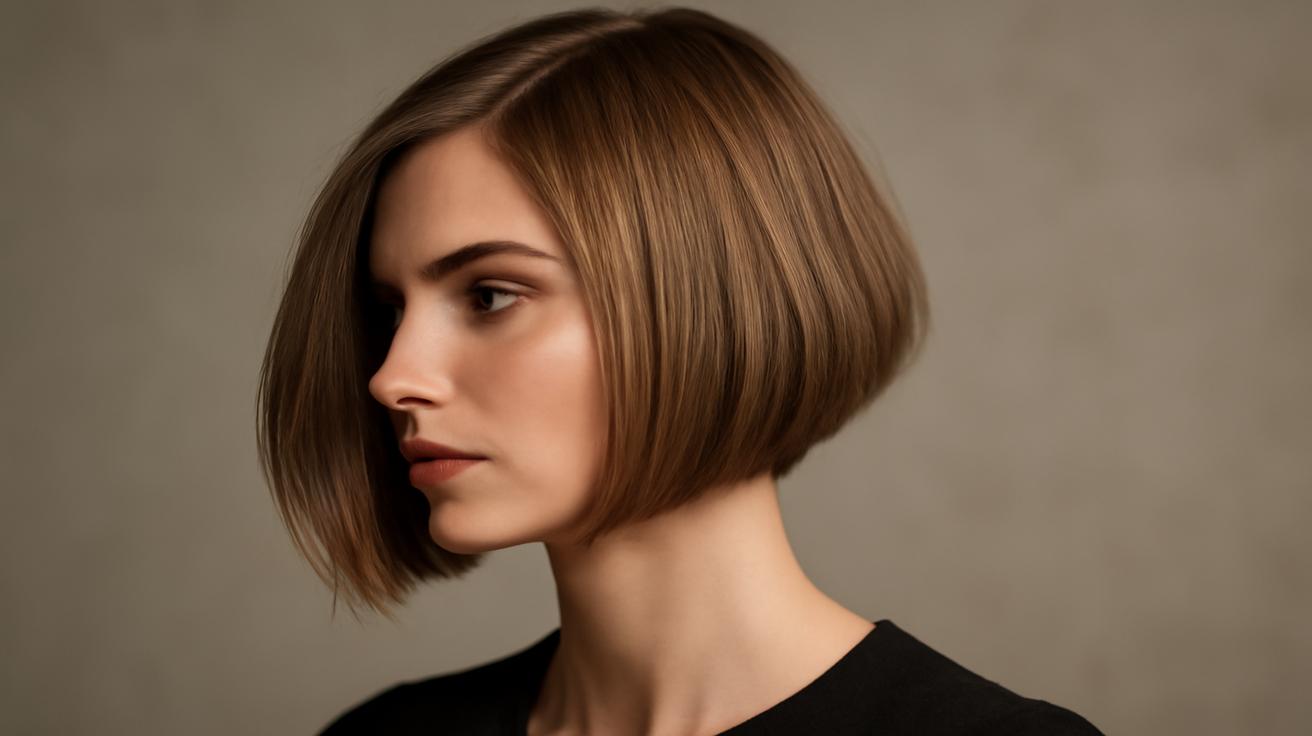
The first thing you notice is the sound. That soft, deliberate snip of scissors gliding through hair, the gentle fall of fine strands onto a black cape, the slight intake of breath as length is traded for shape. Outside, leaves are already starting to crisp, catching in the wind like confetti. Inside the salon, the light is honey–gold, pooling across mirrored stations, catching the silhouettes of women who, like you, are ready to shed a little of summer and walk into fall with something sharper, clearer, more intentional. Your reflection looks back—familiar, and yet right on the edge of change. The stylist lifts a section of your hair, angles her fingers, and you see it in the mirror for the first time: the clean, sloping line of an A-line bob beginning to take form. It’s subtle but powerful, like the first cool morning after a long, heavy August: a whisper of what’s coming.
The Bob That Moves With the Season
There’s something about fall that makes us crave structure. After the sun-faded looseness of summer—freckles, frizz, air-dried waves and ponytails—we start to want edges again. Sweaters hug the shoulders, jackets find their way back onto hooks by the door, and our hair, suddenly, feels like it could say something more than just “I survived humidity.”
The A-line bob slips perfectly into that seasonal mood. At first glance, it’s simple: shorter in the back, gradually lengthening toward the front, following the soft line of your jaw and collarbone. But the magic, especially for fine hair, is hidden in the geometry. The stacked, slightly elevated back gives the illusion of fullness and natural lift, while the longer, face-framing front keeps the overall look soft and flattering instead of severe. It’s the hairstyling equivalent of a crisp trench coat worn over a worn-in, beloved tee: structured, yet easy.
On a windy October sidewalk, this cut doesn’t just hang. It moves. The shorter layers at the nape resist collapsing into a flat sheet, and the forward-skimming pieces catch the air just enough to sway. Fine hair tends to fall limp, sliding into a shapeless curtain by midday. The A-line bob turns that tendency on its head. The weight is distributed differently—light in the back, with just enough length in the front to keep it from feeling too cropped. You walk, and your hair walks with you, not against you.
Why Fine Hair and an A-Line Bob Are Secret Soulmates
If you’ve lived with fine hair for long, you probably know the unique blend of frustration and resignation that comes with it. You’ve watched curls deflate by lunchtime, volume vanish before you’ve even left the house, and any attempt at long layers gradually slide into static, flyaway ends. Fine hair loves to misbehave in subtle ways: it doesn’t always look bad; it just rarely looks like it has intention.
The A-line bob changes that conversation, not by fighting your hair’s natural texture, but by working with it. The cut uses three quiet strategies that are especially kind to fine strands:
1. Weight where you need it, lightness where you don’t.
The back of the bob is slightly shorter and, depending on your stylist, can be softly stacked or just gently graduated. That means the hair layers over itself, building the illusion of density without relying on heavy layering that can actually thin out fine strands. The longer front pieces keep just enough weight at the ends so they swing, rather than fray.
2. Built-in volume at the crown.
Because the back is cut shorter, the hair at the crown doesn’t have as far to travel. It naturally wants to lift instead of lie flat. For someone who has spent years teasing, spraying, and pleading with their roots, this is a small revolution. You can step out with a lightweight blow-dry and still look put-together.
3. A clean perimeter line that reads as fullness.
Fine hair responds beautifully to a strong outline. The crisp, angled hem of an A-line bob makes your hair look thicker where it counts—at the edges—because the eye reads that sharp line as volume. It’s not just hair; it’s architecture.
When a gust of cold air snakes its way down the street, lifting fallen leaves and scarves, the A-line bob reveals one of its quiet superpowers: it keeps its shape. Even when your hair is fine enough to float, the cut reins it in just enough. You get movement without mess, softness without collapse.
The Fall Story Your Hair Can Tell
It’s late afternoon, and the light outside has shifted. Summer’s harsh white glare is gone; in its place, a deeper, burnished gold. You notice how everything seems more dimensional in this kind of light—the ridges on tree bark, the subtle veins in a drying leaf, the rise and dip of sidewalks you’ve walked a thousand times. This is the kind of light that flatters an A-line bob.
In fall, clothing layers naturally become more structured. Turtlenecks show off your neck. Coats define your shoulders. Scarves frame your face. A long, shapeless haircut can get swallowed by all that fabric—tucked under collars, pressed under wool, losing itself in the folds. An A-line bob, though, thrives in this season of wrapping and layering.
Picture yourself stepping into a café, cheeks flushed from the wind. You unwind your scarf, and your bob falls neatly into place around your face. The shorter back is safely above your coat collar, while the longer front pieces skim just along your jaw and graze the top of your sweater. Your hair becomes part of the composition, not an afterthought to be yanked free from under your jacket every few minutes.
There’s also a feeling to this cut that matches the emotional palette of fall. It’s not dramatic like a pixie, not romantic like long, cascading waves. It sits in that sweet spot of “I made a choice” without screaming for attention. The A-line bob whispers: I know who I am, and I’m editing the excess. The same way you might sift through your closet and keep only what feels right for the person you’re becoming this season, this cut lets you trim away what’s weighed you down—unruly ends, outdated layers, the old story of “my hair is too fine to do anything interesting.”
Different A-Line Bobs for Different Kinds of Fine Hair
Not all fine hair is the same, and not all A-line bobs should be either. Fall’s trend isn’t about a single, cookie-cutter version; it’s about an overall silhouette that can be tailored like a perfect coat.
Here’s a simple way to think about how different versions might work for you:
| Fine Hair Type | Ideal A-Line Shape | How It Helps |
|---|---|---|
| Silky, very straight | Sharp A-line with subtle graduation | Creates strong outline and natural swing |
| Fine with slight wave | Soft A-line with minimal layering in front | Lets the wave show without looking wispy |
| Fine but dense | More pronounced angle, with gentle internal thinning | Prevents bulk in back while keeping fullness |
| Fine and prone to frizz | Slight A-line, length just below the chin | Gives weight to calm frizz but keeps a modern shape |
This fall, the trend leans toward softer, slightly undone versions of the A-line bob—nothing too aggressive or sharply stacked. Think: an angle you can sense, not measure with a protractor. The hair grazes the jaw or brushes the collarbones, with ends that can be worn straight and sleek one day, then tousled and airy the next. For fine hair, that versatility feels like freedom.
Living With an A-Line Bob: The Everyday Ritual
Morning comes earlier in the colder months. The alarm sounds in the dim half-light, and the sky hasn’t quite made up its mind to be day. There’s comfort in rituals now—coffee brewing, a favorite mug warmed between your hands, the quiet hum of the blow dryer in the bathroom. One of the underrated gifts of an A-line bob is how it fits into the rhythm of real life.
With fine hair, long cuts can feel like a commitment to constant optimization: root lifting sprays, round brushes, hot tools, the desperate midday fluff. The A-line bob eases that pressure. Its very structure does some of the styling work for you.
Here’s what an ordinary fall morning with this cut might look like:
- You step into a warm shower, the bathroom mirror fogging over while the first chill of the day loosens from your shoulders.
- After washing, you press a towel gently into your hair, not rubbing, just absorbing. Fine hair loves kindness.
- You smooth in a lightweight volumizing mousse or spray, focusing at the roots at the back and crown.
- Head flipped upside down, you blow-dry until your hair is almost dry, letting gravity help with lift.
- Then you stand upright, guiding the front pieces with a brush or your fingers, letting them fall along your cheeks, framing your face softly.
In less time than it takes to toast a slice of bread and spread it with jam, your A-line bob has found its shape. The shorter back sits neatly against your neck—or floats just above a higher neckline—while the longer front pieces skim forward, drawing the eye toward your features. Your hair looks like you tried harder than you did. On busy days, that matters.
And for the evenings when the world asks you to be a bit more polished—a dinner, a date, a gathering in a warmly lit living room where boots pile up by the door—this cut rises to the occasion. A quick glide of a flat iron for sleek shine, or a few bends with a curling wand for loose, modern waves: the A-line bob knows how to dress up without drama.
How to Ask for the Cut (And Actually Get It)
Walking into a salon with a picture in your head and leaving with something only vaguely related is a rite of passage most of us would be happy to skip. The A-line bob might be simple, but its power is in the details—especially when you’re working with fine hair. Having the right language helps.
When you sit down in the chair this fall, cape rustling lightly as it settles over your shoulders, here are some phrases that can guide the consultation:
- “My hair is fine and tends to fall flat. I want an A-line bob that builds volume in the back without too many layers.”
- “I’d like the back to be shorter but not severely stacked—more of a soft graduation.”
- “In the front, I want it to angle toward my chin/collarbone so it still feels feminine and frames my face.”
- “I want the perimeter line to stay strong so my ends don’t look wispy.”
- “I need something that looks good with minimal styling most mornings.”
Bringing a few reference photos helps, but be honest about your daily habits. If you know you’ll rarely spend more than ten minutes on your hair, say so. A good stylist can tweak the angle, the length, and the density of the ends so the cut cooperates with your life, not just your fantasy.
When the scissors finally do their work and the last long pieces slide to the floor, there’s a familiar flutter—a mix of loss and excitement. But as your stylist dries and shapes the new line, you see something you maybe didn’t expect: your neck looks elegant, your shoulders defined, your face somehow more visible without being exposed. The A-line bob doesn’t hide you; it reveals you gently, and that feels strangely like coming home to yourself.
Why This Bob Is About More Than a Trend
Every season comes with its list of what’s “in”—colors, fabrics, hemlines, silhouettes. Hairstyles, too, are presented like a rotating carousel of shoulds. But the reason the A-line bob feels poised to become the cut for fine hair this fall isn’t just because it’s stylish. It’s because it answers a deeper seasonal shift.
Autumn is, at its heart, a season of editing. Trees let go of what they no longer need. Gardens retreat quietly underground. We pare back, prune, store up what nourishes, and release what doesn’t. In that context, chopping off a few inches might seem small, but it sits in harmony with the bigger rhythm of the natural world.
For someone with fine hair—hair that has maybe been a source of limitation or low-grade annoyance—the A-line bob can feel like a reclamation. Instead of chasing volume that never lasts, you’re choosing a shape that is designed to work with what you have. Instead of clinging to length that looks better on a hanger than on your real-life head, you’re trading it for movement, clarity, and ease.
Imagine yourself a month from now. The trees outside your window have traded green for bronze and russet. Your boots live permanently by the door. Your mornings are cooler, your evenings darker, your calendar fuller. You catch a glimpse of yourself in a shop window—a flash of clean angle at the jaw, hair tucking neatly into the collar of your coat, eyes brighter somehow. You don’t just look “on trend.” You look like you’re in conversation with the season itself.
The A-line bob doesn’t ask you to become someone else. It simply sharpens the outline of who you already are, giving your fine hair the structure and story it’s been quietly asking for. And this fall, when the air turns crisp and the world leans into change, that small act of alignment might feel like exactly the right kind of transformation.
FAQ
Is an A-line bob hard to maintain for fine hair?
Not usually. Most people find that with fine hair, this cut needs a trim every 6–8 weeks to keep the angle crisp. Daily styling is relatively quick—often just a simple blow-dry with a light volumizing product.
Will an A-line bob make my fine hair look thinner?
No, if it’s cut correctly. The key is a strong perimeter line and minimal over-layering. That combination makes fine hair look denser and more intentional instead of wispy.
Can I still curl or wave an A-line bob?
Yes. In fact, a soft wave looks beautiful with this shape. Use a curling wand or flat iron to add loose bends, mainly in the front and mid-lengths, leaving the ends slightly straighter for a modern feel.
What face shapes does an A-line bob suit best?
It’s very versatile. For round faces, a longer A-line that hits at or just below the collarbone is especially flattering. For oval or heart-shaped faces, chin to mid-neck lengths work well. The angle can be customized for you.
Will an A-line bob work if my fine hair is also a bit wavy?
Absolutely. A soft, less dramatic A-line can enhance your natural wave without making your hair look messy. Your stylist may keep layers minimal and rely more on the angle to create shape.
What should I tell my stylist if I’m nervous about going too short?
Ask for a gentle A-line that just brushes your collarbone, with the back slightly shorter but not stacked. You can always go shorter at your next appointment if you love it.
Is this cut still flattering if my hair is fine but getting thinner with age?
Often, yes. The clean lines of an A-line bob can make thinning hair appear fuller. Ask your stylist to avoid overly texturizing the ends and to keep the shape simple and strong around the edges.







Leave a Comment