

The sky over the neighborhood looked strangely hard, as if someone had pulled a sheet of frosted glass over the sun. The air had that thin, metal taste you only notice in the hours before a true cold snap, when every sound seems sharpened. At the end of the block, a delivery driver slammed his van door and muttered, “They’re saying this is gonna be like Snowmageddon times ten.” A woman across the street, still in her running gear, shook her head. “They say that every year,” she called back. “It’s just climate hysteria.”
Between them, in that strip of winter-gray air, hung the thing nobody could quite agree on: a historic polar vortex disruption that some forecasters were calling once-in-a-generation, and others were calling, simply, overblown fear.
The Cold Above Our Heads
We talk about the polar vortex now the way people once talked about the moon—mysterious, distant, vaguely threatening. But unlike the moon, the polar vortex isn’t a solid object hanging in the sky; it’s a restless, circling river of icy air high above the Arctic, a strong band of westerly winds in the stratosphere that usually keeps the worst of the cold locked up far to the north.
On satellite maps, it looks like a ghostly pinwheel, swirling around the pole. Inside that spinning ring: air cold enough to flash-freeze bare skin, to still the sap in trees, to turn highways into glass. As long as the vortex stays tight and fast, winter behaves itself—cold, sure, but mostly predictable. Storms skim the northern tier, the Midwest digs out as it always does, and the rest of the country carries on.
But some winters, that pinwheel falters. High in the stratosphere, waves of warmer air ripple up from below, disturbing the flow. The vortex wobbles, stretches, sometimes even cracks in two. And when that happens, pieces of the Arctic can spill south like a broken bowl of ice water.
That’s what forecasters have been warning about: a major disruption, already brewing thousands of miles above our heads, poised to tilt. The models show the vortex weakening and displacing, great lobes of brutal cold wandering away from the pole and slouching toward populated continents. The kind of setup that has, in the past, paralyzed cities, choked interstates with jackknifed trucks, and frozen rivers that rarely see ice.
In weather offices around the country, eyes are fixed on those maps. On social media feeds and cable news chyrons, the phrase of the year has arrived: “historic polar vortex event.”
Forecasts, Fear, and the High-Stakes Art of Being Early
In a low-lit forecast center, dozens of screens glow soft blue and white. Animated swirls of pressure systems crawl across continents. Ensemble models—the meteorological equivalent of asking a crowd of well-informed experts—run the same scenario a hundred slightly different ways. The question is simple: where will the cold dump out, and how bad will it be when it gets there?
On one screen, frigid air—darker, more sinister shades of blue—funnels toward the central United States. On another, it plunges into the Northeast, squeezing against the Atlantic like a fist. In both cases, the result is the same: blizzards roaring out of nowhere, freezing rain sheathing roads, whiteouts that turn travel into a gamble with survival.
This is the point where the science of meteorology collides with the psychology of risk. Forecasting a historic disruption days or even weeks ahead is a public service if it saves lives. It’s also a gamble. Shout too loudly, too soon, and you’re accused of stoking panic. Stay quiet until the snow’s already falling, and you’re blamed for leaving people unprepared.
Meteorologists understand the stakes in a bone-deep way. They’ve seen how a missed phrase—“rain changing to snow” instead of “ice storm capable of crippling infrastructure”—can mean the difference between cautious preparation and chaotic, last-minute scrambles. They know that a travel warning issued 48 hours early can give truckers time to reroute and airlines time to preemptively cancel flights instead of stranding passengers overnight on airport floors.
But they also know what the critiques sound like. Climate hysteria. Doom merchants. Alarmists. The language of blame arrives as regularly as the storms themselves.
The Numbers Behind the Headlines
Strip away the drama, and the core forecast for this coming vortex disruption rests on a few solid pillars: stratospheric temperature readings far above normal near the pole, observed weakening of the westerly winds that usually keep the vortex intact, and computer models that, despite their differences, keep converging on one message—anomalous cold surging southward in a dramatic fashion.
In quieter corners of the internet, away from incendiary talk shows, meteorologists patiently explain concepts like “sudden stratospheric warming” and “vortex displacement.” They post charts, not panic. But by the time their explanations filter into the mainstream, nuance tends to evaporate. “Historic,” “crippling,” and “paralyzing” are the words that stick.
| Factor | What It Means | Why It Matters Now |
|---|---|---|
| Polar Vortex Strength | How fast and tight the stratospheric winds circle the pole. | Current weakening hints that cold air can escape southward. |
| Sudden Stratospheric Warming | Rapid warming high above the Arctic that disrupts the vortex. | Observed warming events are historically linked to severe cold outbreaks weeks later. |
| Jet Stream Pattern | The wavy river of air that steers storms and air masses. | Expected to buckle, allowing Arctic air to dive deeper into mid-latitudes. |
| Ground Conditions | Soil moisture, existing snowpack, and temperatures near the surface. | Can amplify or blunt the cold; frozen ground leads to faster icing and hazardous travel. |
Somewhere between these carefully worded bullet points and the blaring “historic polar vortex disruption” headlines, the public is left to choose who to trust—and how much to fear.
On the Road to Nowhere: Travel in the Grip of the Vortex
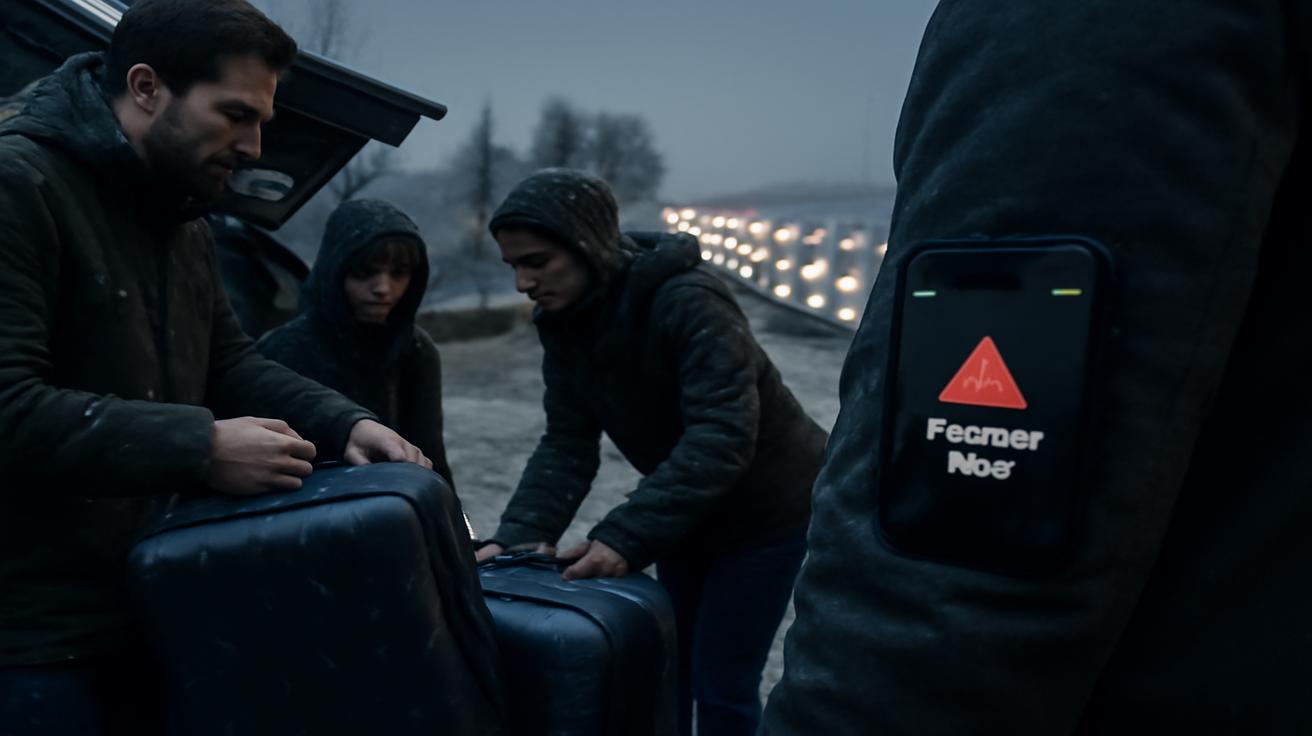
Imagine you’re behind the wheel on a long stretch of interstate when the front edge of that dislodged Arctic air arrives. The day started gray but manageable—wet shoulders, maybe a few flurries drifting in the air like ash. Now, the temperature drops so quickly you feel your breath crystalizing inside the car. The raindrops that were tapping against your windshield turn to tiny bullets of ice and then, almost instantly, to snow.
Visibility collapses. Tail lights in front of you smudge into pale red ghosts, then vanish. Somewhere ahead, a semi-truck loses traction and begins its slow, awful sideways drift across the lanes. Another driver taps the brakes and feels the car continue gliding helplessly forward, as if the road has been replaced by Teflon.
This is what forecasters mean when they warn of “crippling travel paralysis.” It’s more than inconvenience. It’s the physics of water and air and terror teaming up. Even a few degrees of unexpected cold can flip the script from wet to lethal. A million individual choices—to leave work early, to push on just one more exit, to pull over and wait it out—stack into regional crises measured in miles of backed-up traffic, closed mountain passes, overloaded towing companies, and emergency rooms buzzing with hypothermia cases and broken bones.
Air travel doesn’t fare much better. Jet engines dislike extremes, and runways need friction. When snow blows sideways along the tarmac and deicing crews sprint from plane to plane trying to stay ahead of the storm, schedules disintegrate. A single snarled hub can ripple outward, stranding passengers thousands of miles away from any snowflake at all.
This is why some meteorologists are willing to roll the dice on strong language earlier than they might have in the past. They’ve seen, again and again, how a few hours of forewarning can mean the difference between orderly shutdowns and dangerous improvisation.
“You’re Just Trying to Scare People”
Yet when the early warnings go out—days of potential whiteout conditions, hazardous wind chills, “life-threatening” cold—so does a familiar counter-chorus. Comment sections fill with accusations: The models are always wrong. This is about ratings. You’re using fear to control people. Climate hysteria.
It’s not an accusation born of pure fantasy. Weather and climate are big business now; dramatic images drive clicks and ad buys. Storms are branded like blockbuster movies: Snowzilla, Polar Punch, Bomb Cyclone. Viewers are conditioned to expect escalating language. When every winter brings an “unprecedented” something, the word itself begins to hollow out.
And layered under that media fatigue is a deeper, hotter debate: climate change. For some, any mention that a disrupted polar vortex might be linked, in part, to long-term warming trends feels like a political grenade. For others, downplaying those connections feels like denial bordering on negligence.
So the polar vortex, once a mostly obscure term known to specialists, has become a symbol in a cultural tug-of-war. Is it a sign of a climate spiraling into chaos? Or just one more chapter in nature’s endlessly variable winter story?
Is Climate Change Twisting the Winter Knife?
Step back from the shouting, and the science offers a murmur rather than a scream. The Arctic is warming faster than the rest of the planet—a fact no serious climate scientist disputes. Sea ice retreats earlier, grows back thinner. Snow cover changes. The temperature contrast between the pole and the mid-latitudes softens.
Some researchers argue that this smaller temperature contrast can weaken the jet stream, making it more wavy, more prone to meandering loops. Instead of a tight west-to-east flow, you get deep dips of cold pushing south and bulges of warmth pushing north. Under this view, a destabilized polar vortex and its wayward lobes of bitter cold are not a contradiction to global warming, but a side effect: a restless atmosphere searching for balance in a heated world.
Others are more cautious. The climate system is immense and messy, they remind us; tying one specific vortex disruption directly to climate change is like blaming a single wild wave on the overall rising tide. The connections are plausible, suggestive, but not settled beyond debate.
Here, predictably, is where the label “climate hysteria” often appears. Any attempt to connect the dots in public—between warming oceans, displaced cold air, and the increasing oddity of winter storms—is accused of being part of a fear campaign. Keep people scared, the critics say, and they’ll accept restrictions. On their cars, on their flights, on their thermostats.
But ask the people who have to stand outside in that displaced Arctic air—the utility workers fixing downed lines in the dark, the paramedics wading through drifts to reach a stranded diabetic, the ranchers losing calves to sudden blizzards—and their framing is rarely so abstract. They don’t talk in slogans. They talk in details. “It’s like the cold comes out of nowhere now,” one Montana rancher might say. “And when it hits, it hits hard.”
Living With Risk, Not Running From It
There’s a quieter alternative to both panic and dismissal: treating these forecasts as one more piece of information in a world full of imperfect but useful warnings. A polar vortex disruption doesn’t mean the sky is falling; it means conditions are aligning for a potentially dangerous episode of cold and snow that deserves respect.
Respect, in this context, looks like preparation: topping off the gas tank before the storm rather than during it, keeping an extra blanket and a charged phone in the car, choosing to reschedule that cross-country drive when the forecasts show a well-advertised bulls-eye of ice along your route.
It also looks like an honest acceptance that weather, by nature, resists certainty. Sometimes the cold core slides 200 miles east of where the models predicted, and cities braced for calamity wake up to a mere dusting. Critics seize on those outcomes as proof of hysteria. Yet every time the worst misses, somewhere else gets what was meant for you. The vortex doesn’t care about zip codes or reputations.
Between Calm and Catastrophe: The Human Weather
In the days before the disruption fully arrives, a strange anticipatory tension takes hold. Grocery store aisles thrum, half emergency drill, half ritual. People stand in line with carts heavy with bread, milk, batteries, salt. Neighbors who haven’t spoken in months compare snowblower stories in the parking lot. Kids, faces pressed against school bus windows, watch the low, swollen clouds drifting in.
Online, the divide widens. One camp shares detailed preparations, screenshots of forecast models, and practical tips: how to prevent pipes from freezing, how to recognize the first signs of frostbite. The other camp posts memes: “Remember when ‘winter’ was just called ‘winter’?”
Each side sees the other as slightly ridiculous. The cautious are mocked as fearful; the unconcerned, as reckless. Somewhere in the middle is the messy truth of living with modern risk: we have more information than ever before, more tools to anticipate danger, and also more ways to drown in worst-case scenarios.
This is the real weather we’re navigating—less the pattern of clouds and isobars overhead, more the shifting currents of trust and skepticism around us. Do we believe the models enough to act? Do we discount them because the last storm underperformed? Do we let the possibility of freezing rain change our travel plans, our work schedules, our sense of control?
The Vortex Will Pass. The Question Remains.
Soon enough, the disrupted polar vortex will make its move. The exact timeline is the one thing nobody can quite nail down, but the shape of it is familiar: first the wind, then the cold, then the silence that falls over a landscape locked in ice. Highways empty. Runways go dark. Snowplows become the only steady motion in a world reduced to shades of white and gray.
Afterward, the stories begin to accumulate. The commuter who slept two nights in his car on an off-ramp because the exit ahead was entirely blocked by spun-out vehicles. The emergency nurse who walked the last two miles to her hospital through thigh-deep drifts. The family that lost power for 36 hours and huddled in the living room with every blanket they owned, watching their breath puff in the air.
There will be, too, stories of over-preparation, of flights canceled preemptively that might have taken off in time, of cities that deployed their full snow clearing arsenal for a storm that sputtered at the last minute. These, inevitably, will fuel the next round of accusations: See? Overblown. Hype. Hysteria.
But out on the actual roads, in the actual cold, the question isn’t whether the warnings were perfectly calibrated. It’s whether enough people had enough time to choose caution over bravado. Whether we saw the chilled air gathering over the pole not as a horror movie trailer, but as a serious forecast about real physics headed our way.
Because in the end, the polar vortex disruption doesn’t care if you believe in climate change. It doesn’t know about ratings, or politics, or the latest viral thread accusing forecasters of secret agendas. It’s a river of cold air shifting under the invisible hand of atmospheric waves and planetary spin. It will surge south or it won’t; it will stall over your region or the one three states away.
Our only choice is how to meet it: eyes open or eyes rolled.
Questions People Are Asking About the Coming Polar Vortex Disruption
Is this polar vortex event really “historic,” or just normal winter weather hyped up?
“Historic” is a strong word, and sometimes it’s used too loosely. In this case, the term is based on how unusual the disruption in the stratosphere appears compared with past years and how far south the cold is projected to plunge. It may end up ranking among the more significant events in recent decades—or it may fall short. The potential impacts are serious enough that forecasters prefer to lean on the side of caution.
Does a severe polar vortex outbreak mean climate change isn’t real?
No. A cold outbreak in one region doesn’t disprove long-term global warming. Climate change describes trends over decades and across the entire planet, not isolated events. Some research even suggests that rapid Arctic warming can make the jet stream and polar vortex more unstable, increasing the odds of these wild winter swings, though that relationship is still being actively studied.
How will this disruption affect travel specifically?
If the forecasts verify, expect dangerous conditions on major highways—especially where rain transitions rapidly to ice and snow. Black ice, whiteout visibility, and extreme wind chills can make travel life-threatening. Air travel could see waves of cancellations and delays as airlines preemptively adjust schedules and as airports struggle to keep runways clear and planes deiced.
What can I do to prepare without giving in to “fear culture”?
Treat the forecast the way you would treat a serious storm warning or hurricane track: as information to help you make smart choices. That could mean adjusting travel plans, stocking a modest supply of essentials, insulating pipes, and making sure you have backup warmth and light if the power goes out. Preparation is not panic; it’s simply acknowledging that nature doesn’t run on our convenience.
Why do some people call these forecasts “climate hysteria”?
For some, there’s fatigue from years of dramatic headlines, and frustration when worst-case scenarios don’t materialize exactly as predicted. For others, any mention of climate change feels political, so they view strong language about weather risks as part of a broader agenda to control behavior. The reality is more mundane: forecasters are trying to translate complex, uncertain data into clear public guidance. Sometimes they overshoot; sometimes they undershoot. But the intent, more often than not, is safety, not fear.




Leave a Comment