
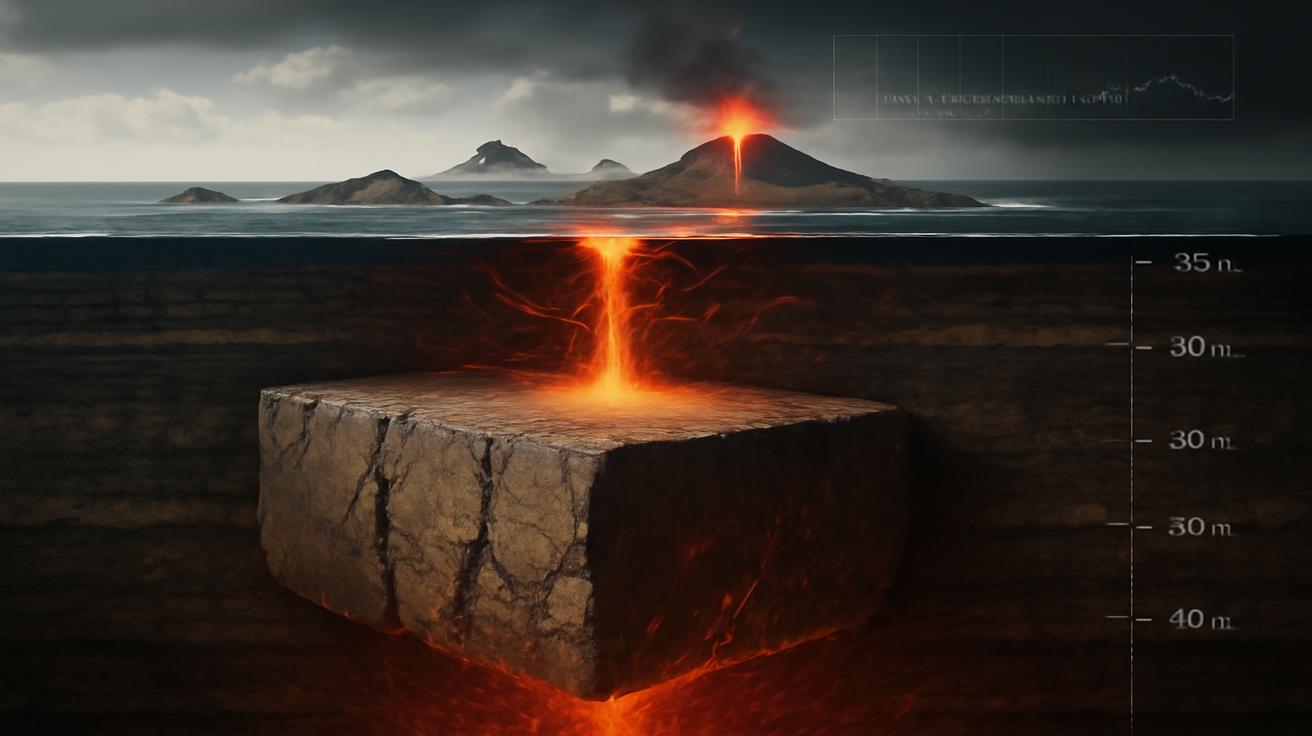
The ocean feels endless from the window seat. Somewhere beneath the thin skin of clouds, the Pacific flexes and rolls, a sheet of restless blue stretching from horizon to horizon. As the plane hums toward Hawaii, most people are thinking about beaches, mai tais, and the perfect angle of the sun on turquoise water. But if you could peel back the ocean, the islands, and the crust of the Earth itself, you’d find something else entirely: a gigantic, ancient block of rock, buried deep beneath Hawaii—silent, motionless, and quite possibly the key to understanding why the volcanoes here have burned so steadily for millions of years.
Listening to the Islands Breathe
Step off the plane in Honolulu or Kona and the air hits you like a warm wave—salt, plumeria, faint traces of jet fuel and sunscreen. The islands hum with life. Waves collapse against black lava rock, coqui frogs chirp at night, and trade winds hustle clouds across rugged volcanic ridges. Hawaii feels young. It looks young. Lava flows on the Big Island can still glitter faintly with heat under the stars, and cooled ʻaʻā rubble crunches underfoot where, not long ago, fire met the sea.
Yet the engine behind this volcanic world is not young at all. It is ancient, deep, and hidden—far below the surf breaks and hotel pools and hiking trails, down in the part of Earth we almost never imagine: the mantle. Far under the crust, where rock flows like an extremely slow, hot river, something unusual seems to lie beneath Hawaii. Geophysicists have begun to suspect that there is a colossal buried block—denser, colder, and more stubborn than the rock around it—anchoring the Hawaiian hotspot like a thumb pressed against the underside of the crust.
For decades, Hawaii has been the poster child of a long-standing geological mystery: why do some volcanic hotspots remain remarkably steady, even as the tectonic plates above them drift like cracked ice on a dark, fiery lake? Why does the Hawaiian plume stick in one place, building an orderly chain of islands and seamounts that pretty much trace the movement of the Pacific plate like dotted lines on a map? To answer that, we have to go deep—far deeper than any human-made drill has ever reached.
The Hotspot That Refused to Wander
Stand on the rim of Kīlauea or gaze up toward Mauna Loa’s broad shoulders, and you’re looking at magma that started its journey hundreds of kilometers down. Hawaii is what geologists call a “hotspot volcano”—a place where a focused plume of unusually hot mantle material rises, melts, and punches its way through the crust. The Pacific plate, creeping northwest over millions of years, has been carried like a slow raft over this fixed blowtorch.
The result: a spectacular trail of islands and underwater mountains, the Hawaiian–Emperor seamount chain, arcing across the Pacific floor. If you could drain the ocean, you would see them: a dotted trail of extinct volcanoes, each one once an island, now ground down by waves or submerged beneath the sea as the plate marched on. In the simplest version of the story, the hotspot stays put while the plate moves overhead—a clean, almost elegant mechanism.
But reality, as usual, is messier. When geologists traced the line of volcanoes back in time, they found a sharp kink in the chain—a sudden bend near the northwestern end, where the Emperor seamounts jog toward the north. For years, that bend was explained by a change in the direction of the Pacific plate’s movement about 50 million years ago. But data from other hotspots and from detailed plate reconstructions hinted at something else: maybe the plate didn’t change direction so dramatically. Maybe the hotspot itself wandered.
That raised an uncomfortable question: if mantle plumes are supposed to be relatively stable, why would Hawaii’s drift? And if it didn’t drift very much, why did the chain bend so sharply? The mystery of the bend became one more thread in a larger puzzle: what, precisely, pins a hotspot in place?
The Shadow Beneath: A Buried Block in the Deep
Earth doesn’t yield its secrets easily. We can’t exactly go “look” under Hawaii. Instead, geophysicists listen—using earthquakes like sonar pings, reading the planet’s interior from how seismic waves bend, slow, speed up, or echo as they move through different rocks. Over the past few decades, global networks of seismometers and advanced imaging techniques have created something like a fuzzy MRI of the deep Earth.
In those ghostly images, certain regions in the lower mantle stand out: vast, dense, chemically distinct blobs near the core–mantle boundary, called “large low-shear-velocity provinces.” One looms beneath Africa, another beneath the Pacific. They don’t behave like the surrounding mantle, and they seem to have been there a long time. Rising plumes—the engines of hotspots—often appear to originate near their edges, as if they are perched on the borders of buried continents of strange rock.
But even higher up in the mantle, closer to where the Hawaiian plume feeds the volcanoes we see at the surface, there may be structure we hadn’t previously appreciated. Recently, researchers modeling the behavior of mantle plumes noticed something odd: their simulations kept hinting at a stiff, dense anomaly—something like a giant keel of rock—just beneath Hawaii. Not as large as the deep mantle provinces, but big enough and different enough to change the way the plume behaves.
Imagine a rising column of hot rock in a slow, swirling fluid. Now put a heavy, solid block just above its source. The plume doesn’t just wander freely. It is deflected, squeezed, possibly even guided by that block. In some models, that interaction is precisely what keeps the Hawaiian hotspot so strikingly stable over tens of millions of years. The block acts like a brace behind a bookshelf—unseen, but vital to keeping the whole structure from tipping or drifting.
| Feature | Typical Mantle | Buried Block Beneath Hawaii (Hypothesized) |
|---|---|---|
| Temperature | Hot, slowly convecting | Slightly cooler, more rigid |
| Density | Relatively uniform | Denser than surroundings |
| Role in Plumes | Allows freer plume ascent | Guides, stabilizes, and reshapes plume path |
| Timescale of Stability | Tens to hundreds of millions of years | Potentially similar or longer, acting as a long-term anchor |
To be clear, no one has seen this block directly. It isn’t a carved slab or a buried island. It’s more like a massive, sluggish hump of mantle rock with a subtly different composition and density, inherited from some forgotten episode of Earth’s violent youth—perhaps the wreckage of an ancient plate or accumulated material from the deep mantle provinces. But in models and seismic data, its ghostly outline keeps appearing, like a shadow beneath a shadow.
How a Hidden Block Makes a Volcano Steady
If this buried giant exists, what does it actually do? Picture the Pacific plate above Hawaii as a huge conveyor belt, moving northwest. Beneath it, the Hawaiian plume rises from deep within the mantle. Without obstacles, that plume might drift as the convecting mantle flows and stretches. Over millions of years, its base could slide along the core–mantle boundary, its tail bending, its head wandering relative to the surface.
But now add a stable, denser block into this picture. Its presence changes how mantle material circulates. The plume feels a kind of topographic steering in the fluid rock: it hugs the side of the block, or is squeezed into a more focused column that doesn’t meander too far. The block also locally modifies the stress field in the mantle, subtly resisting the forces that would otherwise nudge the plume sideways.
In some computer simulations, the Hawaiian plume emerges from near the edge of a deep mantle province, then travels upward until it encounters this mid-mantle block. The plume’s path bends slightly, then straightens, like a jet of water redirected around a rock before shooting upward. By the time it reaches the base of the Pacific plate, its position has become surprisingly stable.
This could explain why the Hawaiian hotspot appears to have stayed nearly fixed, even while other hotspots—such as those that helped form parts of the Atlantic seafloor—show hints of greater motion. It might also help decode the long-debated bend in the Hawaiian–Emperor chain. The kink could be partly due to the Pacific plate changing course, yes—but also to subtle shifts in how the plume interacted with deeper mantle structures over millions of years, including this enigmatic block.
A Landscape Written in Lava
It’s easy to forget, wandering through a lava tube or tracing the hardened ropes of pāhoehoe, that every ridge, every cinder cone, every coastal cliff is a message from the deep Earth. The shapes of the islands—broad shield volcanoes, overlapping like massive shoulders—are a record of how steadily and how long magma has welled up in one place.
Hawaii’s volcanic architecture speaks of consistency. The Big Island alone hosts some of the largest volcanoes on the planet, by volume. That kind of sustained growth demands a reliable supply of magma over extraordinary timescales. Unlike the frantic, edge-of-plate volcanoes that ring the Pacific in the so-called Ring of Fire, where crust is forced downward and melts in chaotic pulses, Hawaii’s fire seems almost patient, like a slow candle flame rather than a sputtering torch.
If a gigantic buried block is indeed bracing the Hawaiian plume, that calm persistence suddenly makes more sense. The deep engine is not drifting wildly; it is tethered by ancient, unmoving architecture. Lava flows might come and go, eruptions wax and wane, but the source itself holds steady. Volcanoes grow, age, erode, and sink, yet the hotspot simply continues to supply molten rock in roughly the same place as the plate glides overhead.
There’s another implication as well. If features like this block can influence plumes, then every hotspot on Earth might carry some fingerprint of the deep structures under it. Perhaps the reason some hotspots wander or sputter, while others—like Hawaii—run almost like clocks, lies buried far below the ones we can reach with our drills and sensors. Our familiar landscapes might be answering to hidden architecture we’ve only begun to glimpse.
Rewriting the Deep Story of Our Planet
The idea of a gigantic buried block beneath Hawaii is more than a local curiosity. It nudges at the edges of how we think about Earth as a whole. We’ve long pictured the mantle as a churning, mostly uniform layer—hot rock rising here, cool rock sinking there, all gradually remixing over geological time. But the more we peer into it, the less uniform it seems. There are provinces, piles, slabs, and now, perhaps, anchored blocks that refuse to be easily stirred away.
This suggests that Earth holds onto its memories. Old tectonic plates don’t always melt and vanish; they may sink, stack, and quiet down, still affecting mantle flow millions of years later. Strange chemical reservoirs accumulate and linger. The buried block beneath Hawaii may be a remnant of these ancient processes—a kind of fossil in rock, not frozen in place but heavy and different enough to shape the surrounding currents.
For geologists, this is both frustrating and thrilling. Frustrating because each new layer of complexity makes the job of modeling Earth’s interior harder; thrilling because it opens a richer, more textured story. Our planet is not just a machine with simple moving parts. It’s a layered history, where events from more than a billion years ago can still dictate where new islands will rise today.
In this view, Hawaii’s serenity at the surface—its steady hotspot, its ordered volcanic chain—is the visible end of a very long, very deep chain of cause and effect. The buried block may have formed when supercontinents broke apart, when older oceans closed, when plates crumpled and dove into the mantle. Those long-lost shores and mountains, crushed and buried, might now be playing their final role as unseen scaffolding beneath a tropical archipelago.
Standing on the Skin of a Deep Mystery
Walk out on a fresh, jet-black lava field on the Big Island at dusk. The rock is still sharp, glassy in places, crunching under your boots. Heat rises in soft waves from cracks that glow faintly red. You can smell sulfur in the wind, feel the air tremble with distant, low rumbles. Under your feet, this new ground is the thinnest of skins. Below it, the volcanic edifice plunges down through older layers, into oceanic crust, into the upper mantle, and then farther, into realms we will never touch.
Far below the surface, where pressures are crushing and temperatures soar beyond imagination, the hypothesized block sits in darkness, indifferent to sunsets and surf. It doesn’t move quickly, if it moves at all on human timescales. It has watched the Pacific plate drift. It has felt plumes rise past its edges. It has outlived continents and ocean basins. It may well outlive Hawaii as we know it, long after the islands have eroded back into the sea and a new chain of volcanoes has formed somewhere else along the plate’s path.
The idea that a single, buried mass of rock could help keep a hotspot stable is humbling. It reminds us how parochial our timescales are, how thin our slice of the planet’s story really is. We live in a brief interlude between flows of lava, on islands that exist only because deep processes decided, for now, to burn consistently in this one spot. The stability we depend on to build homes, plant gardens, and watch the waves is not guaranteed by some surface order. It’s negotiated, moment by moment, in darkness and heat, far beneath our feet.
Next time you stand at the edge of a Hawaiian cliff, feeling the trade winds push at your back while waves hammer the rock below, it’s worth picturing what lies under all this color and light. Imagine the crust, relatively thin and brittle, riding a slow, powerful current of mantle. Imagine a column of hot rock rising for hundreds of kilometers. Then imagine it encountering something massive and ancient—an invisible buttress—before straightening, tightening, and delivering its molten cargo to the base of the plate, again and again, for millions of years.
We will likely refine this picture in the years to come. Better seismic data, faster supercomputers, more sophisticated models—they will all chip away at the fuzziness of our planetary “MRI.” Maybe we’ll confirm the size and shape of the buried block. Maybe we’ll find others like it beneath different hotspots. Perhaps we’ll learn that what makes Earth so surprisingly habitable—a steady climate, long-lived oceans, a dynamic crust—is tied not just to plate tectonics at the surface, but to this complex, hidden architecture in the deep.
For now, the buried block beneath Hawaii remains more hypothesis than headline. But its story is already changing the way scientists think about hotspots, stability, and the tangled memory of our planet’s interior. Hawaii, with its postcards and palm trees and glowing lava, sits on top of a mystery that stretches from the seafloor to the edge of the core. And somewhere down there, in a world without light, a gigantic block of rock may be quietly holding the hotspot in place—an unseen hand beneath an ocean, steadying a line of fire.
FAQ
Is there direct evidence for a buried block beneath Hawaii?
There is no direct physical sample of this block. Evidence comes from seismic imaging and numerical models that show unusual, dense mantle structure beneath Hawaii, consistent with a large, rigid anomaly influencing plume behavior.
How deep is the hypothesized block?
Models suggest it lies in the mid to lower mantle, hundreds to over a thousand kilometers below the surface, far deeper than any drilling or volcanic conduit can reach directly.
Does this change how we think hotspots work?
Yes. Instead of imagining hotspots as simple, vertical plumes rising through a uniform mantle, this idea supports a more complex picture where deep, long-lived structures steer and stabilize plumes over geologic time.
Could similar buried blocks exist under other hotspots?
Possibly. Early studies hint that deep mantle structures may affect several hotspots, but Hawaii is one of the best-studied cases. As seismic data improve, we may identify comparable features beneath other long-lived volcanic chains.
Does the buried block affect volcanic hazard in Hawaii?
Not on human timescales. The block influences the long-term location and stability of the hotspot over millions of years. Short-term volcanic activity and hazards are controlled mainly by shallower processes in the crust and upper mantle.





Leave a Comment