
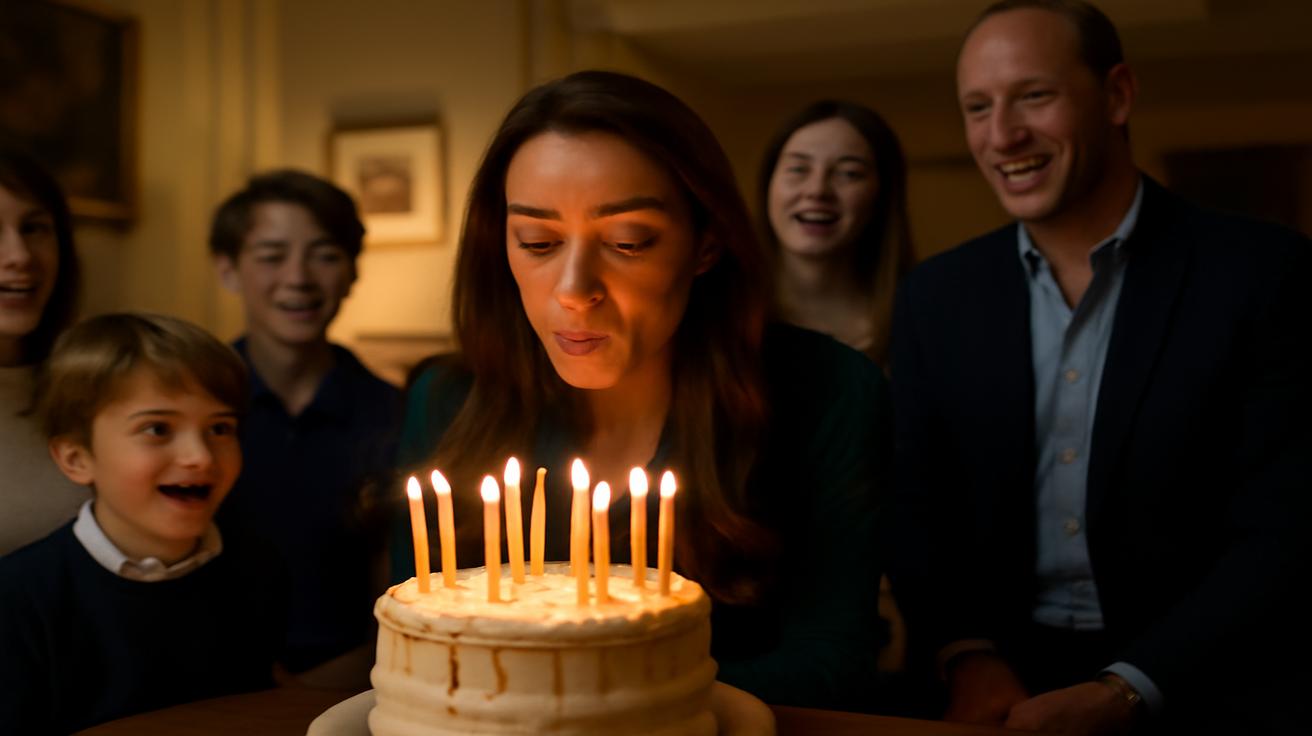
The winter light over London has a strange way of softening stone. It slips along palace walls, floats between bare branches in the parks, and settles—almost tenderly—on the faces of those who happen to lift their eyes and notice. On a January morning like this, the city holds its breath a little. Somewhere beyond those guarded gates and heavy curtains, a woman who occupies both the most public and the most private of roles is blowing out birthday candles with three small pairs of eyes fixed on her, and an entire country watching from a respectful distance.
She is a devoted mother, a future queen, and, whether she ever asked for it or not, an emblem of resilience in a shifting age. The Princess of Wales—Catherine, Kate, “Mummy” to three children who know her simply as the person who kneels to tie their laces before the cameras click—is celebrating another year of life at a moment when the ground beneath the monarchy itself feels as if it is quietly, steadily moving.
A Birthday in the Eye of History’s Weather
It is tempting to imagine this birthday as a still photograph: a perfect royal portrait framed in gilt, the Princess poised in a silk dress, a spray of white flowers behind her and the faintest smile playing at the corner of her mouth. But life inside those historic walls is less like a posed image and more like a weather system—fronts of duty and emotion colliding, gusts of change, brief clearings of joy.
For Catherine, this birthday falls in the thick of a historic royal transition. The late Queen’s steady, unbroken reign has given way to a new era under King Charles III, and with it, subtle but unmistakable shifts in tone, responsibility, and expectation. The line of succession, once an abstract concept in constitutional textbooks, now feels startlingly human: a grandfather on the throne, a father stepping more firmly into the role of heir, and three small children with titles they will one day either shoulder or redefine.
In the center of this evolving story stands the Princess of Wales. She is familiar to us: the swing of her ponytail on a windy day outside a primary school, the quick, conspiratorial grin she flashes at a child who’s too shy to meet her eyes, the steadying touch she offers her husband at a solemn ceremony. Yet the true weight of her role is harder to see. It lies in the moments between flashbulbs—the late-night briefings, the private decisions about which causes to champion, and the silent calculations required of a woman who must be both deeply herself and a symbol for millions.
On this birthday, it is impossible not to feel that she stands at a threshold: one foot still in the relative informality of the past decade, the other edging toward the austere clarity of queenship that awaits her somewhere on the horizon.
The Quiet Craft of Modern Queenship
Motherhood in the Gilded Fishbowl
Perhaps the most disarming thing about Catherine is not the gowns or the jewels or the choreography of ceremonies, but the ordinariness she allows to slip through the seams of her extraordinary life. There is a particular look she gives her children in public—half amusement, half whispered reminder—that any parent recognizes immediately. Tantrums, restless feet, sideways questions during solemn occasions: these are not unusual in childhood, but they are unusual when broadcast worldwide.
The Princess has always seemed to understand that the most powerful thing she can offer the future monarch and his siblings is not perfection, but stability. It is there in the small rituals—school runs, family photographs taken behind the lens of her own camera, birthday cakes baked by her own hands even after an evening of engagements. Those flour-dusted, late-night hours in the kitchen, as she has warmly admitted, are her way of anchoring her children to something ordinary in an entirely unordinary existence.
In an era when the very concept of monarchy is questioned, those small scenes matter. They humanize the Crown without stripping it of dignity. They allow the public to see not simply a future Queen Consort of the United Kingdom, but a woman who, like many others, is juggling school schedules and bedtimes with demanding professional responsibilities—only with the added glare of global attention.
The Weight of a New Title
The title “Princess of Wales” carries with it a kind of historical echo. It is, for many, inseparable from memories of another woman who walked this path in a different time and under a very different media storm. When Catherine inherited that title upon Charles’s accession, it marked more than a change in stationery and introductions; it signaled a recalibration of her role, her influence, and public expectations.
Over the years, she has quietly shaped her royal life around a cluster of causes that speak not to spectacle but to substance—early childhood development, mental health, the unseen architecture of family life. While others may have sought drama, she has sought data: research, long-term studies, coalitions of experts. Her speeches are not fiery manifestos; they are measured, grounded, often gently worded but deeply intentional in their trajectory. She has chosen the slow, sometimes invisible route of cultural change over the quick flare of headlines.
In this transitionary moment, that approach feels crucial. The monarchy, if it is to endure in anything like its present form, must be more than a ceremonial echo from a fading age; it must be a listening institution, one that engages with the real roots of social wellbeing. Catherine’s focus on the earliest years of life may seem quietly domestic, but it is in fact profoundly structural—an attempt to address the point where inequalities, traumas, and opportunities first take shape.
In the Shadow of Palaces, the Human Heart
An Unexpected Mirror for Many Women
Watch the way conversations unfold when Catherine’s name surfaces among women in cafés, on school playgrounds, in office break rooms. Some speak of her fashion—the way she rewears dresses, pairs high-street pieces with couture, gives a soft nod to sustainability by resisting the temptation to appear in something new every time. Others talk about her public composure, the way she faces crowds with an open, unhurried calm that seems to draw shy children closer.
But beneath those surface comments, something more personal often emerges. Many see in her a reflection of their own tightrope walk: the desire to be present, emotionally available, and attentive at home while also cultivating purpose in their work and contributions to the wider world. Catherine simply occupies a far grander version of that intricate balancing act—and every wobble, every adjustment, every hard-won bit of grace plays out in view of millions.
Her influence, then, is not about unattainable perfection; it’s about a form of modelled imperfection. She has spoken candidly about the loneliness of new motherhood, the worry, the constant questioning of whether one is doing enough. She has admitted to nerves before big speeches, to the effort that goes into each carefully poised appearance. Instead of insisting on effortless brilliance, she lets us glimpse the work behind it—and in that glimpse, many find comfort.
In a world saturated with glossy, filtered versions of womanhood, her willingness to acknowledge struggle, preparation, and vulnerability becomes its own quiet rebellion.
Tradition Meets a New Kind of Intimacy
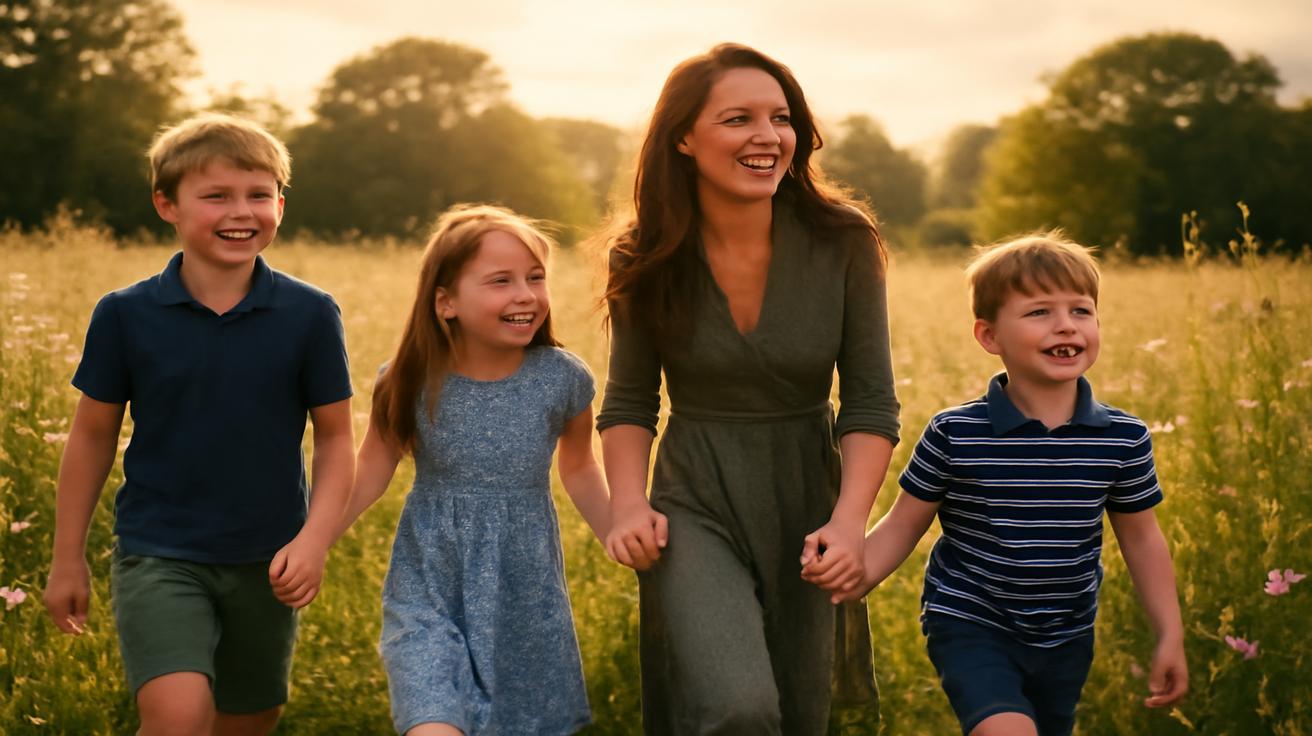
The royal family, by its nature, is built on distance: the balcony, the procession, the carriage window. Catherine has not dismantled that distance—nor could she—but she has gently, consistently thinned the glass. Through her own camera lens, we see her children in muddy boots, on windswept beaches, in sunlight-dappled fields. We see the royal story not just in velvet and ermine but in denim and wellingtons.
These images are more than charming. They mark a shift in how the monarchy chooses to be seen. Rather than allowing tabloids to define every domestic detail, the Princess takes control of the narrative by offering small, curated glimpses of authentic family life. There is strategy in this intimacy: it builds trust without oversharing, warmth without eroding the sense of role. It acknowledges a modern public’s hunger for realness while maintaining the quiet, necessary boundary that separates a public figure from total exposure.
Her birthday, then, is not just an occasion for royal-watchers to post collages of favorite moments; it becomes a kind of annual checkpoint in the story of this experiment in modernized monarchy. Another year of walking that narrow path between symbolism and self. Another year of being both protected and profoundly scrutinized. Another year of asking, and answering, the same question: How can an ancient institution remain human without becoming ordinary, relevant without becoming rootless?
The Monarchy’s Living Bridge
Standing Between Past and Future
To understand the Princess of Wales in this moment is to picture a bridge arcing quietly across a river at dusk. On one side, the memory of Elizabeth II: decades of almost impossibly consistent presence, a queen whose life spanned wars, cultural revolutions, and digital upheavals, yet who remained, to the end, a symbol of continuity. On the other side, a future that no one entirely recognizes yet—a Britain grappling with identity, diversity, economic disparity, and global uncertainty; a world whose young people question inherited structures with increasing urgency.
Catherine stands, very much alive and learning in real time, in the center of that span. Her husband, Prince William, is the visible heir, the one whose path is more clearly marked. But she is the one who may well determine the emotional tone of the monarchy’s next chapter: its warmth, its reach, its capacity to listen. The late Queen embodied duty with a kind of reserved majesty; Catherine, by contrast, embodies service with an approachable humanity, one that still bows respectfully to tradition while nudging it, bit by bit, toward openness.
In the years since her marriage, significant royal moments have unfolded: jubilees, funerals, coronations, visits to communities at their most fragile and their most hopeful. Each time, there is Catherine—standing at the front lines of national feeling, dressed not only in carefully coded colors but in the shared emotions of the day. She has wept; she has laughed; she has bent low to speak to children holding trembling bouquets; she has offered silent support beside her husband as he shoulders grief and responsibility.
This is what it means to be a living bridge: to carry the weight of what came before while making space for what has not yet arrived. It is not only a constitutional role but a deeply human one, enacted not in legal documents but in everyday acts of presence.
Moments That Mapped a Journey
When we look back on Catherine’s path so far—from a university student walking across a campus green to the Princess of Wales navigating state banquets—we see not a series of isolated events, but a narrative arc. Certain moments have come to define how the world understands her, each one a point on a quiet, steady ascent into her role.
Consider the key chapters many observers recall when they speak about her growth and influence:
| Year | Milestone | Why It Matters |
|---|---|---|
| 2011 | Royal wedding to Prince William | Introduced Catherine as a global figure, blending fairy-tale expectations with genuine warmth. |
| 2013–2018 | Birth of Prince George, Princess Charlotte, and Prince Louis | Reframed her public image around motherhood, visibility, and the future of the monarchy. |
| 2016–2020 | Mental health and early years advocacy gathers pace | Signaled a long-term, research-based commitment to social wellbeing. |
| 2022 | Becomes Princess of Wales after the accession of King Charles III | Marked a visible step into higher responsibility during a period of national grief and change. |
| Ongoing | Development of early childhood initiatives and public engagements | Shows a consistent, evolving vision for her role as a future Queen Consort. |
These milestones are not simply royal trivia. They are touchpoints in a wider cultural conversation about leadership and empathy, about how those born—or, in her case, married—into institutions can gently reshape them from within.
A Birthday Wish for the Future Queen
What We Celebrate When We Say “Happy Birthday”
So what are we really applauding when we send birthday wishes to the Princess of Wales? It is not just the elegance or the famed poise. It is something quieter, perhaps more fragile and therefore more precious: the ongoing effort of a woman to grow into the vast outline of a role that no handbook can fully explain.
Each year she blows out those candles, the stakes feel subtly different. In the early years of married life, the wishes might have centered on adjustment, on finding her footing in a family whose every gesture is interpreted a hundred ways. During the first chapter of motherhood, perhaps the hope was simply for rest, for small pockets of peace amid new routines. Now, in this era of transition, the hopes for her may be broader: that she continues to find the courage to show vulnerability, the stamina to pursue long-term change, the freedom—within all the constraints—to stay rooted in the person she was before the titles.
There is something almost paradoxical about the role of a future queen in the 21st century. She must be simultaneously ordinary and exceptional, rooted in tradition yet alert to injustice, symbolic yet undeniably human. Catherine has not solved that paradox—no one could—but she has stepped into it with a kind of thoughtful steadiness that many find reassuring.
As she celebrates another year, England’s winter landscape hums with its usual life: buses sighing into stops, pigeons lifting from statues, schoolchildren racing across playgrounds, clouds rolling low and heavy over The Mall. Somewhere above this daily choreography, history continues its slow turn. Monarchs age, successors prepare, and the future Queen—the devoted mother in the middle of it all—cuts a slice of cake and laughs at a joke only her family can hear.
We cannot know the shape of the years ahead. We cannot map exactly how the monarchy will adapt, or predict which moments will later be circled as turning points. But we can see, today, the outline of a woman who understands the seriousness of her path and refuses to let that seriousness erase her humanity. When we say, “Happy Birthday, Your Royal Highness,” we are, in some small way, blessing that balance.
May the Princess of Wales continue to walk that narrow line between duty and self with the same grace we have seen so far—feet firmly on the ground, eyes open to the world, and heart anchored, always, in the home she has built within those ancient walls.
Frequently Asked Questions
Why is this birthday especially significant for the Princess of Wales?
This birthday comes amid a historic royal transition following the end of Elizabeth II’s long reign and the accession of King Charles III. As Princess of Wales, Catherine now stands closer than ever to her future role as Queen Consort, making each passing year part of a visible journey into greater responsibility.
What makes the Princess of Wales an inspiration to many people?
Many admire her for blending public duty with private devotion to her family. Her commitment to early childhood, mental health, and long-term social change, combined with her openness about the challenges of motherhood and public life, resonates with people who juggle similar pressures in less public roles.
How has Catherine helped modernize the image of the monarchy?
She has introduced a gentler, more relatable tone—sharing family photographs she takes herself, rewearing outfits, and supporting evidence-based causes rather than symbolic one-off gestures. This creates a sense of authenticity while still respecting royal tradition and protocol.
Why is the title “Princess of Wales” so important?
The title has historic weight and is closely associated in the public imagination with previous holders. When Catherine became Princess of Wales, it signaled not only her senior position in the royal family but also heightened expectations regarding her influence, visibility, and charitable leadership.
What aspects of her work are likely to define her future as Queen Consort?
Her sustained focus on early childhood development, mental health advocacy, and family wellbeing may become hallmarks of her queenship. By investing in long-term, research-driven initiatives now, she is laying the foundations for a future role centered on empathy, resilience, and social understanding.






Leave a Comment