
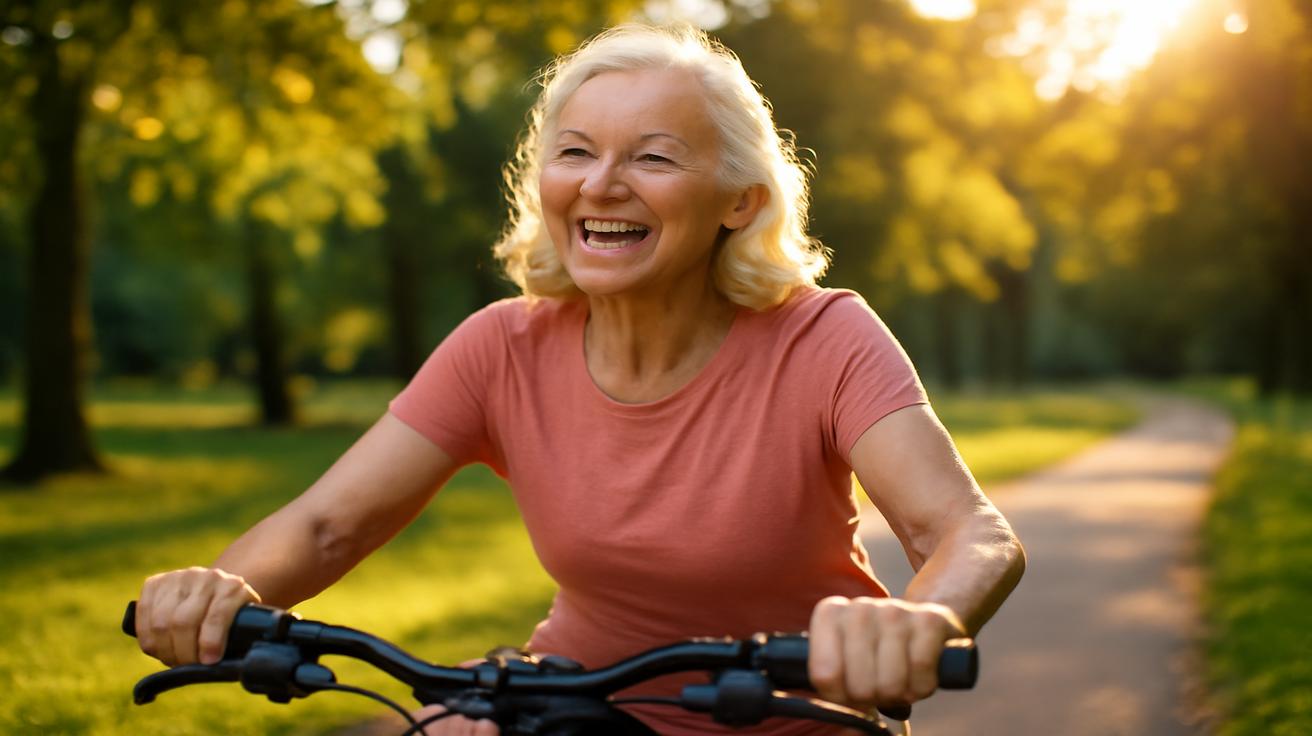
The woman in the bright red raincoat is the first to notice the heron. She is seventy-three, though you’d never know it from the way she hops off the trail to get a better angle with her phone. A few younger hikers pause politely behind her, but instead of being annoyed, they start watching the heron too. One of them whispers, “I hope I’m like that when I’m older.” The woman doesn’t hear it. She’s too busy grinning at the bird, at the sky, at the quiet miracle of being out here at all.
1. Keep Saying “Yes” to New Things
There is a subtle but dangerous phrase that creeps into many lives somewhere between sixty and seventy: “Oh, that’s not for me anymore.” It sounds reasonable on the surface. Knees hurt, balance isn’t what it was, the world feels faster and louder. But here’s a quiet truth: the people who inspire others at seventy are not necessarily the fittest, the richest, or the most accomplished. They’re the ones still saying “yes.”
Not a reckless yes. Not the yes that ignores what your body is telling you. This is a curious yes. A measured yes. A yes that says, “I’ve never tried that—tell me more,” instead of, “I’m too old.”
Imagine you’re invited to a pottery class. The old script might say, I’ve never been artistic. I’d be terrible. I’ll just skip it. But the seventy-year-olds that make everyone’s eyes light up? They show up. They sit at the wheel, make an absolute mess, and laugh until the clay dries under their fingernails. They understand that being bad at something new is one of life’s underrated joys.
Or maybe your grandson wants to teach you a new card game. The rules sound ridiculous. There are dragons and mana points and colors that don’t match the suits you grew up with. It would be easy to say, “You just play, I’ll watch.” Instead, you put on your glasses, pull your chair closer, and say, “Deal me in.” In that tiny moment, you shift from observer to co-conspirator in his world.
The specific “yes” doesn’t even matter. It might be a cooking class, a short trip with friends, a neighborhood committee, or learning how to use a new app so you can see your great-granddaughter’s latest finger paintings. What matters is the posture: a tilt toward life, not away from it.
The people we admire in their seventies haven’t stopped growing; they’ve just changed how they grow. They collect experiences instead of promotions. They chase awe instead of achievement. And that simple habit—of still letting new things into their life—creates a quiet radiance that others can’t help but notice.
2. Nurture a Body That Still Wants to Move
The best seventy-year-olds to be around are not the ones who can run marathons (though some can). They’re the ones who move like their body is still a trusted partner, not a broken machine they resent. You can feel it in the way they rise from a chair, the easy rhythm as they walk beside you, the way they stretch their arms to point out a bird overhead.
Movement in your seventies is not about athletic heroics. It’s about tending the garden of your body with gentle consistency. Think morning walks where you can smell the damp earth before the sun bakes it dry. Think slow stretches by an open window, where you can hear a neighborhood slowly waking up: a garbage truck, a barking dog, a kettle whistling somewhere down the block.
There’s a simple, steady magic in small daily movements. To make this feel more concrete, here’s a look at how that might look in real life:
| Daily Move | How It Feels | Why It Matters at 70+ |
|---|---|---|
| 15–20 minute walk | Steady breath, loose shoulders, chance to notice trees, sky, neighbors | Supports heart health, balance, mood, and independence |
| Light strength work (bands, cans, or small weights) | Muscles wake up with a pleasant burn, not pain | Maintains muscle to get out of chairs, carry groceries, climb stairs |
| Gentle stretching or yoga | Joints feel smoother, body taller and more open | Helps prevent stiffness, falls, and improves posture |
| Balance practice (standing on one leg near a wall) | A little wobbly at first, then more steady | Reduces fall risk, builds confidence in everyday movement |
| Joyful movement (dancing, gardening, swimming) | Feels like play more than exercise | Keeps you emotionally buoyant and socially engaged |
You don’t have to become a gym person. You don’t have to follow a perfect routine. What you do need is a relationship with your body that says, “I’m still here with you. Let’s keep going, gently.”
And if something hurts? The admirable seventy-year-olds take that as information, not a full stop. They ask questions, get help, adapt. They trade running for swimming, or long hikes for shorter ones, or gardening on their knees for gardening at waist-high planters. They don’t give up moving; they change how they move.
3. Stay Soft-Hearted and Sharp-Minded
There is a particular glow around the elders who can talk with a teenager about something baffling and modern—streaming, memes, new music—and not roll their eyes. They may not understand everything, but they’re curious instead of condemning. This combination—a soft heart and a sharp mind—might be the most powerful thing you can carry into your seventies.
The sharp mind part is practical. Read widely, and not only about the past. Learn the basics of the tools the world is currently using: video calls, messaging, perhaps a new device. Work the crossword. Pick up a puzzle. Join a book club that sometimes tackles books outside your normal taste. Ask younger people what they’re reading or listening to—and then actually sample it.
Staying mentally alive doesn’t mean pretending to like everything. It just means you’re willing to walk into mental rooms you haven’t visited before. Even if you step back out again, you’ve kept the door from rusting shut.
The soft heart part is less about intellect and more about posture. It’s the decision not to turn grumpy as a default. Both your body and your world will give you reasons to complain. Technology will change faster than your comfort. Friends will move away or pass on. You’ll watch customs and values shift. But the inspiring seventy-year-olds choose a kind of gentle resilience. They vent to a trusted someone when they need to, then they look for what still works, what still delights, who they can still help.
It shows up in conversations. When they talk about their past, they share stories and wisdom, but they don’t insist that every modern thing is terrible. When they talk to young people, they ask more questions than they give lectures. They listen as if they might actually be changed by what they hear—because they know that being changed is a sign of life, not defeat.
Underneath it all is a quiet understanding: your seventies do not have to be the decade of shrinking into your own opinions. They can be the decade where you weave your experience with the present, creating something that feels both grounded and open. That’s what makes people turn to their friends and say, “Look at them. That’s how I want to be.”
4. Keep Investing in Real, Messy Relationships
It’s tempting, as you get older, to let your social world slowly narrow until it’s just a few people: the neighbor you wave to, the sibling you talk to on holidays, the adult child who calls on Sundays. Comfort is easy. Predictability is easy. But the seventy-year-olds who glow? They’re still tangled up in community.
This doesn’t mean being the life of every party or joining every club. It means continuing to move toward people instead of away from them—even when it’s awkward, even when it’s tiring, even when everyone you used to rely on isn’t around anymore.
It looks like sending a text to a friend you haven’t talked to in six months, just to say, “You popped into my head today. How are you?” It looks like showing up to the local community garden day, even if you’re not sure you’ll know anyone. It looks like letting your neighbor’s kids help you bring in the groceries, and then learning their names, and then remembering their birthdays.
There’s nothing glamorous about consistently maintaining relationships. You will be the one who calls more often sometimes. You will be disappointed by people. You’ll have to learn to forgive, and to ask for forgiveness yourself, even after all these years. The wise seventy-year-olds know this is not a sign that something’s wrong; it’s a sign that relationships are still alive.
They also know that offering and receiving help is not a one-way street. Maybe you can’t lift as much as you once did, but you can listen like very few people know how to listen. You can look at someone with the weight of your own decades behind your eyes and say, “I’ve felt something like that. You’re not alone.” That kind of presence is a gift people remember long after they forget your precise words.
And don’t underestimate the magic of making new friends at seventy. Sit next to someone you don’t know at a gathering. Ask a sincere question and actually wait for the answer. Invite someone over for tea without fussing over whether your house looks perfect. The elders who still make room for new people in their lives feel somehow larger, even if their physical world has gotten smaller.
5. Keep Some Spark of Personal Style
You know this person when you see them: the seventy-year-old whose scarf is just a little too bright, or whose shoes are unexpectedly bold, or who wears silver bangles that clink softly when they gesture. They’re not dressing young. They’re dressing like themselves—still.
There’s a subtle power in maintaining a sense of personal style in your seventies. It’s not about fashion in the magazine sense. It’s about insisting that your outer self still reflects an inner life that hasn’t gone dim.
Maybe you’ve always loved hats. Keep wearing hats. Maybe you adore the color green. Let it show up in your earrings, your socks, the cover of your notebook. Perhaps you’ve reached the blessed stage where comfort truly matters more than trends—but comfort can still be chosen with care. Soft fabrics you love to touch, colors that bring your skin to life, shoes that feel like clouds but still make you want to walk somewhere.
That little spark of style tells the world that you still see yourself as an active character in your own story, not a background figure waiting for the credits to roll. It’s a quiet way of saying, “I still care, both about myself and about this day I’ve been given.” People notice. They may not comment, but they notice—your grandchildren, the barista, the stranger passing you on the street—and somewhere, a thought rises: I hope I’m still like that at their age.
6. Keep a Project That Pulls You Forward
There’s something magnetic about a seventy-year-old who says, “I can’t stay long; I’m in the middle of something.” Not in a harried, stressed way—in a delighted way. A garden they’re redesigning. A memoir they’re drafting. A quilt for the next baby in the family. A bird list they’re slowly adding to, one muddy hike at a time.
A project is different from a hobby. A hobby is something you do when you have time. A project is something that quietly rearranges your time around it. It doesn’t have to be grand. It just has to matter to you enough that tomorrow feels a little more interesting because of it.
Maybe it’s recording your family stories—in a notebook, on a voice recorder, or as short essays you send out in an email newsletter to whoever wants them. Imagine your great-grandchild, years from now, reading your account of a childhood winter, the way the snow smelled, the way your father’s boots thudded on the porch. You’re not just filling your days; you’re leaving breadcrumbs.
Maybe it’s working toward a small physical goal: walking a local nature trail end to end, learning to float comfortably on your back in the community pool, mastering a series of gentle yoga poses that once felt impossible. Each incremental improvement reminds you that growth didn’t expire at retirement.
Or it could be something entirely outward-facing: volunteering for a cause that leaves you tired and happy at the end of the day. Packing food boxes, tutoring kids, answering phones, writing letters to people who are isolated. You go home worn out, yes—but also lit from within, because your hours are still part of something larger than you.
The project itself is less important than the posture it creates. It anchors you. It gives your days an arc. It reminds you, over and over, that you are not finished. People feel that, even if they don’t know the details. They can sense that you’re still on your way somewhere, and they want that feeling for themselves someday.
7. Don’t Stop Looking for the Beautiful Bits
The seventy-year-olds who stay luminous are not the ones whose lives have been painless. They’ve buried people. They’ve sat in waiting rooms. They’ve had days when getting dressed felt like an accomplishment. But somewhere along the way, they formed a quiet habit: keep looking for the beautiful bits.
They pause to notice how the late afternoon light hits a chipped mug. They comment on the clouds. They tell you, unprompted, about the hilarious thing the cat did this morning. They savor the way their favorite chair fits their back just so. They find something to be honestly delighted by in almost every day—even if it’s tiny, even if it’s fleeting.
This is not forced cheerfulness; it’s practiced noticing. It requires slowing down enough to pay attention. When you do, the sensory richness of the world starts coming back into focus: the rustle of a newspaper, the first sip of coffee, the murmur of distant traffic like an ocean, the particular shade of green outside your window after the rain.
Gratitude, in this sense, is not a mood. It’s a muscle. You don’t have to write a list every night—though you could. You just have to keep asking yourself: What didn’t I rush past today? What did I actually feel, smell, hear? Where, in the middle of everything hard and ordinary, did something shimmer a little?
People see this in you when you talk. Instead of only listing ailments or grievances, you sprinkle in wonder. “The doctor’s visit was long,” you might say, “but the nurse had the kindest eyes.” Or, “I didn’t sleep well, but the sunrise coming through the curtains was worth being awake for.” That isn’t denial; it’s breadth. It’s an insistence that your story, even now, contains more than one kind of sentence.
And when others hear you talk that way, especially younger people who are quietly terrified of aging, something inside them relaxes. Maybe, they think, growing older doesn’t mean losing all the color. Maybe it just means learning to see different colors more clearly.
Frequently Asked Questions
Is it too late to start these habits if I’m already over 70?
No. None of these things rely on a specific starting age. Whether you’re 70, 78, or 85, you can begin where you are. Start small: a short daily walk, one new “yes” this month, one text to a friend, one tiny project. Momentum builds quietly.
What if my health limits what I can do?
Limits are real, and honoring them is important. The key is to focus on what is still possible, not on what isn’t. Maybe you can’t hike, but you can sit by a window and birdwatch. Maybe you can’t travel, but you can explore stories, music, languages, or family history from your chair. Curiosity, kindness, and connection adapt to any body.
How do I stay socially connected if many of my friends are gone or far away?
Start with one small outreach: call a relative, reconnect with an old coworker, or introduce yourself to a neighbor. Consider joining a local class, group, or volunteer activity that matches your energy level. Digital tools—video calls, messages—can also keep you close to loved ones, even across distance.
What if I don’t feel naturally optimistic?
You don’t need to be naturally cheerful to live in a way that inspires others. It’s less about personality and more about tiny daily choices: to notice one beautiful thing, to listen deeply to one person, to move your body a little, to learn one new thing. Over time, these practices can gently shift your outlook without forcing fake positivity.
How can I find a meaningful project at my age?
Ask yourself three questions: What do I already care about? What am I reasonably able to do with my current energy and health? Who or what could benefit from my time? The overlap is your project space. It might be creating something (writing, crafting), tending something (plants, a place), or supporting someone (mentoring, volunteering, sharing stories). Let it be small at first. If it tugs you forward, you’ve found the right path.







Leave a Comment