
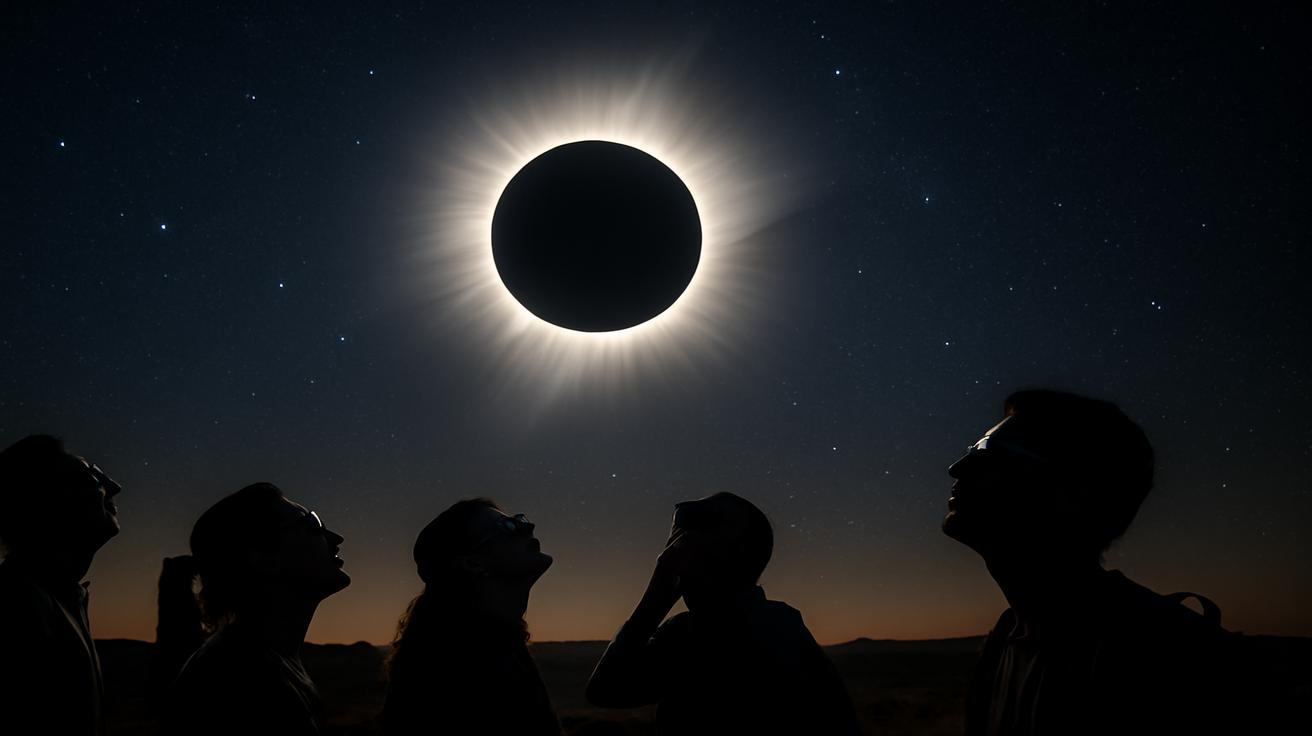
The light will fail in the middle of the day. Birds will go quiet, streetlights will flicker on at lunchtime, and for a few breathless minutes the world will feel like it has slipped its gears. Six minutes—that’s all. Six minutes of daytime darkness, of planets shining where the sun should be, of shadows turning strange and the air cooling against your skin. And yet those six minutes may become one of the most unforgettable natural events of your lifetime: the longest total solar eclipse of the century, a once-in-many-generations moment when the sky tells an ancient story in real time.
The Sky’s Oldest Magic Trick
Imagine looking up at the sun on an ordinary day—too bright to stare at, a single unblinking eye in a wide, familiar sky. Now imagine that same sun being slowly eaten away, a black bite taken out of its edge, then another, until only a thin, glowing crescent remains. The world around you changes gradually at first. Colors flatten. Shadows grow long and sharp, as if the afternoon has been quietly fast‑forwarded.
The idea that the sun could simply disappear has terrified humans for as long as we have been watching the heavens. In old stories, wolves chased it, dragons swallowed it, gods covered it with their hands. Today we understand the geometry: the moon, much smaller than the sun but so much closer to us, slides perfectly between Earth and our star. For a brief span of time, their sizes line up from our perspective with eerie precision. The result is a total solar eclipse, a cosmic coincidence so exact it feels more like a conjuring trick than a piece of orbital mechanics.
Most total eclipses are heartbreakingly short for anyone standing under the moon’s shadow. Two minutes. Maybe three. Before you’ve fully processed what your eyes are seeing, the light returns and the spell is broken. That’s what makes this one so extraordinary. The alignment, the distances, the path across our spinning planet—they all conspire to stretch totality to an astonishing length: about six full minutes of darkness in the middle of the day. In eclipse time, that’s a small eternity.
The Moment Day Turns to Night
As the moon takes a deeper bite out of the sun, the change in light becomes impossible to ignore. You’ll feel it before you fully see it. The temperature slips—just a few degrees at first, a soft exhale of heat rising from the ground as if the planet has taken a sudden breath in. The wind might pick up, then fall again. Wildlife grows restless. Dogs shift uneasily. A flock of starlings wheels in confusion.
In the minutes just before totality, the world doubles down on the strange. Shadows on the ground wrinkle with thin crescents, as sunlight filtering through leaves turns into thousands of tiny pinhole cameras projecting miniature partial suns onto sidewalks and car hoods. Colors wash out into something that looks like the faded edge of a storm or the aftermath of a summer thunderhead—except there are no clouds.
Then it happens. The last shard of the sun breaks into a glittering series of bright beads along the moon’s edge—“Baily’s beads,” sunlight beaming through its rugged valleys. One of those beads lingers, an impossible diamond of light set against a ring of inky blackness. This “diamond ring” phase is your final warning: the sun is about to vanish completely.
When the last bead flicks out, day collapses. Not night as you know it—this is not the slow descent of twilight, but something much more alien. A deep, blue-black dome unfurls across the sky with a suddenness that makes your heart jump. Stars appear at the wrong time, in the wrong places. Planets, usually lost in the sun’s glare, burn quietly overhead like old friends who decided to show up at noon.
And at the very center: the sun, gone, replaced by a black hole ringed in ghostly white fire. This is the solar corona, the sun’s invisible outer atmosphere, normally washed out by its blinding disk. Now it hangs there like a crown of spider silk and lightning, delicate and fierce all at once. You can stare directly at it, unaided, and for six long minutes you are allowed to look straight into the beating heart of our solar system’s energy without hurting your eyes.
The Longest Shadow of the Century
To understand just how special this eclipse is, you have to think in terms of the moon’s shadow—a racing, tapering cone that clips Earth’s surface in a moving path called the “path of totality.” Everyone within that narrow corridor will see the sun fully covered. Everyone outside it will see only a partial eclipse, interesting but not life-altering. The difference between those two experiences is the difference between hearing a song on the radio and standing front row at a live show.
During this particular event, the alignment of Earth, moon, and sun, along with the moon’s orbital position, stretches the duration of totality to its maximum for this century. The moon will be just close enough to Earth in its elliptical orbit that its apparent size in our sky is slightly larger than the sun’s. That extra sliver of size buys us extra time. Meanwhile, the path of the shadow will cross Earth at just the right angle to extend the period during which the centerline observers will stand in deep umbra, bathed in false night.
Six minutes may not seem long compared to the span of a human life, but in the history of eclipses it’s a remarkable gift. Many of the longest eclipses on record occurred long before camera phones and digital sensors, before global streaming and instant sharing. This one will be documented from every angle, by professional observatories and backyard telescopes, but it will also happen, irreproducibly, in your own body: the raised hair on your arms, the shiver along your neck, the stunned silence that tends to fall across crowds when the last light vanishes.
Scientists are already preparing, lining up specialized equipment along the path to capture the corona’s twisting structure, to study solar storms, to watch how our atmosphere responds when the sun flicks off like a switch. But for most of us, our job will be much simpler: be there, be present, and look up—safely.
How to Prepare for Six Minutes of Darkness
Getting ready for an eclipse is part practical checklist, part emotional anticipation. Unlike a meteor shower that lasts all night or an aurora that may come and go, this is a precision event. You either place yourself in the right location at the right time, or you don’t. There are no do‑overs until the next path crosses your part of the globe, and for a six‑minute totality, that probably won’t be in your lifetime.
First, the essentials: you need certified eclipse glasses or a handheld solar viewer that meets proper safety standards. Regular sunglasses are useless here; they block only a fraction of the light and none of the invisible but dangerous radiation. Until the moment of totality—when the sun is completely covered—you must keep those glasses on while looking directly at the sun.
Then there’s location. The difference between one minute of totality and six can be a matter of a few dozen kilometers. If you can, aim for the center of the path of totality, where the shadow is deepest and lingers the longest. Weather is another factor; a cloud at the wrong time can erase months of planning. Some eclipse chasers study historical cloud-cover data and hop airplanes across continents in pursuit of clear skies. You don’t have to go that far, but keeping an eye on forecasts and having a backup viewing spot is wise.
Think about comfort, too. You’ll be outdoors for hours, watching the partial phases build slowly toward the main event. Bring water, a hat, a blanket or chair. If you plan to photograph, test your gear before eclipse day. Practice safely mounting a solar filter over your camera or telescope. But also accept that the best “camera” may simply be your own eyes. More than one photographer has looked back with a pang of regret, realizing they spent their six minutes fiddling with buttons instead of simply standing in the darkened day and feeling it.
| What | Why It Matters | Tips |
|---|---|---|
| Eclipse glasses | Protect your eyes during all partial phases | Use only ISO-certified solar viewers; check for scratches or damage |
| Location in path of totality | Determines whether you see totality or only a partial eclipse | Aim for the centerline to maximize your totality duration |
| Weather check | Clouds can block the entire show | Monitor forecasts; consider a backup spot within driving distance |
| Comfort items | You’ll wait hours for a few crucial minutes | Bring water, snacks, layers, and something to sit on |
| Plan for presence | This is an emotional, once-in-a-century experience | Decide in advance when to put cameras down and simply watch |
What the World Will Feel Like
As totality takes hold, the environment around you stages its own quiet drama. Listen closely. That sudden hush isn’t just in your head. Birds may roost, tricked into thinking night has fallen. Crickets can begin their twilight chorus. Cows and horses drift toward barns. In some places, nocturnal animals poke cautiously into the dimness, their internal clocks briefly scrambled.
People react in their own wild variety. Some cry, overcome by the sheer strangeness of seeing the sun replaced by a perfect black disk. Some shout and cheer like it’s a fireworks finale. Others stand absolutely still, mouths open, lost in a kind of skyward meditation. There is something profoundly humbling about watching a force as constant as the sun flicker and fade. For a moment, the universe feels less like a backdrop and more like a living, moving structure surrounding you.
The air temperature may drop significantly, especially in dry regions, as the ground abruptly stops receiving its usual dose of solar energy. You can feel a gentle chill slide across your bare arms, like the shadow of a cloud magnified to the scale of a continent. Look around the horizon during totality and you may see a 360‑degree sunset, bands of orange and pink circling you on all sides while the sky overhead remains deep slate and violet. It’s as if you’re standing in the center of a vast bowl, the rim aflame while the middle has gone dark.
Above all, your sense of time shifts. Six minutes can feel strangely elastic. The first glance at the corona might freeze you in place. Then, just as you start to relax into it, you’ll notice the light along one edge of the moon brightening. The diamond ring snaps back into existence, and the first spear of direct sunlight returns, flooding the landscape in a rush. Daytime unfolds again in a fraction of the time it took to unwind.
A Human Story Written in Shadow
Every eclipse carves itself into the memory of the people who see it. For ancient communities, such events were often interpreted as omens. Crops, kings, wars—everything felt connected to that sudden hole in the sky. Today, we know the math behind the magic. We can predict, down to the second, when the moon’s shadow will cross each valley and rooftop. Yet the emotional weight has never really gone away.
Stand among a crowd when the sun’s light begins to fail, and you’ll feel a shared pulse of awe and vulnerability. Strangers become companions, pointing and gasping together. Children will remember the color of the air, the way adults around them suddenly became just as wide‑eyed as they were. Couples will exchange nervous laughs that fade into reverent silence. Even the most rational among us may feel a flicker of that ancient fear—What if it doesn’t come back?—before the sky proves, again, that it obeys its own dependable rhythm.
This particular eclipse—longer than any other in your lifetime—is also a kind of time machine. Somewhere, decades or centuries from now, someone will read that people once stood under a six‑minute umbra and watched the corona blaze. They may live in a world where the moon has drifted a little farther away, shrinking its apparent size just enough to make such long totalities rarer. Our six minutes will sound indulgent to them, like tales of winters that used to be colder or summers that used to be milder.
In the grand story of the solar system, eclipses are a transitional phenomenon. The moon is slowly spiraling away from Earth, centimeter by centimeter each year. Eventually, far in the future, it will no longer be big enough in our sky to cover the sun completely. Total eclipses will cease. There will be no more coronal crowns, no more daytime darkness, only “annular” eclipses where a ring of sunfire always remains. To live now, in this narrow window of cosmic time when perfect alignments still happen, is to be quietly privileged in a way most of us never consider.
Six Minutes You’ll Talk About for the Rest of Your Life
When it’s over, when the light is fully restored and the birds resume their songs and cars begin to edge back onto highways, the eclipse shifts from event to memory. It lingers as a taste: the metallic edge of pre‑totality wind, the coolness on your skin. As an image: that impossible black circle cut into the sky. As a feeling: the fragile realization that the things we take for granted—the path of the sun, the rhythm of the day—are not owed to us, but gifted by a clockwork so much larger than our daily concerns.
In the days and weeks afterward, conversations will keep circling back to those six minutes. You’ll find yourself saying, “You had to be there,” because no photo, no video, no simulation quite captures the full-body experience of standing under a vanished sun. You might scroll through your phone and see that yes, you got the shot—the shimmering corona, the ring of fire—but the frame leaves out the chorus of gasps, the scratch of dry grass under your shoes, the way the air smelled faintly of dust and cooling asphalt.
Nature offers countless spectacles: auroras rippling green across polar skies, comets blazing through the dark, meteor storms that paint the night with fire. But a long total solar eclipse is different. It meddles with the most fundamental pattern we know: the certainty that day follows night and night follows day. For six minutes, that certainty is suspended. And when it returns, when the sun reclaims its throne in the sky, you carry forward a quieter kind of certainty—the knowledge that you live on a turning world, orbiting a star, moon in tow, part of a vast choreography that doesn’t notice us and yet shapes everything we are.
So mark the date. Circle it, underline it, mention it to friends who might otherwise let it slip by as just another busy afternoon. Plan your journey into the path of totality, however near or far it lies from your front door. Stock up on eclipse glasses. Scout a field or a rooftop or a quiet hilltop where you can watch the world dim.
And when the day comes, when the first bite appears on the sun’s edge and the light begins its slow, uncanny fade, take a breath. Remember that you’re about to witness something that almost no human beings who have ever lived have seen in this way, for this long. Six minutes of darkness. Six minutes of the universe reminding you that it runs on a schedule far older, and far grander, than ours. Be ready to step into the shadow—and to remember it, vividly, for the rest of your life.
Frequently Asked Questions
Is it really safe to look at the eclipse during totality?
Yes, but only during the brief period of totality when the sun is completely covered. At that point, you can remove your eclipse glasses and look directly at the corona. The moment even a sliver of the bright solar surface reappears, you must put your glasses back on.
Why is this eclipse going to last so long?
The duration depends on the moon’s distance from Earth and the geometry of the eclipse path. For this event, the moon is relatively close to Earth and passes near the center of the sun’s disk from our perspective, maximizing how long its shadow covers any given point.
What if I’m outside the path of totality?
You’ll see a partial solar eclipse, which is still interesting but far less dramatic. The sky won’t go fully dark, and you won’t see the corona. If you can travel into the path of totality, it’s worth the effort; the experience is completely different.
Do animals really react to an eclipse?
Yes. Many animals respond to the sudden darkness as if night has fallen. Birds may go to roost, insects change their calls, and livestock can become unsettled or begin evening routines. Behavior varies by species and environment, but changes are often noticeable.
How should I photograph the eclipse?
Use a proper solar filter on your camera or telescope during all partial phases, and practice your setup in advance. During totality, you can remove the filter to capture the corona. However, consider spending at least part of totality without a camera, simply watching, so you don’t miss the experience while adjusting settings.






Leave a Comment