
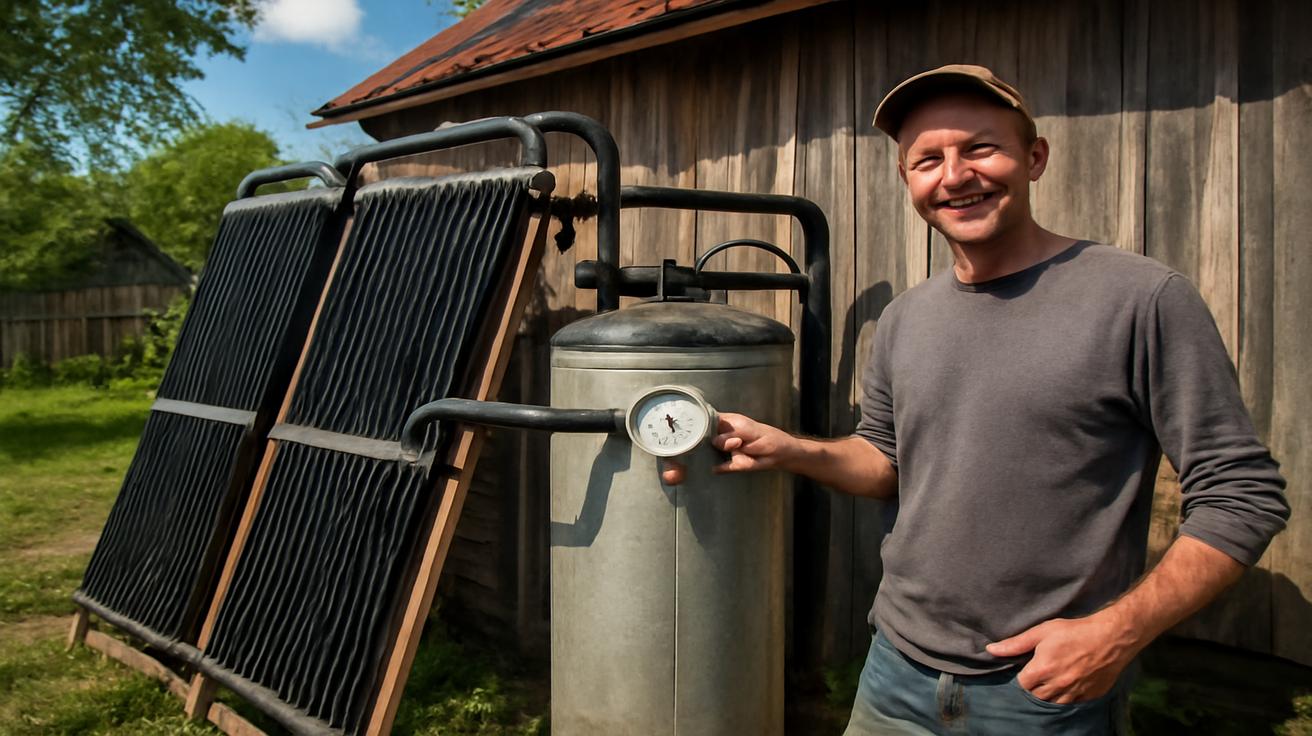
The first thing you notice is the sound. Not the hum of a pump or the thrum of a boiler, but a soft, steady gurgle—water slipping through pipes in the quiet of a waking village. The sun is barely above the rooftops, and a thin mist curls off a gleaming metal surface behind a modest, somewhat scruffy house on the edge of town. A kettle whistles in the kitchen, but the real miracle of hot water is happening outside, under the pale light of morning.
Out there, in a backyard that smells faintly of damp earth and sawdust, stands a homemade machine that looks like a cross between a science fair project and an art installation. Rows of metal pipes, old glass panes, insulated barrels, and salvaged components patched together with the stubborn logic of a mind that refuses to accept “impossible.” This is where 3,000 liters of hot water flow every single day—without electricity, without oil, without gas.
The Man Who Refused to Pay the Bill
“It started with a bill,” laughs Markus, wiping his hands on a rag that used to be a shirt. He’s in his late forties, with the kind of sun-creased face that tells you he spends more time outdoors than in. “And a shower that went cold halfway through winter.”
He remembers the moment well. One January evening, years ago, he climbed into the shower after a long, cold day and was greeted by icy water. The fuel tank was empty. Delivery prices had jumped again. The electric backup was already turned off to save money. He stood there, shivering, staring at the showerhead, and thought: This is ridiculous. The world is full of energy. Why am I dependent on this?
Markus is not an engineer by training. He’s something rarer: a determined tinkerer. The kind of person who can’t walk past a skip without peeking in, who sees not junk but possibility. In his shed, old water heaters, bicycle frames, broken windows, and rusting pipes wait for their second life. The shed smells of metal filings and coffee. The stereo on the workbench plays quietly over the clink of tools and the occasional triumphant curse.
“I didn’t start out wanting 3,000 liters,” he says. “I just wanted a hot shower that nobody could take away from me.” But like many small rebellions, this one grew. A single solar collector led to an extra storage tank, then to a heat exchange loop, then to a gravity-fed circulation system. His friends started coming by to help—and to use the shower. Then neighbors. Then, much later, the village swimming club came to ask if it might be possible to heat their pool, too.
The Backyard Solar Beast
On a clear day, sunlight pours onto Markus’s backyard like a silent, golden flood. Where most people would see just a flat roof and a patch of grass, he saw an untapped reservoir of energy. The machine he built to catch it doesn’t look like the sleek, polished solar systems from glossy brochures. It looks… stubbornly homemade.
Long, blackened copper pipes run inside shallow wooden boxes lined with reflective foil. Old double-glazed windows, scavenged from a renovation site, are carefully mounted on top, sealed with high-temperature silicone. Underneath, thick layers of recycled insulation—leftover from a friend’s attic project—trap the heat.
“If you paint it black, it gets hot. If you insulate it, it stays hot. It’s basically that simple,” he says, though nothing about the tangled arrangement of valves and pipes looks simple at all. In the low angle of morning light, the glass surfaces shine faintly. Touching them is like putting your hand on the roof of a car that’s been sitting in the sun—warm, then quickly hotter than you expect.
By mid-morning, tiny air bubbles begin to appear in the transparent sections of the plumbing. The water inside the collectors is stirring, rising, gently pushed not by pumps but by physics. Hot water expands, becomes lighter, and starts to climb. Cooler water sinks to take its place. Markus smiles when you notice it.
“That’s my pump,” he says, pointing at the shimmering pipes. “Thermosiphon. Works every day, never breaks, never gets a bill.”
The Art of Moving Water Without a Wire
Many modern heating systems rely on circulation pumps, sensors, controllers, and software. Markus’s system relies on gravity, density differences, and careful pipe routing—things as old as hot water itself. His collectors sit slightly lower than the main storage tanks, and the pipes rise continuously, with no dips where pockets of air could collect and interrupt the flow.
“I spent a whole summer just learning how not to trap air,” he admits. “It’s like plumbing Tetris.” On the wall of his shed are three hand-drawn diagrams, annotated with arrows and scribbled notes. Over time, his doodles evolved into a functioning network of collectors feeding multiple insulated tanks, each with a specific purpose—domestic hot water, radiant floor loops, and a buffer for cloudy days.
When the water in the collectors reaches a certain temperature, it glides up into the tanks all on its own. Cooler tank water slips down to replace it. The cycle continues as long as the sun keeps shining. No wiring. No control unit. Just valves, slopes, and quiet patience.
From One Shower to 3,000 Liters
At first, the system was tiny: a single collector panel made from an old radiator painted black, covered with glass. It had a 200-liter storage tank scratched from a scrap yard, patched and insulated with whatever Markus had lying around. It was crude—but the shower stayed hot.
“It was like magic,” he recalls. “I’d turn on the tap, and there was this rush of heat that felt like cheating the system.” Friends came to see the contraption. Some came to mock; most left impressed. “People would say, ‘Nice idea, but you’ll never heat anything big like that.’”
He took that as a challenge.
Today, several tanks stand shoulder to shoulder, wrapped in layers of foam and old blankets beneath a weatherproof shell. Combined, they hold enough water to make a small hotel jealous. Altogether, on a good day, his network of collectors and storage can supply about 3,000 liters of hot water—enough for showers, dishwashing, laundry, and even a small, modestly heated pool that the local kids swarm on summer evenings.
The numbers tell the story of how it all grew:
| Stage | Approx. Collector Area | Storage Volume | Daily Hot Water Output* |
|---|---|---|---|
| Prototype (Year 1) | 4 m² | 200 L | ~150–200 L |
| Family System (Year 3) | 12 m² | 800 L | ~800–1,000 L |
| Extended System (Year 6) | 25 m² | 1,800 L | ~1,800–2,000 L |
| Current Setup (Year 9+) | 40+ m² | 3,000+ L | ~3,000 L |
| *On sunny days; output varies with season and weather. | |||
“I never sat down and said, ‘I will build a 3,000-liter system,’” Markus insists. “I just kept adding what made sense. One more panel here. A bigger tank there. A better way to keep the heat from escaping at night.”
Standing beside the tanks, you can feel the faint warmth under your palm, even through the insulation. In winter, when frost coats the garden, a tiny cloud of steam sometimes lifts from the overflow vents like the breath of some sleeping creature. Inside his house, the radiators and taps respond with a steady, quiet confidence. The boiler that once growled to life now sits mostly idle, a backup rather than a master.
Living with a Machine That Drinks Sunlight
Having a backyard that functions as a solar engine changes the way you move through the day. You start to notice sunlight the way others notice traffic or rain. Markus has become an expert reader of the sky.
“If it’s crisp and clear in the morning, I know by afternoon the tanks will be topped up. That’s laundry day, shower day, maybe even ‘heat the pool’ day,” he says. On cloudy weeks, he watches the temperature gauges with a quiet, protective anxiety, like a shepherd counting sheep.
His children have grown up with a different sense of what hot water means. For them, it isn’t an invisible commodity summoned by twisting a tap. It’s something the house earns. They know that long, luxurious showers on grey days have a cost—not in money, but in stored sunlight.
“They used to roll their eyes when I’d say, ‘Shower later, let the sun do a bit more work,’” Markus says. “Now they tell their friends, ‘Wait till the tank is hot, it’s way better then.’” He laughs. “We’ve turned solar timing into a family culture.”
What 3,000 Liters Actually Feels Like
Numbers are abstract. What does 3,000 liters of hot water actually mean in everyday life? It’s the difference between rationing and generosity. A family of four might use 200–300 liters of hot water a day without thinking—washing dishes, showering, doing laundry. Multiply that by ten, and you have enough for extended family visits, community events, or a rowdy group of teenagers washing off after a muddy football game.
In summer, the excess heat feeds a small above-ground pool that wouldn’t otherwise see much use in this climate. On some evenings, the laughter of children echoes off the water while the sky turns the color of ripe apricots. Parents sit with their feet in the shallow end, surprised by how warm it feels. Few of them realize they are swimming in sunlight that fell on a roof that morning.
Markus walks you through the system with the relaxed pride of a gardener showing off heirloom tomatoes. Thermometers. Pressure relief valves. Gravity loops. Mixing valves that ensure no one gets scalded. He has built not just a solar heater, but a kind of thermal ecosystem.
“The trick,” he says, “is not just to catch heat, but to give it a job. If you’ve got more than you need, you find a way to use it. Heat a bench. Warm a greenhouse. Preheat the cold water going into your washing machine. Wasting hot water you made without fuel feels like letting fruit rot on the tree.”
The Quiet Politics of a Warm Shower
In an age of rising energy prices and climate anxiety, hot water can feel surprisingly political. Every boiler that kicks on burns something. Every heat pump depends on a grid that may or may not be clean. Markus’s contraption is small in the global picture. It doesn’t change national policy. It doesn’t shut down a coal plant. But it demonstrates something quietly subversive.
“People assume you need big companies and big tech to solve big problems,” he says, leaning against one of the tanks. A delicate spider has built a web between two pipes; he carefully avoids it. “But you can do a lot with scrap, time, and stubbornness.”
His neighbors have noticed more than just the lack of oil deliveries. They’ve started to ask questions. A few have cobbled together their own modest systems—nothing as ambitious, but enough to shave the edge off their bills and their dependence.
“We’re not going off-grid or living in caves,” says one neighbor, rinsing dishes in water warmed by a smaller panel Markus helped her build. “We’re just… tapping what’s falling from the sky anyway.”
The village council, initially bemused, eventually came to ask if parts of Markus’s design could be used for community buildings. A local workshop borrowed his ideas to preheat water for a process that used to rely entirely on gas. None of these changes make headlines. But they matter to the people who open their bills in winter and feel less of a sting.
Imperfection as a Feature, Not a Flaw
The system isn’t perfect, and Markus doesn’t pretend it is. On long, grey stretches in deep winter, there simply isn’t enough sun to sustain everything. The backup heater still exists. Temperatures in the farthest loops might drop a bit. Sometimes a valve sticks, or a small leak appears where old pipe meets newer fitting.
“The difference is, now I understand where my heat comes from,” he says. “I can hear it. I can touch it.” He gestures toward the dials and gauges. “If something’s wrong, I usually know before it becomes a problem. It’s not a black box. It’s my box.”
He points at a particularly messy-looking junction of pipes. “That there? That’s my learning curve, in copper. Every ugly bend is a mistake I made and then fixed. If I did it today, it would be cleaner. But I leave it like that to remember.”
He’s cautious when people ask for a blueprint. “I can show you what I’ve done,” he says, “but your roof is different, your climate is different, your needs are different. The point isn’t to copy this monster exactly. The point is to realize you can build your own.”
The Future, One Backyard at a Time
As the afternoon wears on, the collectors on Markus’s roof shimmer with heat. The air above them wavers slightly, like the horizon over a hot road. Inside the tanks, the water climbs past 60 degrees Celsius. Valve by valve, he diverts some of the surplus to where it’s needed most.
“If I had more money at the beginning, I might have bought a fancy system,” he admits. “But then I wouldn’t know it inside out. And I’d be afraid to touch it.” His hands, nicked and calloused, move over his creation with the easy familiarity of someone who has disassembled and reassembled it more times than he can count.
When you ask him what comes next, he doesn’t talk about bigger, shinier gear. He talks about other people’s sheds, other rooftops.
“I’d love to see every street have at least one person who knows how to do this kind of thing,” he says. “Not because everyone needs 3,000 liters, but because once you see hot water come out of a pipe that’s never been connected to a power line or a fuel truck, something in your head changes. You stop thinking of yourself as just a consumer.”
In the fading light, a neighbor’s kid runs through the yard barefoot, trailing a wet towel, hair still damp from a solar-heated bath. Steam curls gently from a vent above the tanks. Somewhere a bird calls, then falls quiet. The only sound left is that soft, persistent murmur of water moving, rising, cooling, and rising again.
Tomorrow, if the sun appears, it will all start over. No meter will spin for it. No invoice will arrive. Somewhere between the improvised collectors and the warm water in the tap, the border between technology and weather, between ingenuity and ordinary life, has quietly blurred.
In one not-so-remarkable backyard, 3,000 liters of hot water a day are a reminder: the world is still full of energy. Sometimes all it takes is someone stubborn enough to catch it.
FAQ
Does a system like this really work without any electricity at all?
Yes, if it’s designed around thermosiphon (natural circulation) and gravity. The hot water moves because hotter water is less dense and rises, while cooler water sinks. As long as the collectors are positioned lower than the storage tanks and the pipes are laid out correctly, no electric pump is required. Some people still add small backup pumps or controllers, but they are optional.
Is 3,000 liters of hot water realistic for a DIY solar setup?
It’s ambitious, but realistic if there is enough collector area, good insulation, and large storage tanks. The exact output depends heavily on climate, season, and system design. Markus reached that scale gradually, expanding his system over years. Most households can start much smaller and still cover a significant share of their hot water needs.
What happens on cloudy or winter days?
On cloudy days, the system still collects some heat, but output drops. In winter, especially at higher latitudes, the sun is weaker and lower in the sky, so production is lower. That’s why most systems—including Markus’s—keep a backup heater for the darkest periods. The goal is to reduce dependence on fuel, not necessarily eliminate it completely.
Is building a solar hot water system like this safe?
It can be safe if built carefully, with proper pressure relief valves, temperature mixing valves to prevent scalding, and correctly rated materials. However, working with pressurized hot water and plumbing is not trivial. Many people choose to combine professional help for the critical parts (like connecting to the existing hot water system) with their own DIY work on non-pressurized or low-risk components.
Do I need specialized materials, or can I really use scrap?
Both approaches are possible. Copper pipes, proper insulation, and tempered glass make for efficient collectors, but many successful DIY systems use repurposed radiators, old windows, and salvaged tanks. The key is to understand which parts must be safe and durable (tanks, pressure lines, safety valves) and where improvisation is acceptable (insulation, mounting, secondary loops).
How big a system would an average family need?
A typical family of four can often cover most of their hot water demand with 4–8 m² of solar collectors and a 300–500 liter storage tank, depending on climate and habits. That’s far smaller than Markus’s 3,000-liter setup, which supports more uses and occasional community needs. Starting small and learning from experience is usually the best path.
Can this idea be adapted to apartments or urban homes?
Yes, in modified form. Apartment buildings and urban homes can install shared solar thermal systems on roofs or façades, with centralized storage tanks. Even a small balcony or roof space can host a compact collector feeding a single flat. While gravity-only circulation might be harder in multi-story buildings, low-power pumps and simple controls can still create an efficient, low-energy system inspired by the same principles.





Leave a Comment