
The alarm that matters most doesn’t beep. It doesn’t glow red on a dashboard or vibrate on your wrist. It hums, quietly, in faint solar winds and whisper-thin air 400 kilometers above your head, where a thin ring of metal and circuitry is keeping humanity’s space dream alive—barely. Up there, in low Earth orbit, the line between “routine” and “ruin” might be as short as 2.8 days. Two point eight days from the first wrong nudge to a roaring, invisible avalanche that could slam shut the doors to space for decades.
The Sky Is Not Empty
Step outside at night and tilt your head back. The sky, at first glance, feels calm, fixed, almost eternal. Constellations hang where they’ve hung for millennia. The Milky Way, when light pollution lets it through, is a soft river above the rooflines. But stare a little longer and something odd happens: the sky moves.
Pinprick stars slide along straight tracks: satellites, one after another, strung out like beads. A fleeting flare, a quiet blink. Some evenings, an entire train of them passes overhead, low and bright, as if someone has threaded the sky with silver. What used to be a rare treat—spotting a satellite—has become a nightly routine in many places.
That motion is your first hint that the heavens, especially the band of low Earth orbit (LEO), are anything but empty. Between about 160 and 2,000 kilometers above the planet’s surface, a storm of human-made objects circles Earth: operational satellites, dead satellites, spent rocket stages, fragments, flakes of paint, lost tools—an unintended scrapyard traveling at bullet speeds. Space agencies track more than 36,000 pieces of debris larger than a golf ball. Tiny fragments? There are likely more than 130 million of them, too small to see from Earth but large enough to tear through metal.
From the ground, the sky feels pure. From orbit, it looks increasingly like a junk drawer that’s never been cleaned out.
2.8 Days: The Invisible Countdown
In 1978, NASA scientist Donald Kessler proposed something that sounded like science fiction: what if the density of objects in LEO grew so high that one collision set off a chain reaction of further collisions? A satellite breaks into shards, which slam into more satellites, which fragment again, and again, and again—until orbit is choked with high-speed shrapnel. The idea, now known as Kessler Syndrome, has hovered over spaceflight for decades like a quiet, patient storm warning.
Today, that storm doesn’t seem remote anymore. There’s a number that has quietly entered the conversation among orbital debris experts: roughly 2.8 days. That’s the average warning time, in some modeled worst-case scenarios, between the first large, unplanned debris-generating event and the moment LEO begins sliding into an unstoppable cascade. Two point eight days between “we might have a problem” and “the ladder to space is collapsing beneath our feet.”
The unsettling part? The first domino might fall without us fully realizing what it means. A defunct satellite breaks apart—maybe from an old battery explosion or a leftover fuel tank that ruptures as it’s warmed by the sun. Radar stations detect a new cloud of fragments. Analysts scramble to re-calculate collision probabilities for thousands of space objects. Maneuver plans are redrawn; emails spike across agencies and private companies. The mood shifts from routine to tense, but not yet to panic.
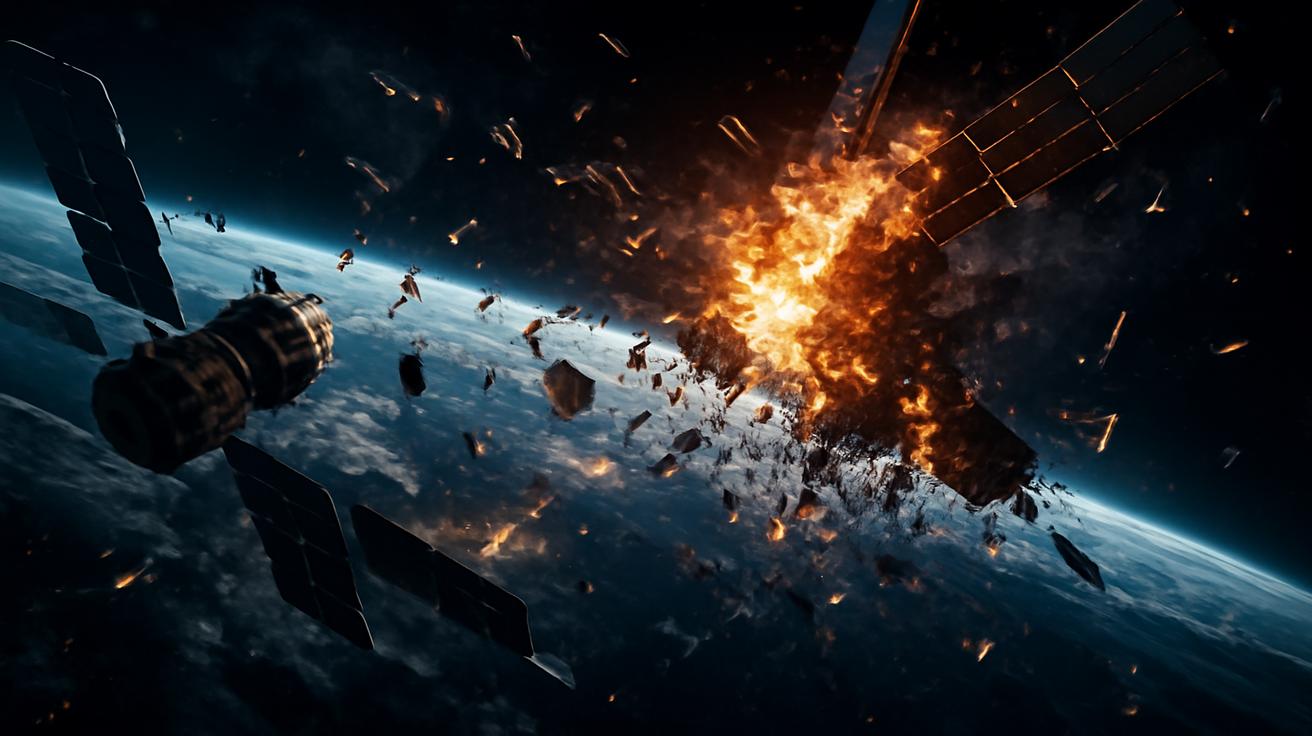
And then collisions begin to multiply. A fragment the size of a marble slams through the solar array of a functioning Earth observation satellite, turning metal and circuitry into a fresh spray of jagged shards. Those shards fan out along the orbit like invisible shrapnel, spreading the risk to everything else circling at similar altitudes. Each impact is not just destruction; it is multiplication.
The Violence of a Single Collision
At orbital speeds—about 7 to 8 kilometers per second—collisions don’t look like the slow-motion crunch of two cars at an intersection. They are, in physics terms, hypervelocity impacts. One satellite slamming into another releases energy equivalent to several kilograms of TNT, enough to completely pulverize both objects. Where once there were two, now there may be tens of thousands of fragments, each one a bullet with no friction to slow it down.
Imagine driving on a freeway where every broken headlight explodes into a thousand razor-sharp shards that keep their speed forever and can punch through any other car they hit. That’s low Earth orbit if the cascade begins. And because everything is circling the planet, the wreckage doesn’t pile up in a ditch; it wraps itself around Earth in a deadly, shifting belt.
What We Stand to Lose in a Week
When something goes wrong in orbit, there’s no air to carry sound, no fireball spreading through clouds—just silent flashes of impact and expanding clouds of debris. Down here, the first sign that something is very wrong might be simpler: your phone navigation stops working. A weather forecast quietly misses a storm. Flights are delayed in unexpected patterns. A money transfer takes longer than usual.
Modern life is woven through with threads of data carried by satellites, many of them in low Earth orbit. It’s easy to forget how much of our world now depends on that thin, crowded shell of machinery above the atmosphere.
| Everyday Activity | How LEO Satellites Support It | What Could Happen in a Cascade |
|---|---|---|
| Using maps or ride-share apps | Precise positioning and timing signals | Navigation errors, slower service, outages |
| Checking weather forecasts | Cloud, temperature, and storm tracking from orbit | Less accurate forecasts, poorer storm prediction |
| International banking and trading | Global timing and secure communication links | Delays, higher error risks, increased costs |
| Flights and ship navigation | Route planning, tracking, and communication | Reduced safety margins, detours, disruptions |
| Earth monitoring & climate science | Sea level, ice melt, forest and crop tracking | Data gaps, weaker climate and disaster response |
In a severe debris cascade, the first to suffer would likely be the most crowded orbital highways where mega-constellations operate—networks of thousands of small satellites delivering broadband to remote villages, fishing boats, and mountain cabins. Pieces of debris would begin shredding these constellations one by one, turning life-giving infrastructure into the very shrapnel that accelerates the disaster.
Within days, satellite operators might be forced to power down or move out of threatened orbits, if they can. But dodging shrapnel with half-second precision in a swirling, expanding cloud is like trying to change lanes on a freeway where every car is crashing at once. The more crowded an orbit, the less room there is to maneuver, and the more every move you make can put you in the way of something else.
When Space Becomes a No-Go Zone
As debris density rises, the risk isn’t confined to what’s already up there. Launching anything new through that shrapnel field becomes dangerous. Rockets must thread their way up through the lower layers of junk, then deploy satellites into regions where collision probabilities might be orders of magnitude higher than what we consider acceptable now.
In some worst-case projections, specific orbital bands could effectively become “no-go zones” for years, possibly decades. Not because we lack the technology to reach them, but because the risk of instant, catastrophic loss of any spacecraft crossing those altitudes would be too high.
Human spaceflight would be especially vulnerable. The International Space Station (ISS) already performs regular maneuvers to dodge debris, changing its orbit in quiet bursts of thrust when tracking data suggests a worrying near miss. A true cascade could trap the station in a crossfire it cannot dodge fast enough, potentially forcing a hasty evacuation or, in the most extreme outcome, making continued human presence in LEO impossible.
The poetic tragedy of it is hard to miss: the same species that transformed low Earth orbit into a halo of intelligence and observation could, through neglect, fast-track it into a shell of high-speed ruins that guards the sky against its makers.
The Physics of a Slow Emergency
Disasters on Earth are easy to picture. Tornadoes and wildfires roar and glow; earthquakes crack roads and topple walls. Orbital disasters move differently. They’re made of trajectories and probabilities, of spreadsheets that turn red before anything visible happens.
Consider the way debris spreads. A single collision sends fragments in slightly different directions and speeds. Some pieces find themselves in slightly higher orbits; others are nudged lower. Higher fragments may circle Earth for decades, their speed slowly eroding as the faint drag of the upper atmosphere pulls them down. Lower fragments fall back faster, sometimes burning up as faint shooting stars that no one on the ground knows are pieces of destroyed machines.
Meanwhile, every fragment carries its own potential impact, its own opportunity to become the seed of another breakup event. The math begins to turn unpleasant: a density is reached where, even if we launch no new satellites, the existing debris field is self-sustaining. Collisions generate more fragments; more fragments cause more collisions. This is the heart of Kessler’s nightmare—not just a bad day in orbit, but a slow, grinding transformation of low Earth orbit into a long-term hazard.
How 2.8 Days Becomes Years
The “2.8 days” figure that haunts some simulations is not the lifespan of the disaster. It is the time between a tipping-point event and the moment humans lose the ability to effectively intervene. Once the cascade begins, it is like knocking snow loose from a high slab on a mountain; gravity and momentum take over. The avalanche might sweep the slope clean in seconds, but the conditions that made it possible built up over seasons.
In LEO, those “seasons” are the decades we’ve spent launching, abandoning, exploding, and occasionally smashing objects together. Anti-satellite missile tests that pulverized spacecraft into clouds. Defunct weather satellites left to drift unpowered. Rocket bodies that never vented their leftover propellants and later burst apart. Each fragment, each bolt, each shard, a tiny dice roll that might stay harmless for centuries or might, one unlucky day, become the last straw.
Listening for Trouble in the Orbits Above
So how do we keep a quiet hum from turning into a siren? The answer begins with seeing. Space surveillance networks—ground-based radar, optical telescopes, and, increasingly, space-based sensors—are trying to map the chaos. For large objects, the tracking is sophisticated; we know where they are, how they move, and often who owns or once owned them. For small debris, it’s more like hearing a storm at night without being able to see each raindrop.
Operators get warnings called “conjunction alerts” when tracking predicts a close pass between two objects. Thousands of such alerts are generated each week for satellites in busy orbits. Most result in no action, because the chance of collision is low or the uncertainty in the data leaves operators with tough judgment calls. Moving a satellite isn’t free: it uses precious fuel, shortens mission life, and sometimes places it at risk from something else.
The uncomfortable truth is that our picture of the debris field is still incomplete, especially for smaller fragments. In other words, we are trying to manage a crowded freeway from a distance, with hazy traffic cameras that sometimes miss motorcycles and bicycles entirely. In that uncertainty lives the possibility of surprise—the kind that flips the invisible countdown clock to 2.8 days and starts it ticking.
From Cleaning Up to Growing Up
Researchers are working on ways not just to dodge debris, but to remove it. Concepts range from nets and harpoons to robotic arms, tug satellites, drag sails, and even ground-based lasers designed to nudge tiny fragments into lower orbits where they burn up quickly. Each idea runs up against harsh realities: cost, legal responsibility, international politics, and the fact that grabbing a dead, tumbling rocket body in orbit is more like catching a spinning car on ice than picking up trash.
But cleanup alone isn’t enough. The deeper shift has to be cultural and political: treating orbit as a shared ecosystem rather than an infinite dumping ground. Regulations that once assumed a small number of big satellites now strain under swarms of thousands. Disposal rules, post-mission deorbiting plans, collision avoidance standards—these are the orbital equivalent of fishing quotas and fire codes. They are the difference between a resource that endures and one that collapses.
What makes the LEO crisis uniquely tricky is that it’s both global and borderless. No single nation owns orbit. A fragment created by one country’s rocket can maim another country’s climate satellite twenty years later. Any meaningful solution has to be cooperative, built on trust and verification in a domain where military secrecy and commercial competition both run deep.
Reimagining Our Relationship With the Thin Blue Edge
Listen closely to the way we talk about space, and you’ll hear a familiar note: frontier. The wild West above the atmosphere, ripe for conquest—launch more, move fast, disrupt, scale. This language has driven an extraordinary burst of innovation: cheaper launches, smaller satellites, global connectivity promises. It has also, quietly, reinscribed some of our oldest habits of extraction: use first, worry later.
But orbit is not a gold rush waiting to be exhausted; it is a fragile interface, more like a coral reef than a mine. A coral reef thrives on diversity and balance, but once it’s broken, it rebuilds slowly, if at all. Low Earth orbit is the coral reef wrapped around our planet’s waist, a living shell of machines that watch storms, relay voices, and help us understand the changing climate below. Treat it roughly, and it breaks in ways that outlast human attention spans and election cycles.
The sensory reality of space is easy to overlook because we don’t live there. We don’t hear the soft hiss of atomic oxygen scraping against solar panels or feel the tiny jolts as micrometeoroids pepper metal skins. We don’t see the glitter of a slowly dispersing fragment cloud backlit by sunrise over the curve of Earth. For most of us, space is a map on a screen, a dot labeled “ISS,” a line of satellites gliding overhead like fireflies trained into formation.
Yet, our future with space—whether it remains a canvas for science, exploration, and connection, or becomes a mirror of our worst ecological instincts—depends on choices being made right now, often in quiet conference rooms and control centers, by people whose job it is to worry about orbits so that the rest of us never have to.
We may never know when we are exactly 2.8 days from disaster. That uncertainty is not a reason for fatalism; it’s a reason for humility. We have been given a narrow, astonishingly useful band of near-Earth real estate, and we have filled it at a pace far faster than our ability to clean up after ourselves. The story we tell about low Earth orbit from here on out—whether it is a cautionary tale or a story of course correction—depends on recognizing that the sky is not just above us. It is, increasingly, something we are building.
Next time you step outside at night and see that straight, steady glide of a satellite overhead, try a different kind of gaze. Don’t just see a dot of light; see a crowded, fragile river of machines, all racing around the world in synchronized free fall. Feel, for a moment, how thin the line is between the calm beauty of that motion and the chaos brewing at its edges. The clock, if it starts, will not announce itself. But the time to listen for it is now, while the sky is still mostly quiet—and the stars still shine through.
Frequently Asked Questions
What exactly is low Earth orbit (LEO)?
Low Earth orbit is the region of space from about 160 to 2,000 kilometers above Earth’s surface. It’s where the International Space Station flies, many Earth observation and weather satellites operate, and a growing number of communication constellations orbit.
What is Kessler Syndrome?
Kessler Syndrome is a scenario in which the density of objects in LEO becomes so high that collisions between them create more debris, which then causes more collisions. This chain reaction can make certain orbits unusable for long periods.
Is the 2.8-day figure a real prediction?
It’s not a fixed countdown, but a result from some worst-case modeling: under certain conditions, once a major debris event happens, the system may cross a tipping point within a few days, after which it’s extremely hard to prevent a cascading chain of collisions.
Could we really lose access to space?
We’re unlikely to lose all access, but specific altitude bands could become so hazardous that launching or operating satellites there would be too risky. Human spaceflight could become much more difficult if debris density rises dramatically.
What can be done to prevent a debris cascade?
Key steps include designing satellites to deorbit safely after their missions, avoiding destructive anti-satellite tests, improving debris tracking, coordinating collision avoidance, and developing active debris removal technologies. International cooperation and strong space sustainability standards are essential.



Leave a Comment