
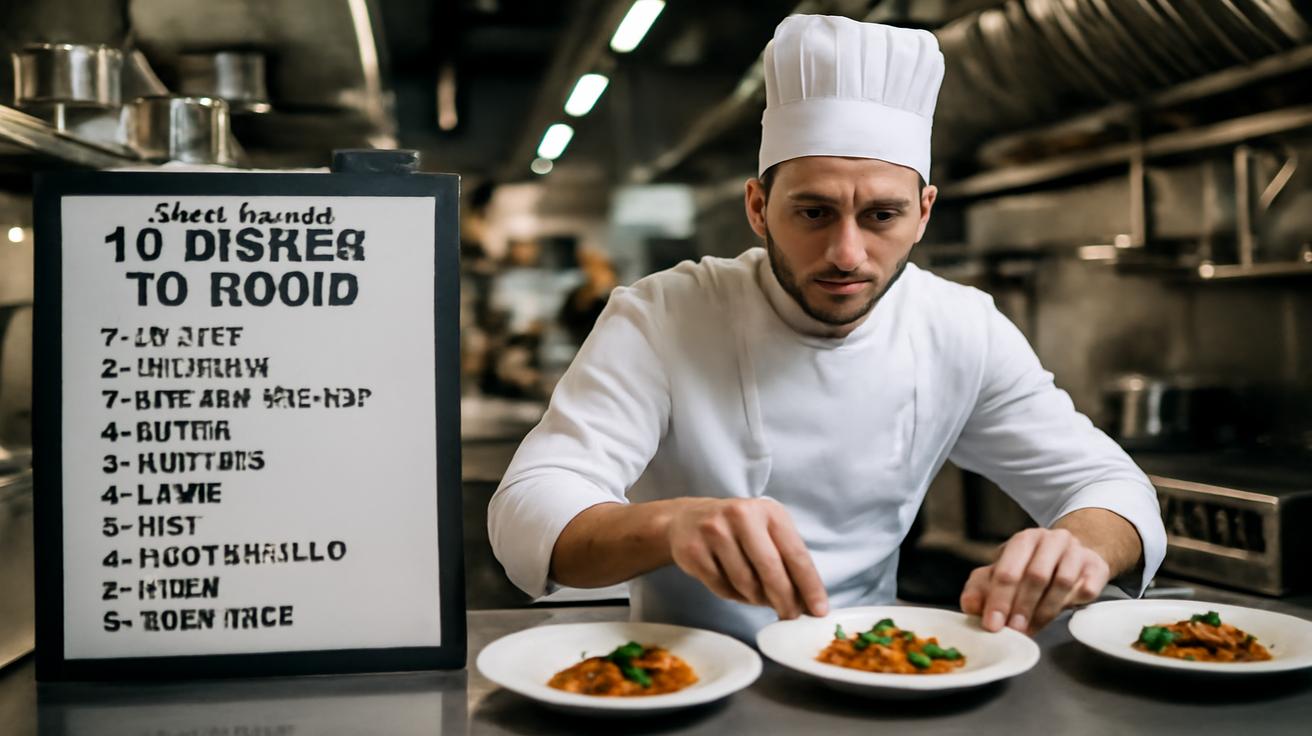
The menu was the size of a small novel, laminated and creased from years of hands flipping through it. It promised everything: truffle this, artisanal that, an awkward romance between sushi and fettuccine Alfredo on the same page. Around you, the dining room hummed with clinking glasses and low laughter, the air salted with garlic and something deep-fried. You were hungry—really hungry—and the words “chef’s special” and “house favorite” shimmered like lures in a deep, blue sea. But somewhere behind those swinging kitchen doors, a line cook raised an eyebrow, the chef sighed, and a quiet truth hung in the steam: there are things on that menu you should never, ever order.
The Hidden World Behind the Menu
Ask a professional chef what they never order when they eat out, and they won’t give you a polite, PR-polished answer. They’ll tell you about the lonely dishes that never move, about seafood that travels too far and sits too long, about pasta that hides its age under a heavy cloak of cream. They’ll talk about the physics of deep fryers and the hazards of brunch. And once you hear them, it’s hard to look at a menu the same way again.
Menus, after all, are stories restaurants tell about themselves. But not every chapter is honest. Some dishes exist because customers expect them. Some are pure profit machines. Some are there to use up what’s left in the walk-in fridge. And some are just risky—culinary landmines dressed up as “house classics.”
Professional chefs learn to read those clues the way trackers read footprints in the mud. They notice what the dining room is actually ordering, how often the fish delivery shows up, whether the fryer oil smells faintly like carnival food gone wrong. And over time, they form a quiet blacklist—dishes they simply won’t touch unless they know the kitchen like family.
Here’s that blacklist, translated for the rest of us. Not to scare you away from restaurants, but to help you order like someone who’s been standing next to the stove for twenty years.
| # | Dish | Why Chefs Avoid It |
|---|---|---|
| 1 | Daily “Catch” in Landlocked Spots | Often not that fresh; vague sourcing and slow turnover |
| 2 | Oysters in the Wrong Season or Setting | High food safety risk; quality depends heavily on handling |
| 3 | Overcomplicated Specials | Can be a way to use up leftovers or mask mediocre ingredients |
| 4 | All‑You‑Can‑Eat Dishes | Quantity often wins over quality and freshness |
| 5 | Well‑Done Steaks | Chefs may use tougher cuts; flavor and texture suffer |
| 6 | Complex Brunch Egg Dishes | Often par‑cooked, held, or rushed in chaotic service |
| 7 | Endless Fried Appetizer Platters | Shared fryers, tired oil, and frozen components |
| 8 | “House” Burgers at Non‑Burger Places | Often an afterthought; pre‑formed patties, generic toppings |
| 9 | Overly Creamy Pasta Dishes | Heavy sauces can hide stale or low‑quality ingredients |
| 10 | Complicated Desserts in Savory‑Focused Spots | Dessert program may be neglected or outsourced |
1. The “Fresh Catch” That Never Met the Ocean
The dish arrives in a cloud of steam, framed by lemon wedges and good intentions: “Today’s Fresh Catch.” It sounds wholesome, almost virtuous, like something that leaped into the boat that morning and then onto your plate by sheer force of destiny.
But chefs will tell you that “catch of the day” can be a gentle fiction, especially far from the coast. In many landlocked restaurants—or places without serious seafood reputations—the fish is as “fresh” as the weekly delivery schedule allows. That might mean it’s perfectly safe, but it might also mean it’s been quietly aging in the coldest corner of the walk-in, waiting for someone to be seduced by the word “catch.”
Seafood is unforgiving. Its perfume should be faint and oceanic, like standing near a tide pool, not like walking behind a fish market dumpster in late afternoon. If the restaurant doesn’t specialize in seafood, if the menu is a sprawling encyclopedia with a single lonely fish option, or if the server stumbles when you ask where it’s from or when it came in—chefs start to quietly shake their heads.
They look for places where the seafood menu is tight and intentional, where the fish name is specific, not vague—faroe island salmon, local line-caught cod, east coast halibut—not just “white fish.” They know that a restaurant proud of its fish will brag about the source the way a vintner talks about grapes.
2. Oysters: Romance with a Side of Risk
There’s a drama to oysters: the rough shell pried open, the gleam of brine, the slide of cold flesh over crushed ice. It feels primal, luxurious, like tasting the sea directly. But behind the romance is a simple rule most chefs live by: never eat raw oysters in a place you don’t absolutely trust.
Oysters are filter feeders; they concentrate everything in the water around them, the good and the very, very bad. In the right hands, they’re carefully sourced from reputable farms, kept at strict temperatures, and shucked to order by people who treat them with reverence. In the wrong hands, they’re a time bomb.
Chefs read the room: Does this place have a real oyster program? Are there multiple varieties listed by name and region, like wine? Is there a bed of crushed ice that looks abundant and cold enough to keep a polar bear comfortable? Is the raw bar busy, or do those oysters look like they’ve been posing under the same dim light for hours?
They’re also picky about timing and geography. Mid-summer oyster happy hours in a dingy bar far from the coast, with a suspiciously good price and no visible turnover, set off alarm bells. A good chef won’t touch them unless they trust the supply chain, the restaurant’s rigor, and the speed at which those oysters are actually being consumed.
3. Specials That Try Way Too Hard
When “Chef’s Creativity” Is Really a Disguise
You’ve seen that special: a plate that sounds like a paragraph. Braised-this over confit-that, with a drizzle of something reduction and a foam of something else, scattered with “market vegetables” and “chef’s choice” garnish. It’s the culinary equivalent of someone wearing all their jewelry at once.
Chefs confess they eye those overcomplicated specials with suspicion when they’re the guest, not the cook. A truly great special is usually simple and seasonal: a perfect tomato in late summer, a wild mushroom risotto in autumn, a local fish in spring. It leans on the ingredient, not the smoke and mirrors.
But when the special board starts sounding like a clearance rack, loaded with components from everywhere on the menu, professionals start doing quiet math in their heads. Specials, in less scrupulous places, can be a way to use up ingredients approaching their last good day. The heavy sauces, the deep braises, the gratins and smears and foams—they’re not just there to impress you. They can also be there to distract you.
Chefs listen for clues: Does the server seem genuinely excited about tonight’s special, or are they reciting it like a spell they barely understand? Is the special aligned with the rest of the menu’s style, or does it feel like a strange outlier? Is it oddly discounted, or suspiciously loaded with luxurious words at a bargain price? Their advice: if a special sounds like a thoughtful extension of the menu, go for it. If it sounds like a kitchen emptying its pockets, maybe don’t.
4. The Bottomless Trap: Buffets and “All‑You‑Can‑Eat” Anything
When More Means Less
There is something undeniably thrilling about the phrase “all-you-can-eat.” It taps into a childhood dream—no limits, no parents telling you that’s enough shrimp. Just you, a plate, and a kingdom of steam trays. But chefs know a less glamorous truth: when a restaurant bets on quantity, quality often quietly bows out.
Buffets and endless dishes rely on prediction and compromise. Food has to sit. It has to hold. It has to survive under heat lamps and in chafing dishes. That often means par-cooking, heavy sauces, and a gentle numbness of flavor. Vegetables lose their snap. Meat goes dry, then gets doused in glaze. Delicate items—like seafood—suffer most, stretching their “ideal” window of enjoyment far beyond what chefs are comfortable with.
Professionals are especially wary of bottomless seafood nights, suspiciously cheap sushi buffets, and extravagantly large salad bars where nothing seems to be moving. They look for one thing above all: turnover. If the dining room is packed and the trays are being refilled constantly, your odds improve. If the room feels sleepy and yet every station is brimming, that abundance becomes unsettling.
It’s not that buffets are inherently evil. Some are careful, lovingly curated, and well-managed. But a chef’s instinct is to prefer a single, well-executed plate over a limitless parade of compromises.
5. Steaks Cooked into Submission
Why “Well‑Done” Can Mean “What’s Left”
Somewhere in the kitchen, a steak hits the grill with a hopeful sizzle. The line cook glances at the ticket—“well-done”—and sighs. They know this piece of meat is going past its prime moment of tenderness, into a territory that’s all chew and char.
Chefs, almost universally, avoid well-done steaks when they eat out. Not only because they prefer the taste and texture of medium-rare, but because they know how some kitchens treat those orders. High-end places with integrity will give every steak the same respect. But in more casual or cost-conscious kitchens, well-done orders can become the final destination for less desirable cuts—the ones with a bit more gristle, a little less marbling, or that have been lingering just a bit too long.
By the time a steak is cooked until fully gray in the middle, resting in its own juices and the memory of what it might have been, nuances are gone. All that’s left is char, a bit of seasoning, and a texture that makes your jaw earn its paycheck. Chefs see that as a waste of a good animal.
If you genuinely prefer your meat with no trace of pink, that’s your taste and it’s valid. But if you’re simply nervous about undercooking or food safety, professionals suggest starting with medium, especially at places specializing in grilled meats. A well-run kitchen won’t send out unsafe meat; they’re far too aware of the stakes.
6. Brunch, Eggs, and the Chaos Behind the Scenes
When the Prettiest Dish Is the Most Rushed
Brunch feels lazy and indulgent out in the dining room: sunlight pooling on tabletops, the soft tinkle of cutlery, the slow pour of another mimosa. But in the kitchen, brunch is war. Tickets stack. Poaching water clouds. Hollandaise splits. Toast burns. Someone just sent back pancakes because they weren’t “fluffy enough.”
Many chefs quietly dislike cooking brunch. The menu is egg-heavy, timing-sensitive, and unforgiving. To survive, some kitchens start cutting corners. Eggs Benedict for a hundred people? Those poached eggs might be made ahead, shocked in ice water, then reheated in a way that leaves whites rubbery and yolks losing their silky center. Hollandaise—an egg-and-butter emulsion notoriously prone to curdling—may sit longer than it should, or be stabilized with shortcuts that trade brightness for shelf life.
Professionals approach elaborate brunch egg dishes—towering Benedicts with multiple toppings, complicated omelets with endless fillings, intricate scrambles with half the produce section inside—with caution. The more moving parts in a dish, the more stations in the kitchen need to coordinate under pressure, and the greater the chance that something sits, steams, or dries out before it lands on your table.
When chefs do go out for brunch, they gravitate toward simpler, harder-to-ruin plates: a classic fried egg with good bacon and toast; a straightforward frittata; pancakes from a place known for them. They’ll seek out spots that clearly pride themselves on breakfast, where the coffee is strong, the menu is tight, and the line out the door suggests a kitchen well-practiced in the morning rush.
7. Fried Everything and the Mystery of the Fryer
Platters, Shared Oil, and the Taste of Yesterday
There’s an almost childlike joy to a platter of fried things: wings and onion rings, mozzarella sticks, calamari, perhaps a stray zucchini fry pretending to be a vegetable. The plate crackles as it hits the table, the air smells irresistibly golden, and everyone reaches in at once.
Chefs, however, can’t not think about the oil.
A fryer is a closed little universe. Everything that goes in leaves some trace behind—breadcrumbs, batter bits, tiny flecks of fish or chicken. Over time, unless the oil is carefully filtered and changed, it darkens and thickens, developing a lingering bitterness that clings to anything you dip in it. In busy, careful kitchens, fryers have clear rules and rotation schedules. In others, they’re a murkier story.
Shared fryers mean your “vegetable tempura” may be picking up the ghost of last night’s fish special. Calamari can emerge with a faint aftertaste of dessert donuts. That glossy crunch you see on a sampler platter might be built on oil that’s done more shifts than anyone working the line.
Chefs are particularly wary of endless fried appetizer deals and giant combo platters at places that don’t seem to specialize in anything specific. They look for crumbs burnt onto everything, for a smell that’s more heavy than inviting, for a too-even, too-neat uniformity that screams frozen-and-bagged rather than hand-prepped.
In spots where fryers are clearly loved—high-turnover fish joints, chicken shacks proud of their bird, tempura bars with delicate batters—fried food can be transcendent. But where it’s just one more station among many, chefs quietly back away from the sampler platter and choose something roasted, grilled, or braised instead.
8–10: The Quiet Letdowns Chefs Side‑Step
8. The Token Burger at a Non‑Burger Place
On a menu full of ceviches, handmade pastas, and carefully composed salads, there’s often one oddball: “House Burger.” It’s there for the reluctant diner, the person dragged along who “just wants a burger.” Chefs know that, and many of them avoid that sacrificial patty.
Unless the place is known for its burgers, that lonely menu item is usually an afterthought. The bun is generic. The patty might be pre-formed and pre-seasoned. The toppings are a predictable trio of lettuce, tomato, and onion, maybe a token “aioli” to sound modern. It’s not offensive, but it’s rarely special.
When chefs want a burger, they go to a place that lives and dies by the grill—where the grind of the meat matters, where the bun is chosen on purpose, where the fries are cut in-house and the menu reads like a love letter to the form.
9. Pasta Drowning in Cream
There’s comfort in a deep bowl of creamy pasta, sauce clinging to every strand, steam fogging your glasses. But professionals tend to eye overly creamy dishes with a mix of skepticism and indigestion.
Very heavy cream sauces can be a place to hide things: shrimp that’s lost its snap, chicken that’s a bit dry, mushrooms that have seen better days. When every bite tastes like dairy and garlic, subtler flaws disappear. These dishes are also easy to batch-cook and reheat, especially in kitchens slammed with orders.
Chefs lean toward simpler pastas: aglio e olio with olive oil and garlic; a sharp, peppery cacio e pepe; a tomato sauce that tastes like actual tomatoes. They look for signs of care—pasta cooked to a gentle bite, sauce that clings without pooling, ingredients that are named, not just “mixed vegetables” swimming in beige.
10. Fancy Desserts from a Dessert-Reluctant Kitchen
By the time dessert menus arrive, many diners are already half-full and half-distracted. Restaurants know this, and some treat dessert as an afterthought, a short list of outsourced cakes and defrosted sweets dressed up with a mint leaf and a powdered sugar snowfall.
Chefs can usually tell when a place loves dessert and when it merely tolerates it. A restaurant with a real pastry program will have a small but focused list: a tart that shifts with the season, a house-made ice cream or sorbet, a signature cake or pudding the staff talks about like a favorite cousin. A restaurant without that passion often has a generic roster of suspects: lava cake, cheesecake, tiramisu, all tasting faintly of the freezer.
Professionals often skip dessert entirely in such places or opt for the simplest thing—sorbet, a scoop of ice cream, a single cookie—rather than a “fancy” tower of reheated sugar. When they do indulge, it’s usually somewhere known for pastries, where dessert feels like the climax, not an obligation.
Learning to Order Like a Chef
Once you hear chefs talk about what they avoid, you start to notice patterns. The dishes they sidestep are rarely about snobbery. They’re about risk, turnover, and honesty. They avoid foods that are fragile but treated casually, that sit too long, or that exist mainly because they’re expected or profitable.
Ordering like a chef doesn’t mean interrogating every server or becoming paranoid about every bite. It means paying attention. How busy is the restaurant? Which dishes keep appearing from the kitchen? Does the menu feel focused, or like a wish list? Does the room smell bright and appetizing, or heavy and stale?
Most of all, it means trusting the places that clearly care. The ones that write menus around the seasons, that trim their offerings rather than expand endlessly, that choose a few things to do exceptionally well instead of trying to be everything to everyone. In those places, even the daily catch can be a love letter to the ocean.
And next time you’re staring down that glossy menu novel, you’ll read it with new eyes—not just as a hungry customer, but with a little of a chef’s quiet, seasoned intuition.
FAQ
Are these dishes always bad, no matter where I go?
No. In excellent, well-managed restaurants that specialize in these items, they can be outstanding. The point isn’t to ban them from your life, but to be cautious when the setting, season, or menu signals that something might not be handled with the care it deserves.
How can I quickly tell if a restaurant takes food safety seriously?
Look for cleanliness in visible areas, staff who can answer basic sourcing questions, busy service with good turnover, and menus that aren’t excessively huge. Overcrowded menus and sleepy dining rooms with lots of perishable options are red flags.
Is it rude to ask the server about freshness or sourcing?
Not if you’re polite. Asking where the fish comes from or whether the desserts are made in-house is normal. Good restaurants are usually proud to talk about these details, and your server may even steer you toward the best bets.
What are some “safe bet” dishes chefs tend to trust?
Simple, seasonal preparations: grilled fish at a busy coastal spot, roast chicken at a bistro known for it, a short pasta menu at an Italian place, or a signature dish the restaurant is clearly famous for. Fewer components, higher turnover, and clear specialization are all good signs.
Should I avoid brunch altogether?
Not necessarily. Just be selective. Choose places known for breakfast and brunch, where the line is consistently out the door and the menu is tight rather than sprawling. Simpler egg dishes and classic breakfast plates are usually a better bet than elaborate, multi-layered creations.








Leave a Comment